The best tile and stone options for Reno fireplace surrounds and hearths include natural stones such as granite, quartzite, marble, dolomite, travertine, and slate, along with porcelain tile in large-format or mosaic formats. Granite and quartzite offer the strongest heat and scratch resistance; marble and dolomite bring elegant veining with moderate upkeep; porcelain provides the widest range of colors and formats with the least maintenance. In Reno, NV, where cold winters mean fireplaces see regular use, material selection also reflects the design aesthetic of the home, which ranges from High Sierra mountain contemporary to updated mid-century ranch.
This guide covers how each material performs around a fireplace, which finishes and formats suit Reno's most common home styles, and one widely used countertop material that should be avoided around wood-burning fireplaces.
Understanding the Parts of a Fireplace: Surround, Hearth, and Feature Wall
Fireplace projects can involve more than one surface, and each has different requirements. The surround is the frame around the firebox opening; it sits closest to the heat source and needs materials rated for high ambient temperatures. The hearth is the floor area in front of the firebox; it takes foot traffic and needs to be slip-resistant underfoot. A feature wall extends tile or stone above the mantel, sometimes floor to ceiling, and sits farther from direct heat, giving more latitude in material choice.
One important note before going further: the firebox interior (the actual combustion chamber) requires refractory materials rated for direct flame contact. Standard tile, natural stone, and slab materials are suitable for the surround and hearth only, not the firebox interior itself.
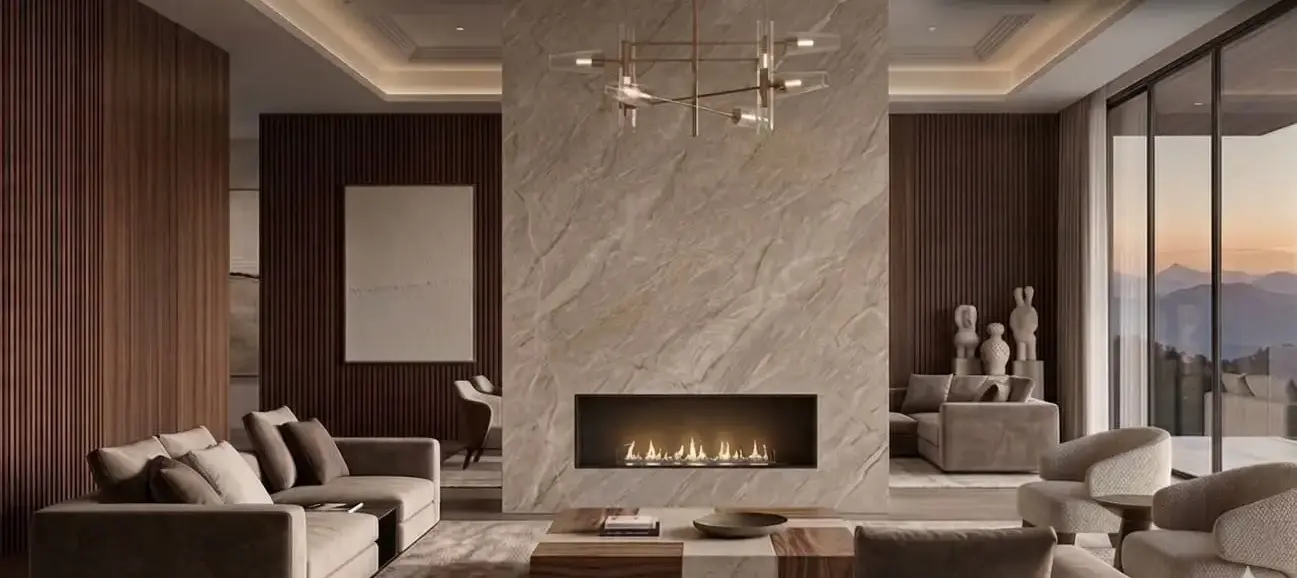
Natural Stone Fireplace Options for Reno Homes
Natural stone has been used around fireplaces for centuries, and for practical reasons. Stones like granite, quartzite, marble, travertine, and slate were formed under geological conditions of extreme heat and pressure, which gives them an inherent ability to handle the ambient warmth of a working fireplace without warping, discoloring, or degrading.
Granite is one of the most durable options available. It is highly resistant to heat, scratches, and staining, and requires minimal ongoing maintenance beyond occasional sealing. It works equally well with gas and wood-burning fireplaces. Visually, granite ranges from subtle speckled patterns to bold, dramatic colorways, making it adaptable to both rustic and contemporary spaces.
Quartzite has become a popular choice for fireplaces across Reno, and the combination of properties explains why. It sits at 7 to 8 on the Mohs hardness scale, at least as hard as granite (6 to 7) and often harder. It also carries the flowing, veined appearance that many homeowners associate with marble, without marble's softness or susceptibility to etching. Quartzite is a metamorphic rock formed from sandstone under intense heat and pressure, which is why it handles fireplace temperatures without issue. Quartzite benefits from periodic sealing, though a fireplace surround faces far less acid exposure than a kitchen counter, so maintenance is typically light. Bookmatched quartzite slabs, where consecutive slabs are opened to create a mirrored veining pattern, are a striking option for floor-to-ceiling installations.
Marble brings a sense of elegance that few other materials match, and it handles fireplace heat well. The etching concern commonly associated with marble applies to kitchen counters where acidic foods and liquids are present daily. A fireplace surround is a vertical surface with no liquid exposure, so etching is not a practical concern in this application. The more relevant maintenance consideration is soot: prompt wiping after heavy use and periodic sealing protect the surface effectively. Classic white marbles with gray veining suit the neutral, warm-toned interiors common in Reno's High Sierra aesthetic particularly well.
Dolomite is worth knowing. It shares visual similarities with marble, with subtle veining and a refined appearance, and carries good heat tolerance along with slightly better hardness than marble (Mohs 3.5 to 4, compared to marble's 3 to 4). Available in polished, honed, leathered, and specialty finishes, dolomite works well on fireplace surrounds and can be coordinated with countertops or flooring elsewhere in the home for a cohesive material palette.
Travertine and limestone both offer warm, earthy tones that suit rustic, Mediterranean, or transitional interiors. Both are porous and benefit from sealing, though on a fireplace surround the absence of liquid exposure makes that porosity far less of a maintenance concern than it would be in a kitchen. Their natural texture and tonal variation give them a distinctly organic character.
Slate is a practical, low-maintenance option with high heat resistance and a distinctly textured surface. Available in shades of gray, green, and black, it suits both traditional and contemporary spaces and tends to hide soot and light ash deposits well.
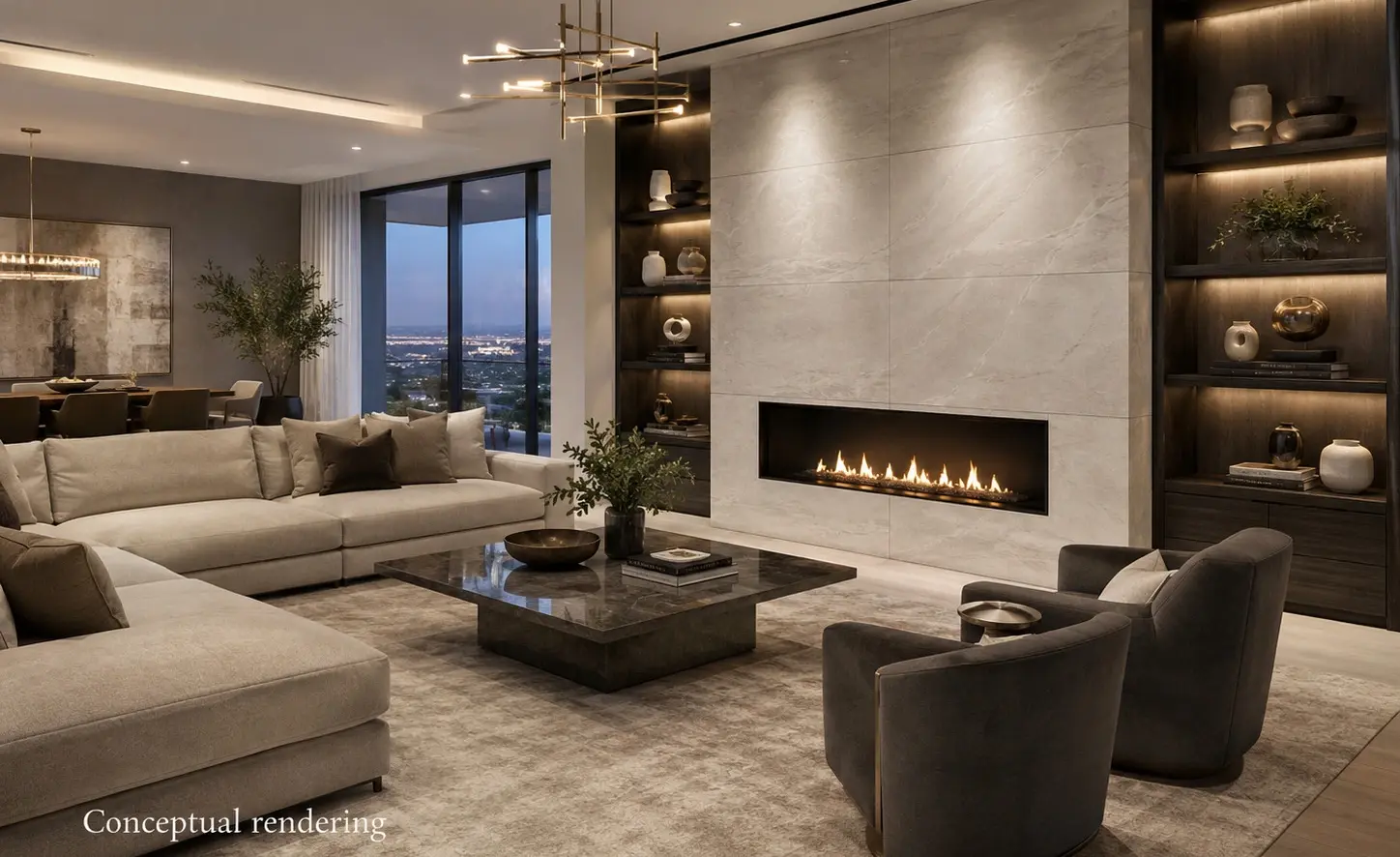
Porcelain Tile for Fireplace Surrounds
Natural stone is not the only strong option for fireplace surfaces. Porcelain tile covers a different set of priorities: consistent color and format, lower maintenance, and design flexibility that stone cannot always match. It is dense, non-porous, heat-tolerant, and available in an enormous range of colors, formats, and finishes, including options that closely replicate the appearance of natural stone, concrete, wood grain, and textured surfaces.
Large-format tile creates a seamless, minimal appearance; smaller tile formats allow for geometric patterns, texture plays, and detailed design work. Current trends favor matte or honed finishes over gloss, as matte porcelain reads as more contemporary and suits the earthy, low-sheen palette common in Reno interiors. A glossy or polished porcelain can still work well in a formal or transitional living room where light reflection suits the space, though for the hearth, a matte or honed finish is the safer choice underfoot.
Subway tile surrounds remain a classic option, clean and adaptable to almost any interior style. Hexagon tiles, geometric patterns, and mosaic panels all work well on surrounds where the goal is a decorative accent rather than a quietly understated one.
A Note on Engineered Quartz
One material that comes up regularly in fireplace conversations is engineered quartz. It is widely used for countertops, and homeowners who already have it in the kitchen sometimes ask whether it can carry through to a fireplace surround. The short answer is that it is not recommended for wood-burning or high-output gas fireplaces. Engineered quartz is composed of roughly 90 to 93 percent ground quartz bound with polymer resins. Those resins begin to degrade, discolor, or crack at temperatures around 300°F, well within the range that can occur near an active wood fire. For a low-heat electric fireplace with adequate clearance, quartz may be considered, but for traditional surround applications, natural stone or porcelain is the safer long-term choice.
Design Directions for Reno Homes
With the material options covered, the next question is how they apply to the actual homes in Reno. The housing stock here is genuinely diverse, and fireplace design tends to reflect that range across a few consistent directions.
High Sierra and mountain contemporary. Many Reno homeowners, particularly in newer neighborhoods toward the foothills and in areas like Northwest Reno and Somersett, lean toward materials that reference the natural landscape: leathered quartzite, honed granite in warm tones, travertine, or large-format matte porcelain in stone-look finishes. These pair well with wood mantels, exposed beam ceilings, and the earthy warm palette that characterizes the regional aesthetic. A floor-to-ceiling stone installation in this style can anchor an open-plan great room in a way that painted drywall cannot.
Mid-century and transitional. Older neighborhoods like the Old Southwest and Old Northwest carry a lot of mid-century ranch homes where original brick fireplaces are common. Tile applied over existing brick is a practical update that avoids the demolition of tiling from scratch. Clean, simple porcelain surrounds, marble surrounds with restrained veining, or textured subway tile installations all suit the proportions and character of that older housing stock. The approach tends to be more restrained than a dramatic floor-to-ceiling slab installation, and often more appropriate to the scale of the space.
Bold and contemporary. New builds and extensively remodeled homes in areas like South Meadows and Damonte Ranch increasingly feature fireplaces as architectural focal points rather than afterthoughts. Large-format porcelain slabs in concrete or stone looks, bookmatched natural stone, and floor-to-ceiling installations are all at home in these spaces. Dark tones (charcoal porcelain, black granite, or slate) anchor airy, light-filled rooms and provide contrast against light walls and floors.
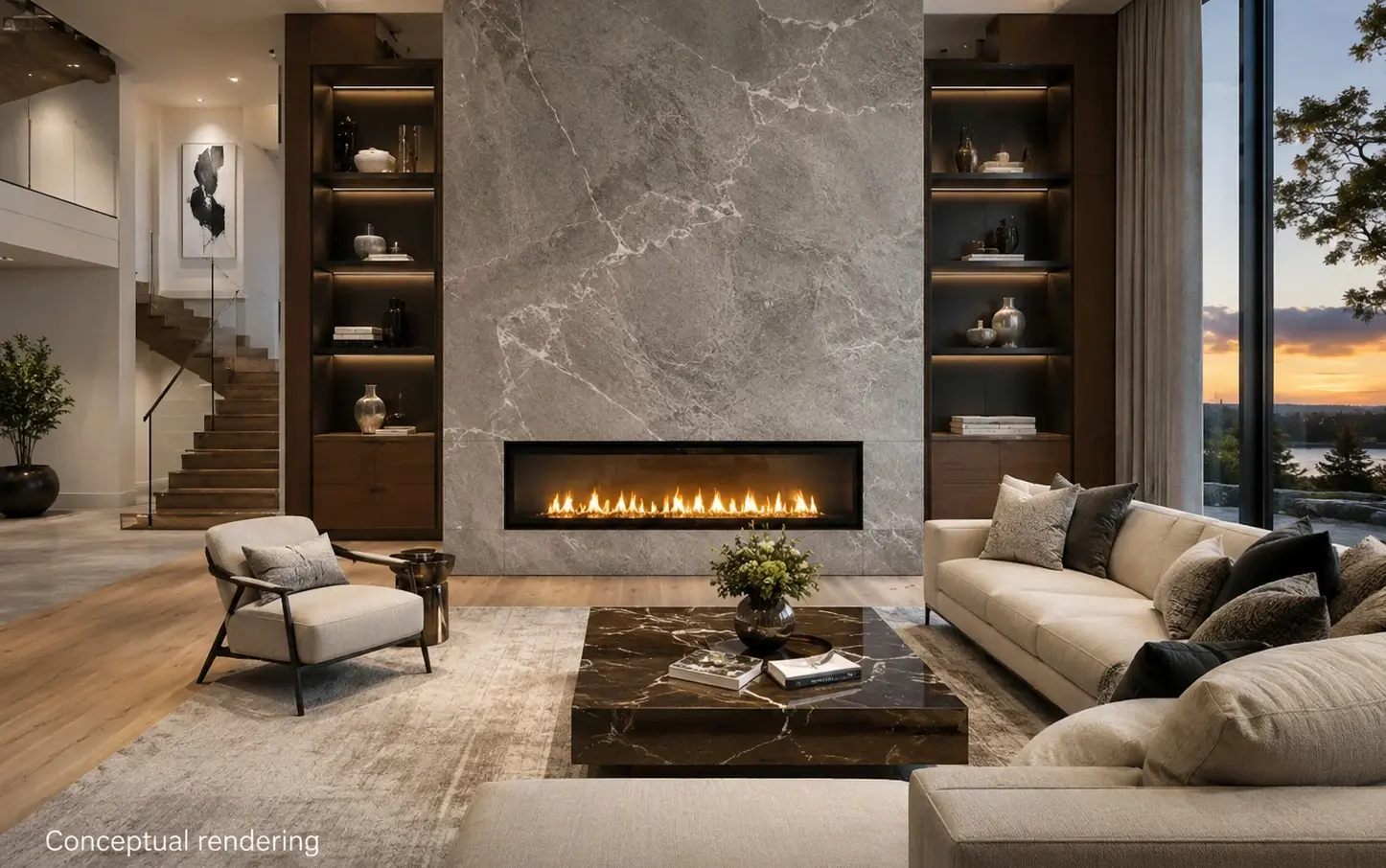
Coordinating the Fireplace with the Rest of the Room
Choosing a design direction is one part of the decision. The other is making sure the material works with everything already in the room. A fireplace surround rarely exists in isolation. The flooring material running up to the hearth, the wall color, the mantel finish, and the furniture tones all interact with the surround material. A few considerations are worth keeping in mind.
Warm undertones (creamy whites, beiges, tawny golds) in stone or tile tend to read more cohesive against warm oak flooring or a wood mantel. Cooler tones (gray veining, charcoal stone, cool white marble) coordinate well with painted cabinetry, white or gray walls, and metal hardware. Matte finishes are more forgiving in terms of fingerprints and dust, which matters on a surface near an active fire. Mid-tone grout is generally a better choice than white grout on a fireplace surround, as it conceals ash deposits and minor soot marks more effectively.
For homeowners considering tiling both the fireplace and another surface in the same room (a kitchen backsplash visible from the living area, or a bathroom with a fireplace), comparing materials side by side in the actual space is more reliable than making decisions from showroom impressions alone. The light in Reno's high desert environment, with its intensity and low humidity, can shift how stone and tile read against walls and floors in ways that are worth checking before committing.
Conclusion
Once the design direction and coordination considerations are clear, the most useful next step is evaluating actual materials rather than making decisions from photographs. Fireplace surrounds are permanent, high-visibility surfaces. Evaluating full slabs and tile samples in person, under natural light and alongside other materials you are considering, gives you information that photographs alone cannot fully convey. This is especially true for natural stone, where veining and tonal variation differ from slab to slab.
Nova's Reno showroom carries natural stone slabs, quartzite, marble, dolomite, porcelain, and tile, along with flooring options including hardwood, LVP, laminate, and carpet. Design consultations are available at no charge. Tile samples can be taken home to evaluate in your own lighting conditions. Nova Tile and Stone serves homeowners, contractors, and designers throughout Reno, Sparks, Spanish Springs, Virginia City, Incline Village, Zephyr Cove, and the Carson City.
Frequently Asked Questions
It depends on the type of fireplace and how much maintenance you want. For wood-burning fireplaces, granite and quartzite are the most reliable choices due to their heat resistance and durability. Marble and dolomite work well where the aesthetic calls for softer veining and the fireplace is gas or electric, or where wood-burning use is moderate. Porcelain is the strongest choice for anyone who wants maximum format flexibility and minimal upkeep regardless of fireplace type.
Engineered quartz is not recommended for wood-burning or high-output gas fireplace surrounds. The polymer resins in quartz can degrade, discolor, or crack when exposed to sustained high temperatures. For fireplace applications, natural stone or porcelain tile is a safer long-term choice.
The surround is the vertical frame around the firebox opening. The hearth is the floor surface in front of the firebox. Each area has slightly different material requirements: the hearth sees foot traffic and needs to be slip-resistant, while the surround is primarily a heat-exposed vertical surface. Both should use non-combustible materials appropriate for proximity to a heat source.
Start with the scale of the space and how prominent you want the fireplace to be. A restrained surround in marble or simple porcelain suits a smaller, older room without overwhelming it. A larger open-plan room can carry a floor-to-ceiling stone installation or a bold large-format tile. From there, match the material tone to what is already in the room: warm-toned stone for wood-heavy interiors, cooler stone or porcelain for painted walls and metal hardware. Evaluating real samples in the actual space confirms that the material reads the way you expect under your home's specific light.
Yes. The Reno showroom at 12835 Old Virginia Road stocks the full range of materials covered in this guide, including natural stone slabs, porcelain, and tile. Walk-in design consultations are available at no charge, and tile samples can be taken home for evaluation.
Note: Some images on this page may be conceptual renderings created to illustrate design possibilities and may not depict actual installations.