What size tile should you use in a home? It depends on the room, but the general rule is straightforward: large-format tile, generally 12x24 inches or bigger, works best where fewer grout lines make a tight space feel more open, while smaller tile is the better choice anywhere the surface needs to curve, flex, or handle an uneven base.
- Large-format tile (12x24" and up): best for small bathroom floors, shower walls, entries, and mudrooms
- Small or mosaic tile (up to about 6x6"): best for shower floors, older or uneven subfloors, and decorative accents
That's the short version. The right choice for a specific room still comes down to its actual dimensions, the condition of the subfloor or walls underneath, and how much grout maintenance you're willing to take on.
That trade-off shows up constantly in Kings Beach, a small town on the north shore of Lake Tahoe where the housing stock leans heavily toward older lake cabins, A-frames, and vacation homes built for weekend use rather than open, modern floor plans. Tucked against the Sierra Nevada, with California State Route 28 running along the shoreline and Route 267 climbing north toward Truckee, it's a place where a compact cabin bathroom or a mudroom built for sand in summer and snowmelt in winter is a lot more common than a sprawling great room. If you're planning a remodel here, tile size is one of the first decisions that shapes how the whole room turns out.
It's easy to treat tile size as an afterthought, something you settle on after picking a color or finish. In a Kings Beach home, though, size often matters more than color. It affects how big a small room feels, how much upkeep you're signing up for, and how well the floor holds up to the kind of use a lake town sees.
Why Tile Size Changes the Whole Room
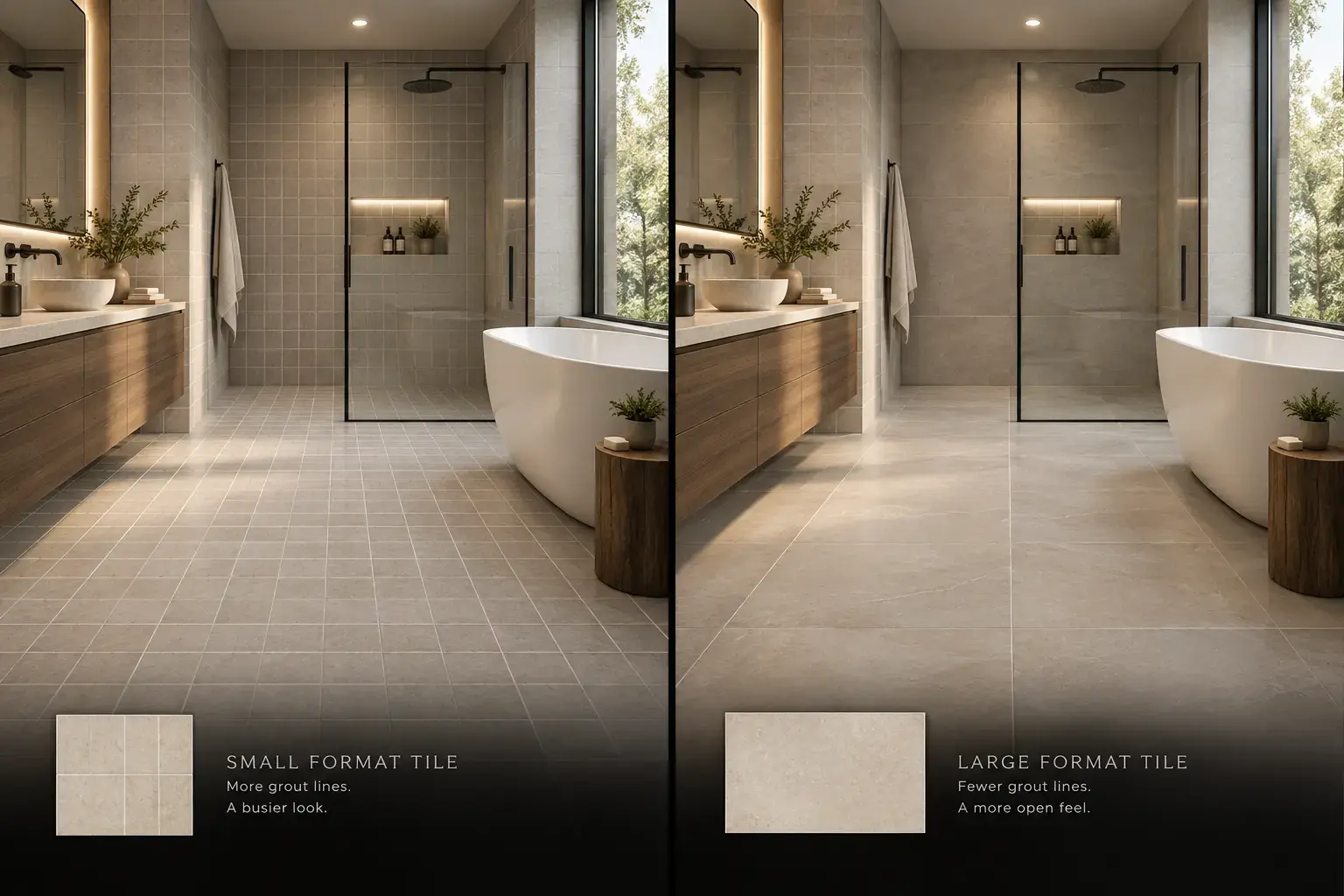
Every tile joint is a grout line, and grout lines do a lot of visual work. More of them break a surface into smaller visual pieces, which can make a floor or wall feel busier and, in a tight room, smaller. Fewer of them let the eye travel across a surface without interruption, which tends to read as more open and calmer.
That's the whole logic behind the shift toward larger tile formats over the past decade. A 12x24 inch tile covers the same footprint as eight 6x6 inch tiles, but with a fraction of the grout lines. In a small bathroom or a narrow entry, that difference is often more noticeable than the tile's actual color or pattern.
This isn't purely a matter of preference, either. Because larger tiles naturally vary a bit more in their exact dimensions than smaller ones do, large-format grout joint guidelines actually call for a wider joint, not a narrower one, once a tile's side length passes 15 inches, so the pattern stays square and doesn't drift out of alignment. That's part of why an installer might push back on a very narrow grout line for a large tile, even when the goal is a seamless look.
None of this means bigger is automatically better. Tile size is a set of trade-offs, and the right answer depends on the room, the layout, and how the space actually gets used.
Scale relative to the room matters too, not just tile size in isolation. A tile that would look perfectly proportioned in a great room can overwhelm a five-foot-wide hallway, while a tile sized for a powder room can look choppy and busy stretched across an open living area. Before settling on a size, it helps to sketch out roughly how many full tiles will fit across the width and length of the room, since a layout that ends in a run of narrow slivers along one wall rarely looks intentional.
Where Large-Format Tile Works Best
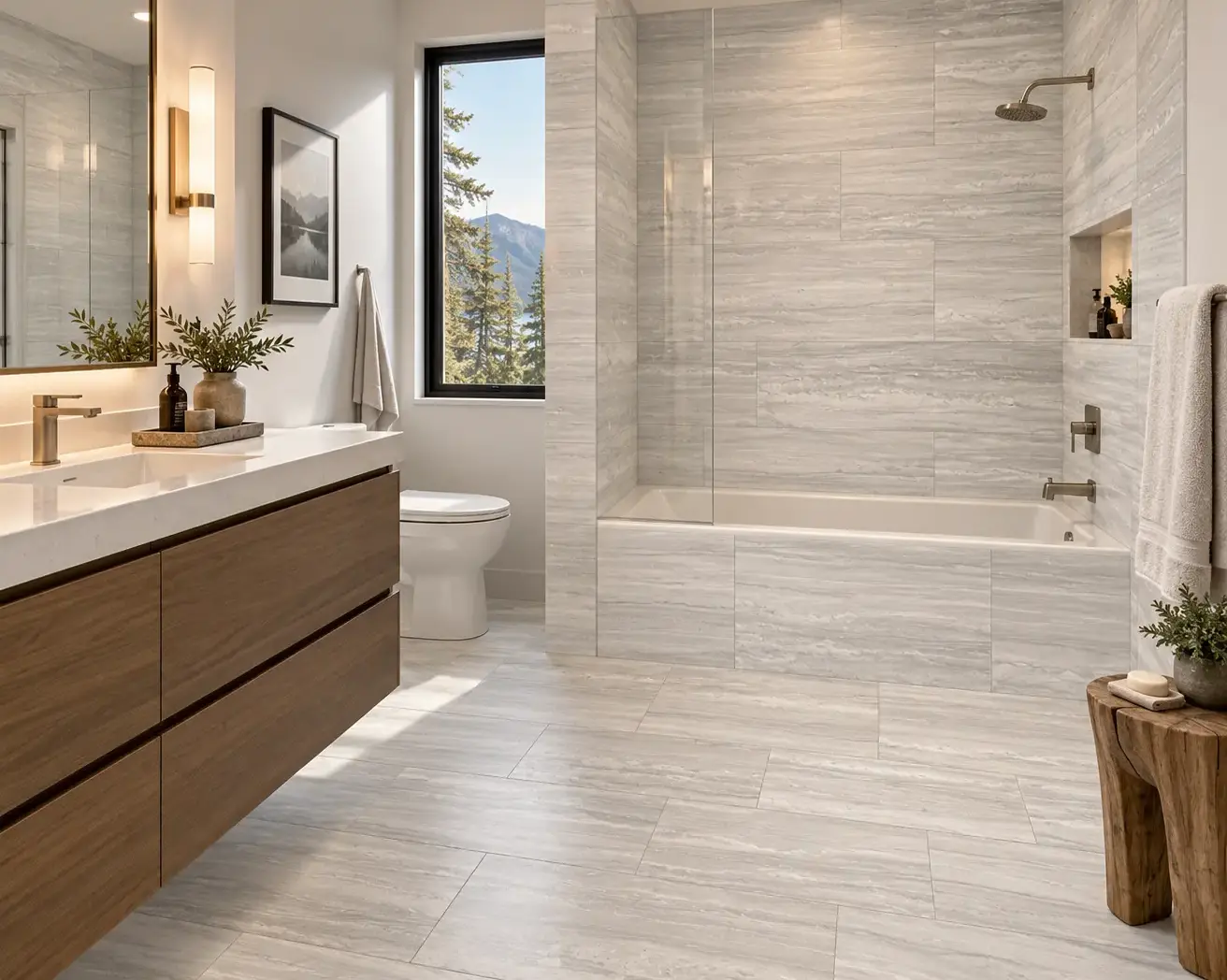
A lot of Kings Beach bathrooms were built decades ago, sized for a single occupant and a tub-shower combo, not a spa-style retreat. In these rooms, large-format tile, generally anything with a side longer than 15 inches, can make a real difference. Fewer grout lines mean less visual clutter, and a tile that runs from the shower wall onto the floor with a matching or near-matching grout color can make a 5-by-7 room feel noticeably larger than it is.
The trade-off is installation. Large tile needs a flat substrate, more precise cutting around fixtures, and a layout plan that avoids narrow sliver cuts at the edges of the room. In a small bathroom with a toilet, vanity, and tub all competing for wall space, that planning matters more than it would in an open room where a slightly awkward cut at one wall barely registers.
Entries and mudrooms are the other place where large format tends to pay off. North Tahoe living means sand tracked in from Kings Beach State Recreation Area in summer, and snow, salt, and slush carried through the door for a good chunk of the rest of the year, so an entry or mudroom is one of the hardest-working spaces in a lake home. Medium to large format porcelain tile, in a matte or textured finish rather than a high-gloss one, is a common choice for these transition spaces. Larger tile keeps grout lines, and the grime that collects in them, to a minimum in a high-traffic zone, while a textured surface helps with grip when boots come in wet.
Where Smaller Tile Still Makes Sense
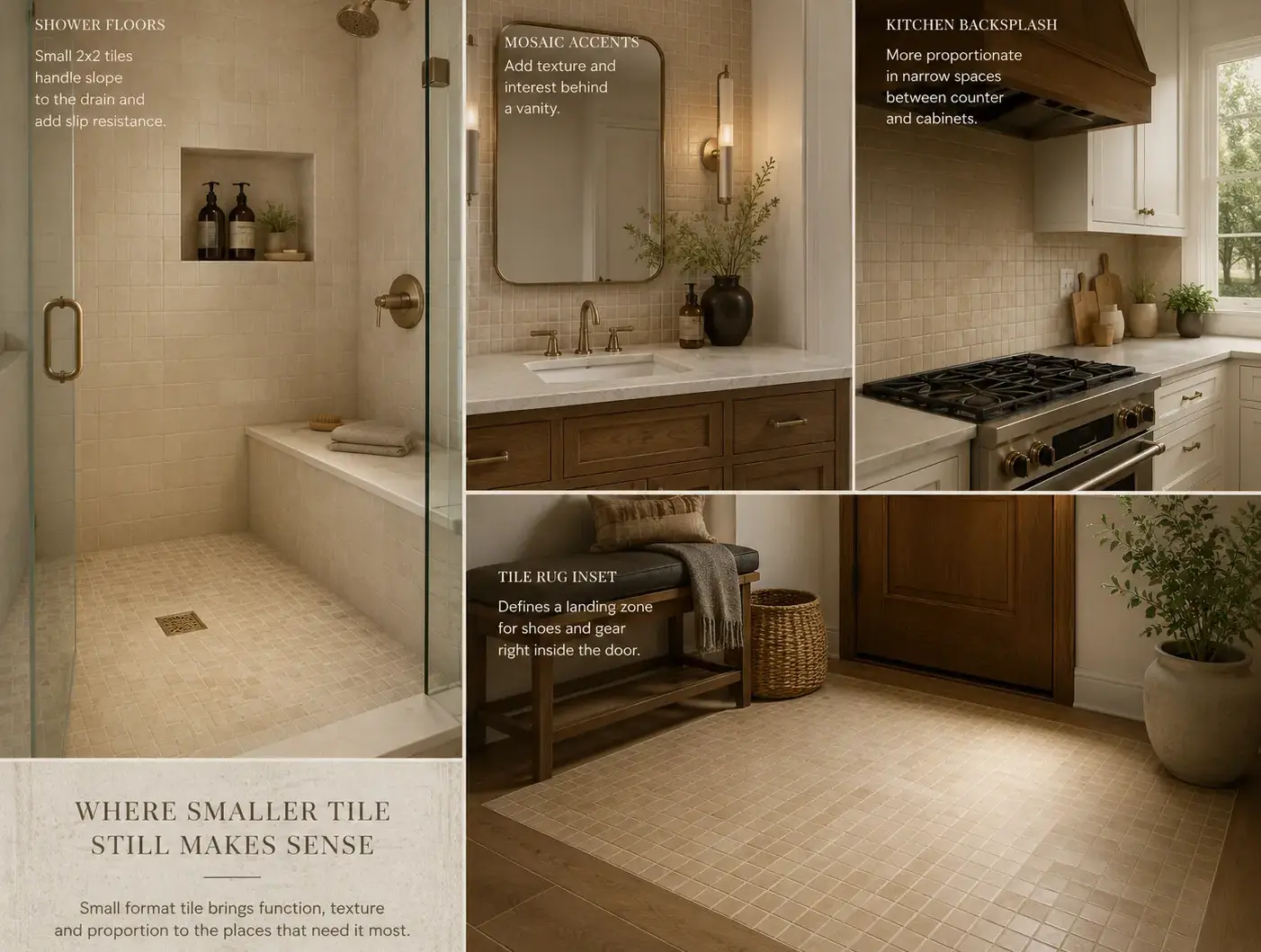
Large format isn't the right call everywhere, even in a compact home. Shower floors are the clearest example. Codes and good practice call for a slope toward the drain, and small tiles, often 2x2 inch mosaics, handle that curve far better than a rigid large-format piece. The extra grout lines on a shower floor also add slip resistance, which matters in a household that's tracking in wet feet from the lake or melting snow off boots.
The slope requirement is not just a preference either. Shower floor slope standards call for roughly a quarter inch of slope per foot toward the drain, and that same slope applies to every horizontal surface in a shower, including seats, curbs, and sills, to avoid trapped standing water. That kind of curved, sloped surface is exactly where small tile or pebble mosaics still outperform a large, rigid format.
Smaller tile also has a place anywhere you want texture or a change of pace: a tile rug inset near an entry, a mosaic accent behind a vanity, or a herringbone backsplash in a cabin kitchen. In those spots, the grout lines aren't a liability, they're part of the design. Kitchens raise a related point, since backsplash tile behaves differently than floor tile. A cabin kitchen with a run of upper cabinets often only has 18 inches or so of wall space to work with between the counter and the cabinets, and a very large tile can end up looking cut off rather than deliberate in that narrow band. Smaller format tile, a subway shape, or a mosaic sheet tends to fit that proportion more naturally, while a slab-look large tile can still work well as a full-height statement wall behind an open shelf or range where there's more vertical room to let the material breathe.
Older Kings Beach homes with uneven walls or floors are another case where smaller tile can be the more forgiving choice. A wavy, decades-old subfloor is harder to disguise under an oversized tile than under a series of smaller ones, since a large flat tile will show every dip in the surface as lippage between pieces. Smaller tile can also work as a defined "landing zone" right inside an entry door, visually marking where outdoor gear stops and the rest of the house begins, even in a space that otherwise uses a larger format.
Getting the Installation Right
Whatever size you land on, the installation side needs to match. Large-format tile in particular relies on a substrate that's genuinely flat. Industry guidance on this point is specific: install standards typically call for a subfloor or wall surface within about 1/8 inch of flat over a 10-foot span, and even less variation over shorter distances, since a larger tile has no give and will show any dip or high spot in the substrate below it. Substrate flatness guidelines also cover checking for moisture before setting tile, since that step is one of the most commonly overlooked parts of a successful large-format installation. In an older Kings Beach cabin with a settled subfloor, that prep step is often the difference between a large-format tile job that looks seamless and one where lippage shows up within a year.
Weight is worth factoring in as well, especially in a second-story bathroom or a loft-level laundry room, both common layouts in Kings Beach's A-frames and multi-level cabins. Large-format porcelain and natural stone tile add up quickly across a floor, and older framing wasn't always designed with that load in mind. A contractor familiar with the home's structure can flag whether a subfloor or joist system needs reinforcement before a large-format tile floor goes in, which is a cheaper conversation to have during planning than after tile is already set.
A Few Rules of Thumb for a Kings Beach Remodel
- In a small bathroom, look at large-format tile for the floor and shower walls, and reserve smaller tile for the shower floor itself and any accent details.
- In an entry or mudroom, prioritize a durable, textured, medium-to-large tile that keeps grout lines low without sacrificing grip.
- If the subfloor or walls are original to an older cabin, budget for substrate leveling before committing to a large-format tile, or consider a mid-size tile that's more forgiving of an uneven surface.
- Match grout color to tile in small rooms to minimize the visual break between pieces, and reserve contrasting grout for spaces where you want the pattern to stand out.
For additional tile options and materials, visit the Reno showroom to explore Nova Tile and Stone's complete offerings.
Conclusion
Tile size is one of those decisions that looks minor on a sample board and turns out to shape the entire feel of a finished room, especially in the kind of compact, well-loved lake cabins and vacation homes that make up so much of Kings Beach. The right size depends less on trend and more on the specifics in front of you: the room's actual dimensions, how the space gets used day to day, whether the existing subfloor can support a heavier format, and how much grout maintenance you're willing to take on. A tile that looks striking in a showroom display can still be the wrong choice for a five-foot bathroom or a wavy century-old floor, and a tile that seems too plain on its own can be exactly right once it's cutting down on visual clutter in a small space.
For homeowners in Kings Beach, Crystal Bay, Tahoe City, and the rest of North Lake Tahoe working through a tile decision, Nova Tile and Stone's Reno showroom is about a 45-minute drive north via I-80 and CA-267. The showroom carries tile in a range of sizes and finishes, and free design consultations are available for anyone working through a remodel plan.
Nova Tile and Stone - Reno Showroom
12835 Old Virginia Rd, Suite 24, Reno, NV 89521
Phone: (775) 331-6682
Frequently Asked Questions
There's no single legal definition, but the tile industry generally considers a tile large format once one side is longer than 15 inches. Common large-format sizes include 12x24, 24x24, and 24x48 inches, along with thin large-scale slabs that can run even bigger. Anything smaller, like 12x12 or the classic 4x4, falls into standard or small format.
There's no single answer that works for every room, but large-format tile, typically 12x24 inches or bigger, tends to work well on the floor and shower walls of a small bathroom because it reduces the number of grout lines and makes the space feel less broken up. Shower floors are the exception, since they need a slope to the drain that smaller tile handles more easily.
Yes, though not in the direction most people expect. Many assume a bigger tile means a tighter, nearly invisible grout line, but industry standards actually call for a wider grout joint as tile size increases, often 3/16 inch or more for large-format tile, to account for the slight dimensional variation between pieces. Smaller, more uniform tile can typically use a narrower joint, sometimes down to 1/16 inch, without that same risk of the layout drifting out of square.
Often, yes, though not because of the material itself. Large-format tile requires a flatter substrate, specialized mortar, and more careful handling since the pieces are heavier and harder to maneuver, all of which can add labor time and cost compared to a straightforward small-tile installation on an already-flat surface.
Not without correction first. Large tile has very little flex, so it will show any dip or high point in the subfloor as an uneven edge between tiles, a problem called lippage. An uneven subfloor typically needs to be leveled with a patching compound or self-leveling underlayment before large-format tile goes down. On a floor that can't easily be leveled, a smaller or mid-size tile is usually the more forgiving option.
Note: Some images on this page may be conceptual renderings created to illustrate design possibilities and may not depict actual installations.