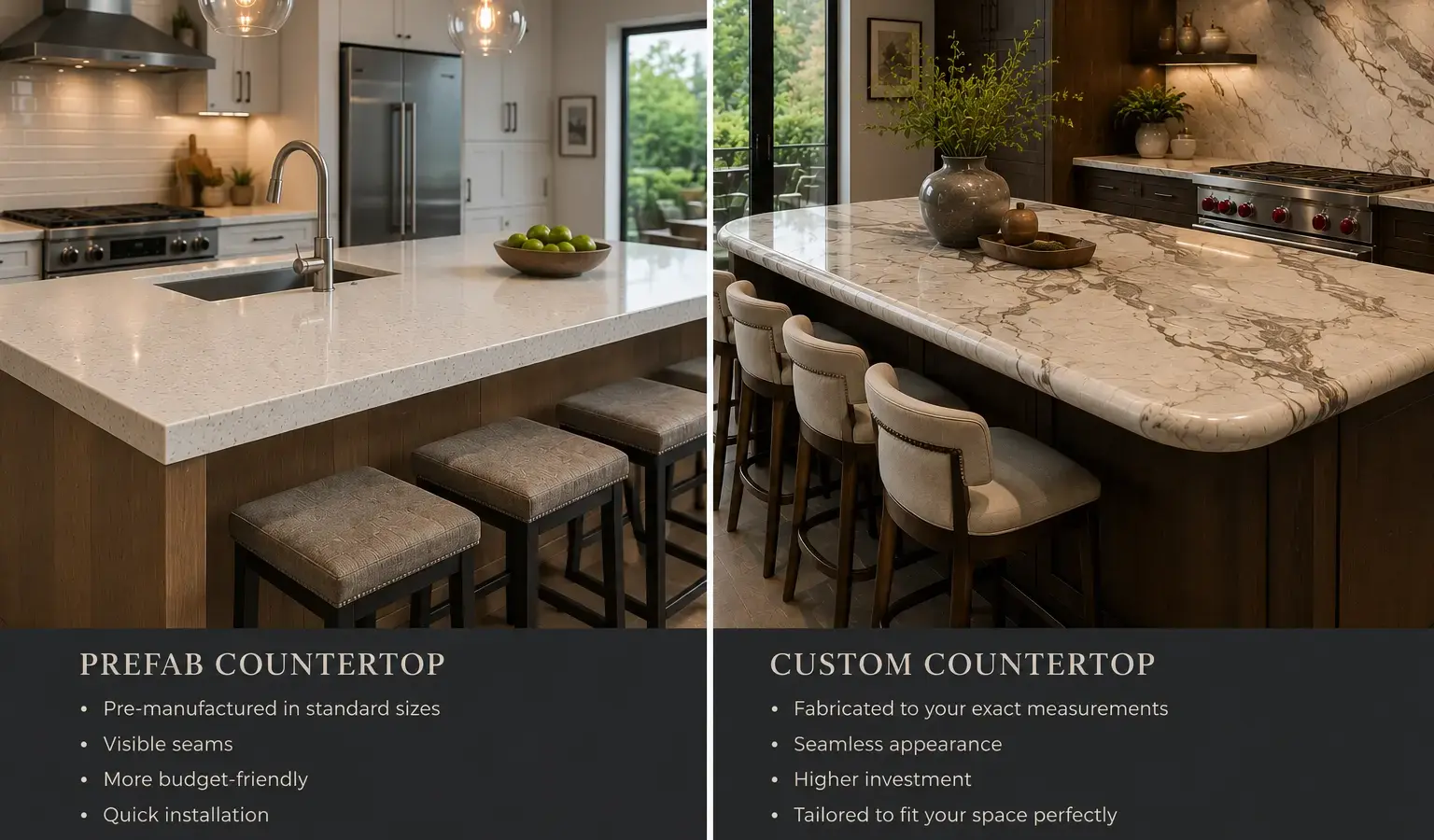
Prefabricated countertops are factory-cut stone slabs sold in standard sizes and ready to install with minimal on-site work, while custom countertops are cut from a full slab to match a specific kitchen or bathroom after professional measurement. Prefab generally costs less per square foot and installs faster, while custom offers more flexibility for islands, curved edges, and non-standard layouts. Which one fits a given project usually comes down to the kitchen's layout, the project timeline, and how carefully the stone was sourced.
Reno sits in the Truckee Meadows, a broad valley at roughly 4,500 feet in elevation, framed by the Sierra Nevada to the west and the lower Virginia Range foothills to the east. That setting shapes a lot of what gets built here: homes range from established neighborhoods near downtown and the river to newer subdivisions pushing out toward Spanish Springs and Verdi, which means kitchens across the area vary widely in age, layout, and cabinet configuration, and that variety is part of why the prefab-versus-custom decision comes up so often for local remodels.
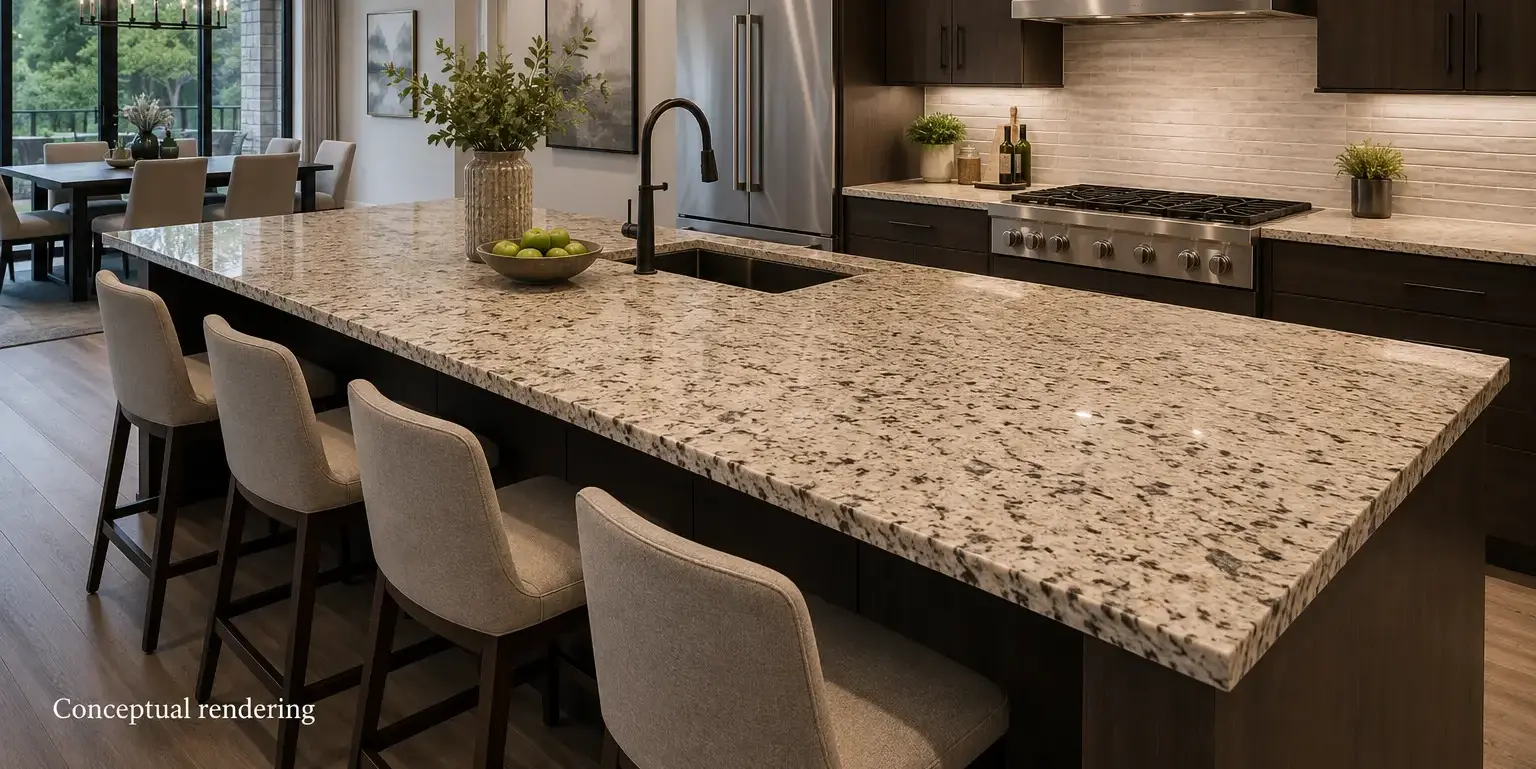
What Prefabricated Countertops Actually Are
Prefabricated, or prefab, countertops are slabs of granite, quartz, marble, or porcelain that are cut, edged, and polished at a factory before they ever reach a showroom. They arrive in standard depths and lengths, usually sized to fit common base cabinet runs and islands. Because the cutting and polishing happen off-site in volume, prefab pieces are ready to install with far less on-site fabrication work than a custom slab requires.
A common misconception is that prefab automatically means a lower grade of material. That's not accurate. Prefab granite and prefab quartz are cut from the same stone and the same engineered material as custom slabs. The difference is in the process, not the substance. Where quality does vary is in sourcing. Slabs manufactured quickly overseas with less oversight can show resin pooling, uneven color, or inconsistent thickness from one piece to the next. That's a sourcing issue, not a prefab issue, which is why it matters where your fabricator or retailer buys their stock. Independent quality benchmarks, like the material specifications ASTM International maintains for dimension stone, exist precisely to catch inconsistencies like these before a slab ever reaches a job site.
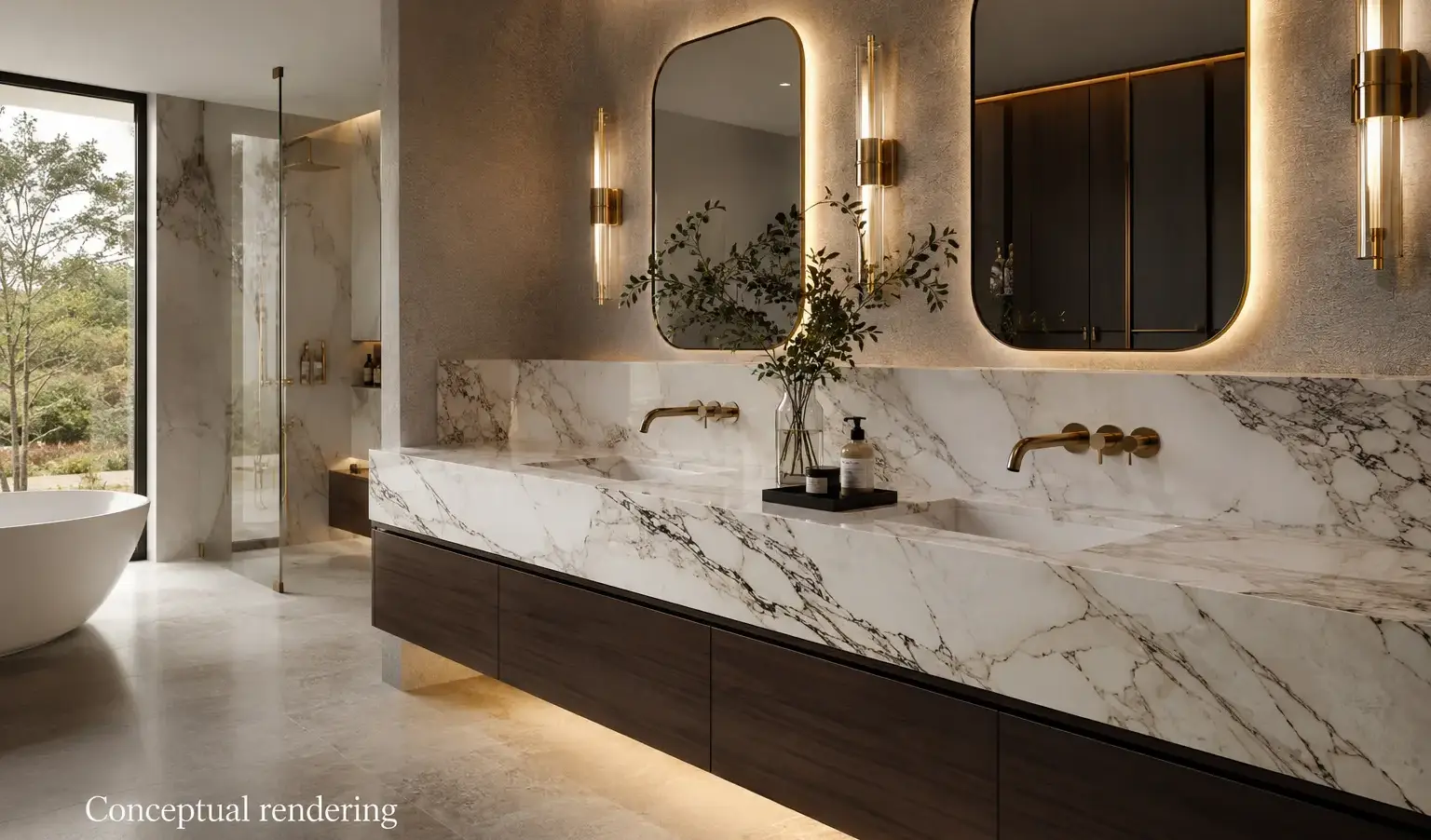
What Custom Fabrication Offers
Custom countertops start as a full slab that a fabricator templates and cuts specifically for your kitchen or bathroom. A contractor measures the space after cabinets are installed, then the slab is cut to match your exact dimensions, including curved edges, waterfall islands, or unusual angles that standard sizing can't accommodate. Custom work also opens up a wider range of finishes, including honed and leathered textures, along with a broader selection of edge profiles beyond the simple eased or bullnose edges typical of prefab. Templating adds a step to the project timeline, and cutting from a full slab produces more waste relative to a small kitchen's footprint.
Where Prefab Works Well and Where It Doesn't
Prefab pieces come in a handful of fixed depths and lengths, most commonly around 25 to 26 inches deep for standard runs and 36 inches for islands, with lengths in the six, eight, and twelve foot range. That works fine for a kitchen with straight cabinet runs that happen to match those dimensions.
Problems show up in two situations. First, an island or peninsula that doesn't match a standard depth will need cutting, which can expose unfinished edges and require extra work to polish. Second, a larger kitchen may need more than one prefab piece to cover the full run, which means more seams than a single custom slab would require. More seams mean more visible joints and more sealant maintenance over time. For builders, fabricators, and other industry professionals sourcing materials for projects of varying sizes, applying for a trade account can simplify the purchasing process.
Comparing the Cost
Prefab typically costs less per square foot installed than custom, since the material is produced and cut in volume and labor time on-site is reduced. That said, the gap narrows once you account for sink cutouts, decorative edge work, and how well a standard size actually fits your layout, as described above. A straightforward rectangular kitchen sees the most savings from prefab. A kitchen with an island, curved run, or non-standard cabinet layout often needs enough custom cutting that the price difference shrinks, and sometimes disappears once seams and waste are factored in.
If your project is mostly straight runs, bathroom vanities, or a simple galley kitchen, prefab is worth pricing out first. If your layout has an island, an unusual angle, or you want a specific edge or finish, custom is usually the more practical starting point.
Getting the Sourcing Right
A slab's origin story doesn't show up on the price tag. Working with a supplier that imports directly and inspects incoming stock gives you a clearer picture of what you're actually getting, whether you end up choosing a prefab piece or a full custom slab.
This matters more in a market like Reno's, where a lot of housing stock built in the early 2000s is now reaching the age where kitchen and bathroom updates make the biggest difference in comfort and resale value. A remodel you're planning to live with for another fifteen or twenty years is worth getting the material sourcing right the first time.
Conclusion
There's no universal right answer between prefab and custom. Simple, straight-run kitchens and bathroom vanities tend to favor prefab, while islands, open-concept layouts, and specific finish requests tend to favor custom, for the reasons already outlined above. Nationally, kitchens remain the most popular room to renovate, and that holds true in Reno as well, which is why this decision comes up so often. What matters most is your layout, your timeline, and how carefully your material is sourced, not which option carries the more appealing label.
Nova Tile and Stone works with homeowners throughout the Truckee Meadows, including Sparks, Spanish Springs, Washoe Valley, and Incline Village, along with Carson City, Minden, and Fernley, to compare both options against a specific kitchen or bathroom layout. As a family-owned, direct stone importer, the Reno showroom stocks both prefab pieces and full slabs, with free design consultations available to walk through material selection, edge profiles, and what fits your space. The showroom is located at 12835 Old Virginia Rd, Suite 24, Reno, NV 89521, just off Old Virginia Road with convenient access from I-580 and US-395, and can be reached at (775) 331-6682.
Frequently Asked Questions
Sometimes, yes. Fabricators occasionally cut both prefab pieces and custom slabs from the same larger blocks of stone before final sizing. The finished product differs mainly in how much of the original slab remains, not necessarily in the block it came from.
A fabricator can trim a prefab piece down to fit a slightly smaller footprint, but they can't add material back. If your layout might grow or change during the project, it's safer to size up or move to a custom cut rather than risk a piece that's too short once final measurements are taken.
Custom projects generally need a templating appointment after cabinets are set, followed by a separate fabrication window before installation, adding roughly one to two weeks compared to a prefab piece that's often ready to install same-day or within a few days of selection.
Standard prefab pieces are most commonly milled at 3 cm thickness, though some budget lines use thinner 2 cm stone with a built-up edge to create the look of a thicker slab. Custom fabrication offers more flexibility in choosing true thickness throughout, which matters most on waterfall edges or islands where the side profile is visible.
Yes, and it's a common way to control cost. Homeowners sometimes choose custom fabrication for a highly visible island or waterfall edge, then use prefab pieces for perimeter runs or a butler's pantry where standard sizing fits without modification. The main thing to watch is matching veining and color closely enough between the two, since prefab and custom pieces of the same stone can still come from different slab lots.
Note: Some images on this page may be conceptual renderings created to illustrate design possibilities and may not depict actual installations.