Blue granite is a natural stone countertop material whose blue color comes from light-reflecting feldspar crystals inside the stone rather than a dye or pigment. It is one of the rarest color families in granite, quarried mainly from Norway, Brazil, and Ukraine, which sets it apart from the gray, black, and beige granites found in most kitchens. Popular varieties include Blue Pearl, Volga Blue, and Azul Bahia, each with its own base color and pattern. The stone's signature shimmer, known as labradorescence, shifts in intensity depending on the angle and warmth of the light hitting it. In Zephyr Cove, NV, where homes along Lake Tahoe's east shore lean toward mountain-modern and lakefront lodge styles, blue granite's natural shimmer fits the setting without any added effort.
What Gives Blue Granite Its Color
Blue granite is a metamorphic rock, and its blue comes from mineral inclusions locked inside the stone rather than a surface treatment. The primary source is a feldspar called labradorite, along with occasional deposits of sodalite and other blue-toned minerals. Labradorite forms as magma cools slowly underground, and as it solidifies, thin alternating layers of feldspar stack on top of each other. When light passes through these microscopic layers, it scatters and reflects in a way that produces a shifting metallic flash, an effect geologists call labradorescence.
This is why a slab can look one color under a showroom's fluorescent lighting and shift to something else entirely under warm kitchen pendant lights. It is also why no two blue granite slabs look quite the same, since the thickness and spacing of those internal layers vary from stone to stone. Labradorite most commonly forms in mafic igneous rocks such as basalt and gabbro, and in anorthosite, where it can make up the bulk of the rock itself, which explains why it turns up as a major mineral component in several of the granite varieties quarried for countertops.
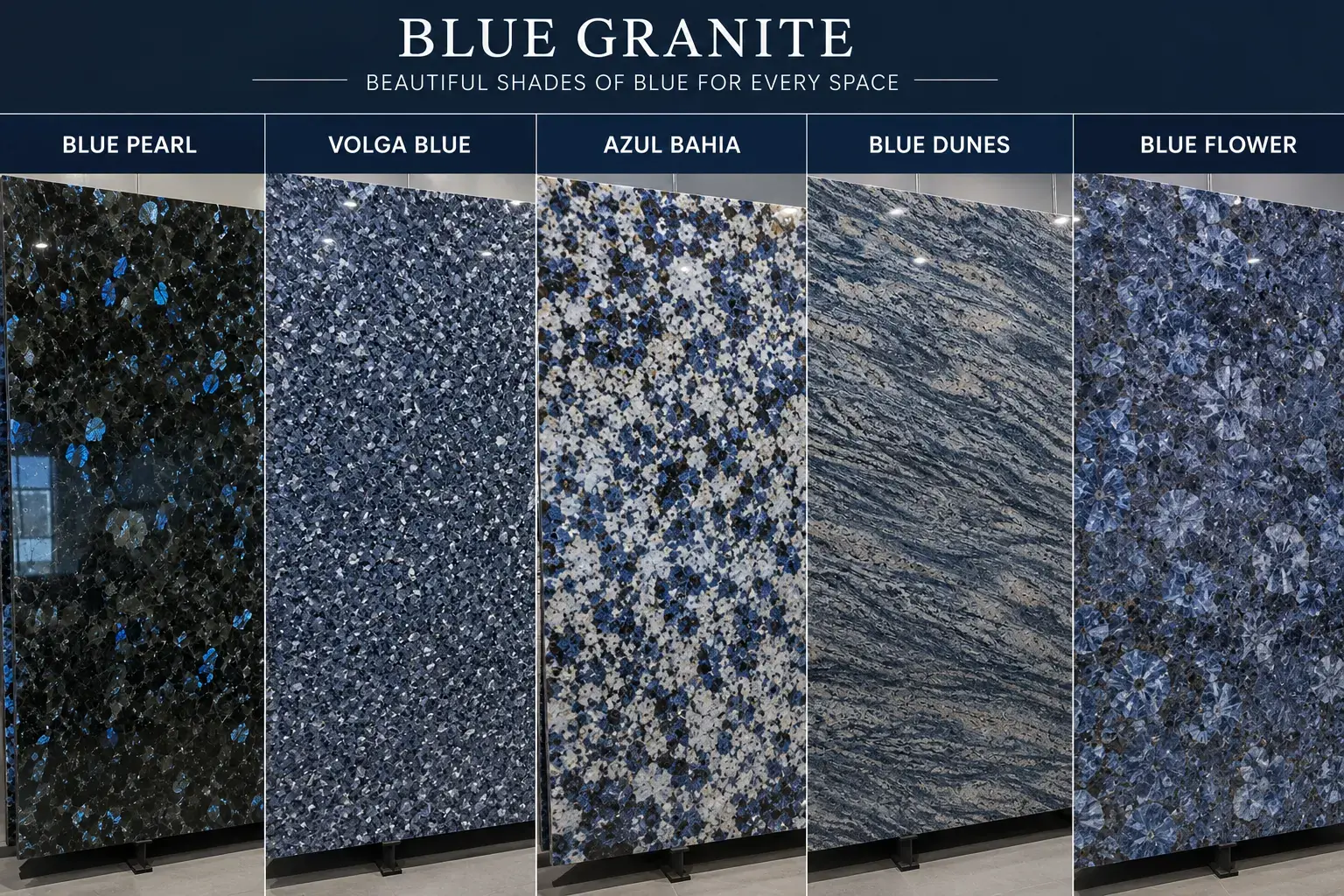
Popular Blue Granite Varieties
A handful of named varieties account for most of the blue granite sold for countertops:
- Blue Pearl is quarried in Norway and is the most widely available blue granite in North America. Its base is a dark gray that carries a silvery-blue shimmer, which makes it read as neutral from a distance and blue up close.
- Volga Blue comes from Ukraine and leans darker, with a blue-black background flecked with silver and white mineral deposits.
- Azul Bahia, sometimes called Blue Bahia, is quarried in Brazil and is known for swirling patterns of blue, white, and gold running through a single slab.
- Blue Dunes and Blue Flower are less common varieties that mix lighter blue tones with white and gray, giving a softer, more marbled look than Blue Pearl or Volga Blue.
Because blue is the rarest color family in granite, these stones typically cost more per square foot than gray or beige granite, and lead times can run longer since supply is limited to a small number of quarries. Slab size and availability can also shift from month to month, since each variety is imported in limited batches rather than produced on demand, so seeing what is currently in stock at a showroom gives a more accurate picture than searching for a specific variety online and assuming it will be readily available.
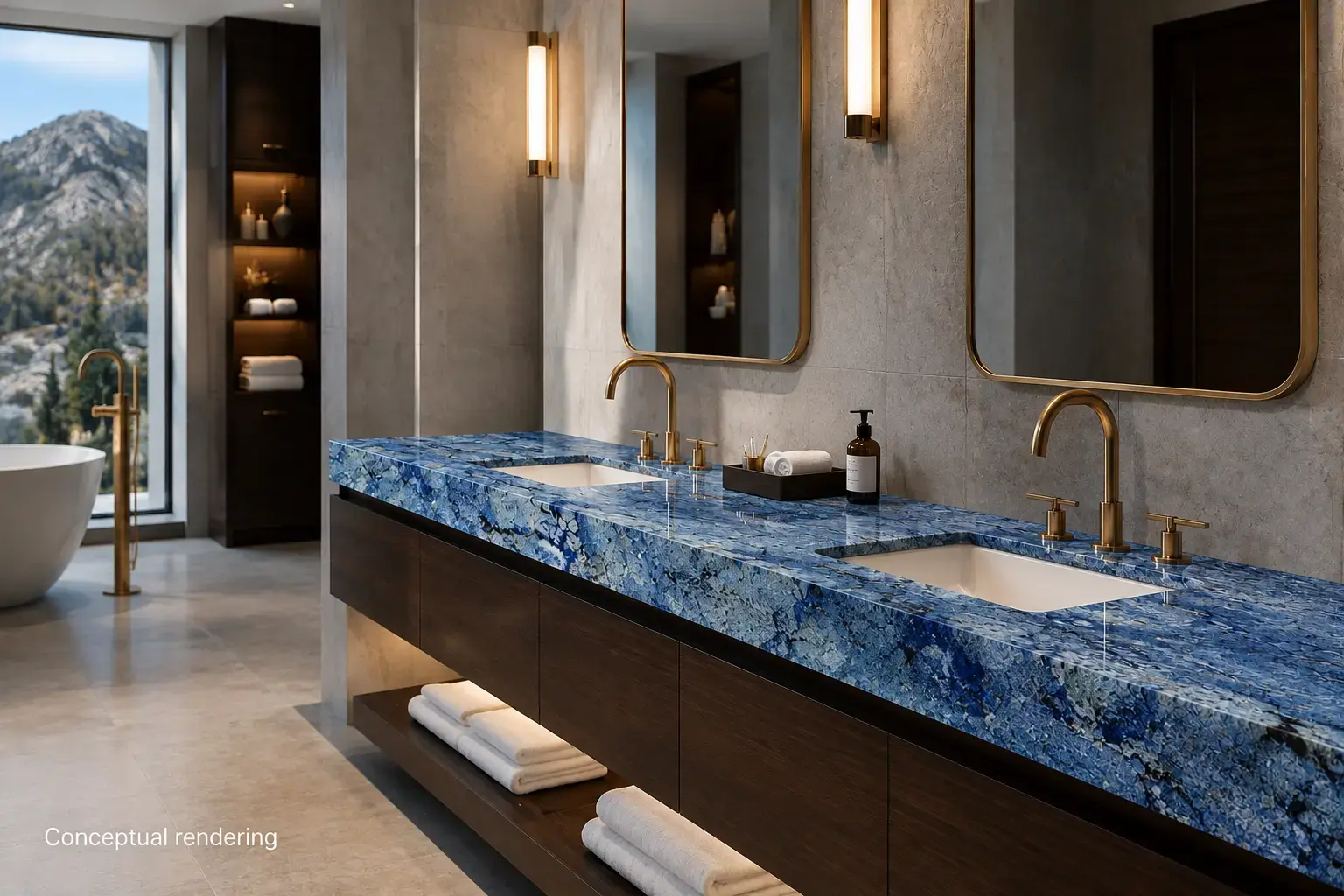
Where Blue Granite Works in the Home
Kitchen countertops and islands are the most common application, but blue granite shows up in plenty of other spaces around a Tahoe-area home. Bathroom vanity tops benefit from the same shimmer effect on a smaller scale, and the stone's density makes it resistant to the humidity a bathroom generates. A fireplace surround in Volga Blue or Blue Pearl can echo the stone hearths common in lodge-style construction while adding a bit more shimmer than a matte granite or a flagstone finish would. Wet bars and butler's pantries are also popular places for rare blue granite. Since these spaces have smaller countertops, homeowners can enjoy the look of an expensive stone without adding as much to the overall project cost. Even in a small area, blue granite creates a distinctive feature that guests are likely to notice.
Around Zephyr Cove specifically, homes tend to lean into this same setting, with exposed timber, stone fireplaces, and large windows framing the lake and surrounding pines, so blue granite fits without feeling like an added flourish. Lake Tahoe's surface sits at roughly 6,225 feet, and the thinner air at that elevation lets in more direct sunlight, which is part of why south- and west-facing kitchens here tend to show off a slab's labradorescence more vividly than the same stone would in a lower-elevation home.
Blue Pearl and Volga Blue, with their gray-silver undertones, pair easily with natural wood cabinetry in maple, oak, or knotty pine, which is common in lodge-style kitchens throughout the Tahoe basin. For a lakefront home leaning more contemporary, Azul Bahia's brighter blue and gold tones stand out against white or light gray cabinetry and work well in a kitchen designed to be a visual centerpiece rather than a supporting player. Because many Zephyr Cove homes orient their main living spaces toward the lake, the same window light that shows off the view will also catch the labradorescence at different angles throughout the day, which is worth factoring in when deciding where to place an island or a run of counter along a window wall.
Durability and Care
Granite ranks 6 to 7 on the Mohs hardness scale, which puts it well above a steel knife blade and makes it highly resistant to scratching from everyday kitchen use. Granite is a porous stone, though, and the Natural Stone Institute notes that while most granite countertops perform well even without sealing, sealing does provide additional protection against moisture and staining, with a quality sealer typically lasting ten to fifteen years.
Blue granites in particular tend to be dense and low in porosity, and owners of Blue Pearl and Volga Blue slabs often find they can go two to three years between sealing applications rather than resealing annually. Many granite slabs also receive a resin treatment at the factory, which fills in the small natural fissures and pits found in most stone before it ever reaches a showroom, adding a further layer of resistance on top of the stone's own density. Day-to-day care is straightforward: wipe up spills, especially wine, coffee, and citrus, before they sit, and clean with warm water and a mild dish soap rather than abrasive scouring powders, which can dull the polished finish over time.
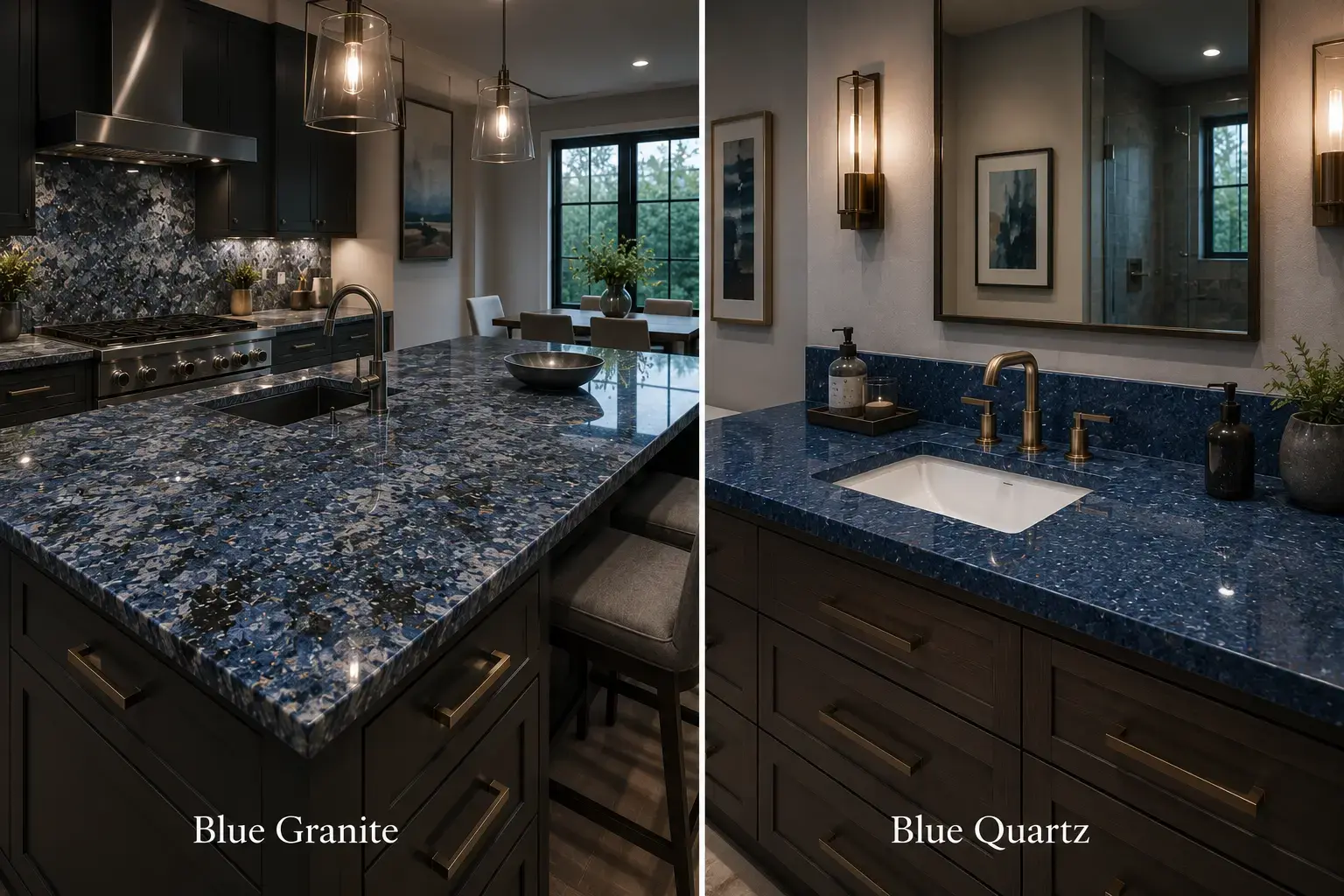
Blue Granite vs. Blue Quartz
Blue granite and blue quartz solve the same design problem in different ways. Granite is a natural stone, so every slab is genuinely one of a kind, with the labradorescence and mineral inclusions varying across the surface. Quartz is an engineered material made from ground quartz crystal bound with resin, which allows for a more uniform, repeatable blue pattern from slab to slab and generally removes the need for sealing altogether.
Independent testing from Consumer Reports rates both materials as excellent for cutting, abrasion, and heat resistance, with quartz showing a modest edge in resisting stains from substances such as beet juice and food coloring. Homeowners who want a truly unique, one-off surface tend to lean toward granite, while those who prioritize low maintenance and consistent pattern matching across a large kitchen often lean toward quartz. Both hold up well in an active kitchen, and the right choice usually comes down to how much variation you want in the finished slab. If you've narrowed your preference, you can request a slab quote to check availability and pricing. Builders, designers, and contractors planning multiple projects can also apply for a trade account for access to trade purchasing benefits.
Visiting Nova Tile and Stone in Reno
Nova Tile and Stone's Reno showroom, located at 12835 Old Virginia Road, Suite 24, in Reno, is roughly 55 miles from Zephyr Cove. The showroom can be reached at (775) 331-6682 for questions before a visit. As a direct stone importer, Nova Tile and Stone carries a rotating selection of natural stone slabs, including blue granite varieties, alongside quartz, sintered stone, and porcelain options, with current inventory viewable through the live slab inventory page. The showroom is open Monday through Friday from 7:30 a.m. to 6:00 p.m. and Saturday from 9:00 a.m. to 3:00 p.m. Our design team offers free design consultations to help match a slab to your kitchen's lighting, cabinetry, and overall style.
Conclusion
Blue granite earns its place in a kitchen or bath the same way the surrounding Sierra Nevada landscape does, through natural variation rather than a manufactured pattern. Its color comes from labradorite crystals reflecting light in ways no factory process can fully replicate, which is why two slabs cut from the same block can still look distinct once installed. For a Zephyr Cove home built around timber, stone, and lake views, that unpredictability is an asset rather than a drawback. Whether the choice lands on the quieter shimmer of Blue Pearl or the bolder swirl of Azul Bahia, the stone rewards a bit of patience during selection, since seeing a slab under the same light it will live with day to day makes the difference between a countertop that blends in and one that becomes the room's focal point.
Frequently Asked Questions
Yes, generally, though the exact premium depends on how much of the slab a project uses. Because imported blue slabs are limited in quantity, cost is also affected by how efficiently a layout uses the material. For example, a large island that requires book-matching two slabs will cost more than a single-slab installation.
Indoors, yes. Granite's density and heat resistance make it well suited to kitchens that see large temperature shifts between a cold morning and a warm oven nearby. Outdoor use in a high-elevation climate with repeated freeze-thaw cycles is a separate consideration, since moisture that gets into any natural stone can expand when it freezes, so an outdoor application should be discussed with a fabricator familiar with local conditions.
Many Zephyr Cove homeowners use blue granite as a kitchen island surface while keeping perimeter counters in a quieter neutral stone or quartz. This lets the blue slab function as a focal point rather than competing with itself across a large kitchen, and it also gives the eye a place to land that a single continuous material would not provide.
Bringing a cabinet sample or paint swatch to the showroom, and viewing slabs near a window if possible, gives a more accurate read than judging color under standard indoor lighting alone, since the shimmer can look noticeably different once it's under your own light source at home.
Minor chips and scratches can usually be filled and polished out by a professional fabricator without replacing the slab, since granite repair kits and color-matched epoxy fillers are widely available for natural stone. Because blue granite's color comes from internal mineral layers rather than a surface finish, a skilled repair can blend in well, though very deep chips near an edge or corner may still be more visible than a repair on a plain gray or black granite, simply because the shimmer draws more attention to that section of the slab.
Note: Some images on this page may be conceptual renderings created to illustrate design possibilities and may not depict actual installations.