Countertop trends for 2026 include slip-matched slabs, full-height stone backsplashes, dark charcoal and black stone tones, leathered and flamed finishes, backlit translucent onyx, and warm neutral tones like taupe and terracotta in Granite Bay, CA homes. Homeowners in the Granite Bay area are moving away from stark white, high-gloss countertops toward more textured, tonal, and dramatic natural stone choices. These shifts are showing up in kitchen islands, wet bars, and bathroom vanities throughout homes near Folsom Lake. This guide breaks down each trend and how it applies to a Granite Bay home.
Slip-Matched Slabs: The New Alternative to Bookmatching
Slip-matched slabs are cut from the same block and installed side by side without mirroring the pattern, so the veining repeats in the same direction across the seam. This differs from bookmatching, where one slab is flipped like a page to create a mirrored, symmetrical design.
For Granite Bay kitchens with long runs of counter space, slip-matching gives a more relaxed, flowing look than a bookmatched pair. It also tends to cost less, since it does not require the same level of slab selection and layout planning that a true bookmatch does. Homeowners who like the idea of continuous veining but do not want the formality of a mirrored pattern are choosing this option for islands and waterfall ends.
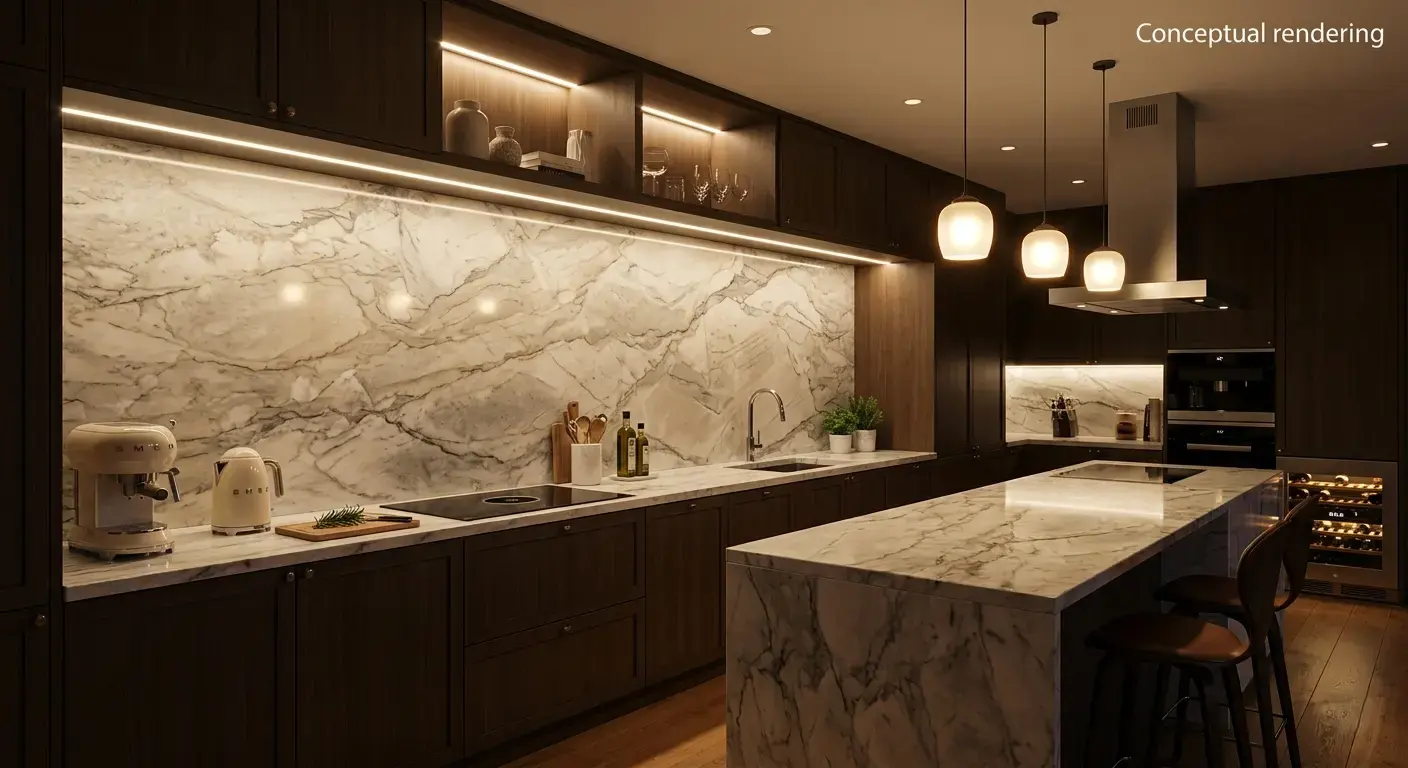
Full-Height Stone Backsplashes: Extending Your Countertop Up the Wall
A full-height backsplash carries the same slab material from the countertop all the way up to the underside of the upper cabinets or to the ceiling, rather than stopping at a standard four-inch or eighteen-inch splash. The material reads as one continuous surface from counter to wall.
This look has become popular in Granite Bay homes with open kitchen layouts, where the cooking area is visible from the dining and living spaces. A full-height backsplash removes the visual break between countertop and wall, which can make a kitchen feel more cohesive, especially behind a range or cooktop where grout lines and seams in tile would otherwise draw attention. Homeowners planning this look can walk through options in person at our Sacramento showroom, where full slabs are easier to visualize at scale than a small sample.
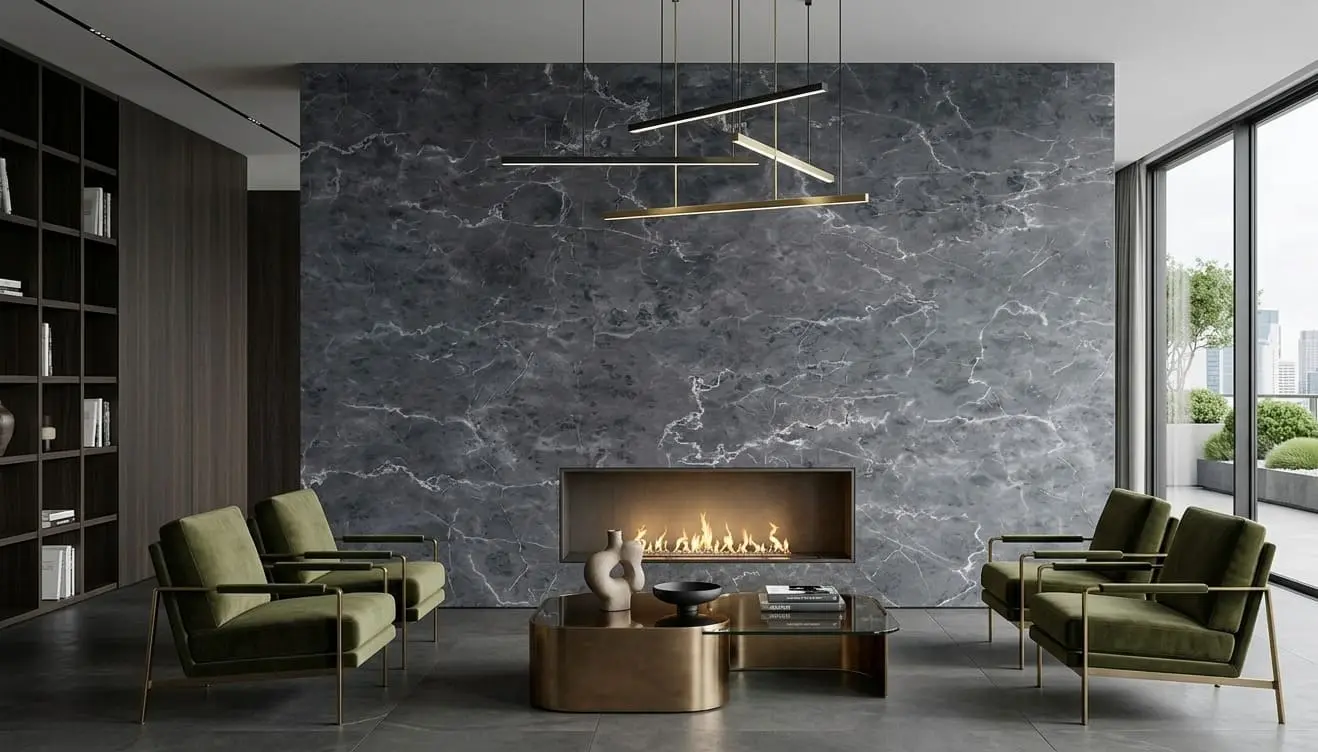
Dark Stone Countertops: Why Charcoal and Black Are Gaining Ground in 2026
Dark stone options such as charcoal granite, black granite, and dark soapstone are showing up more often in new kitchen designs. These tones work well against white or light wood cabinetry, and they also pair with dark or matte black cabinetry for a more monochromatic kitchen.
In Granite Bay, where many homes lean toward transitional and contemporary interiors, dark countertops are often used on islands to create contrast against lighter perimeter counters. Dark stone also tends to show fewer visible water spots and light scratches than very pale materials, which is part of why it appeals to busy households. Fine Homebuilding's guide to natural stone notes that darker, denser stones like granite hold up especially well in high-traffic kitchens, which helps explain the shift toward charcoal and black tones this year.
Thicker Island Slabs, Standard Perimeter Counters: The New Kitchen Hierarchy
Rather than using the same slab thickness throughout a kitchen, homeowners are increasingly specifying a thicker island top, often built up to look like a heavier slab, while keeping the perimeter counters at a standard thickness. This creates a visual hierarchy where the island reads as a substantial, furniture-like piece.
This approach works particularly well in larger Granite Bay kitchens where the island functions as the main gathering point. A thicker profile on the island edge gives it presence without requiring the same thickness, and cost, across every countertop surface in the kitchen. Contractors and designers managing multiple projects with this layered approach can apply for a trade account for dedicated pricing and support on mixed-thickness orders.
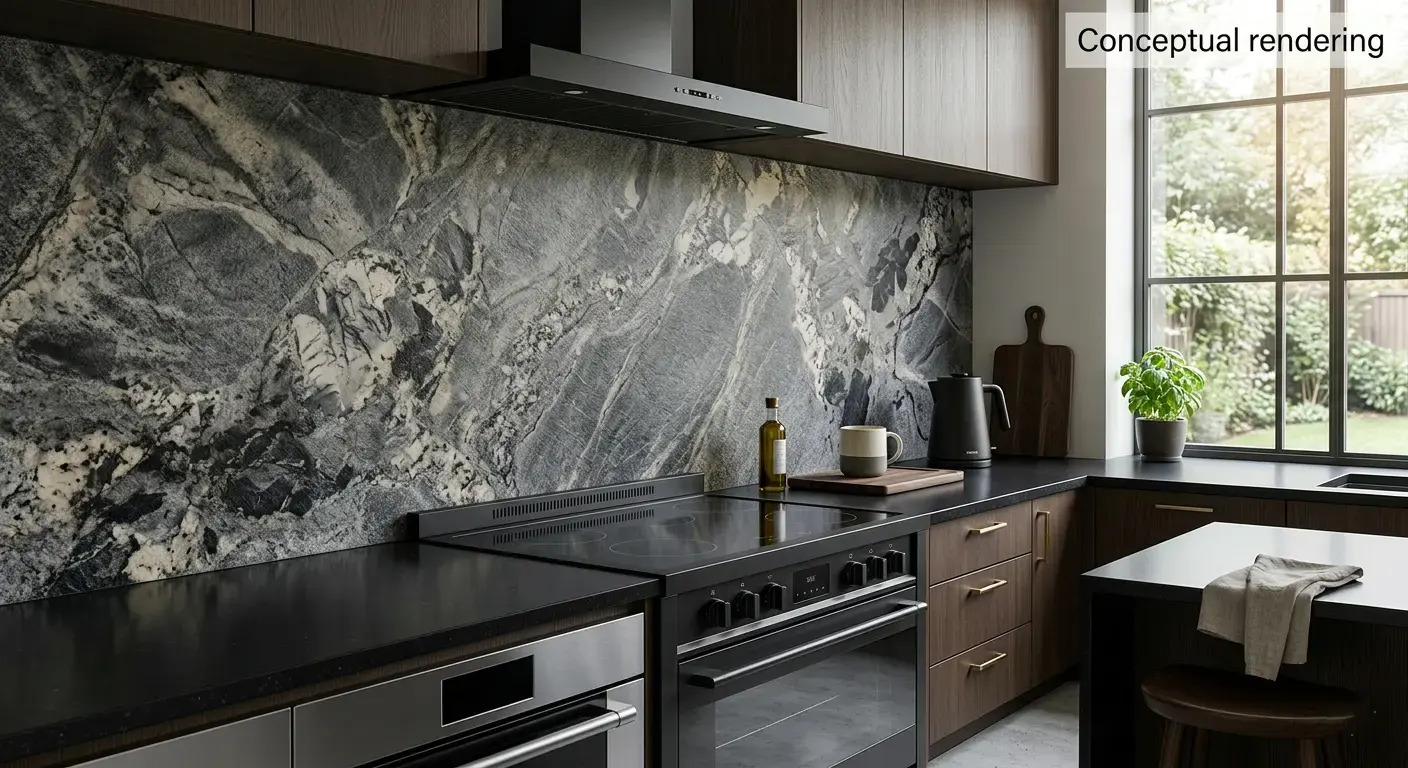
Leathered and Flamed Finishes: Beyond Honed and Polished
Leathered and flamed finishes are texture treatments applied to stone as an alternative to the more common honed (matte, smooth) and polished (glossy) finishes. A leathered finish creates a subtle, textured surface with a slight sheen, while a flamed finish uses heat to create a rougher, more matte texture, often used on exterior stone or flooring.
These finishes are gaining attention because they change how a stone's natural color and veining appear. A leathered finish, for example, tends to deepen the color of dark stones like soapstone or granite while softening the appearance of fingerprints and smudges on countertops. This Old House's guide to stone countertops points out that honed and leathered finishes tend to hide scratches and etching better than polished surfaces, which is part of why they have become more popular for darker stones. Granite Bay homeowners updating kitchens with a more tactile, organic feel have been asking about leathered finishes as a way to add texture without changing the material itself.
Translucent Stone: Backlit Slabs for Bar Tops and Accent Walls
Onyx is the natural stone most associated with this effect. Its translucency allows light to pass through the slab when it is cut to a workable thickness and backlit with an LED panel, creating a glowing effect that highlights the stone's natural banding and color from within. Available pieces can be browsed through our live slab inventory, which shows onyx in polished, honed, and leathered finishes, each of which changes how light interacts with the stone once it is lit.
This trend is most often applied to smaller accent features rather than full kitchen countertops, since onyx is softer than granite or quartzite and performs best in lower-traffic applications. In Granite Bay, we have seen interest in backlit onyx for home bar tops, wine room walls, and bathroom vanities, where the glow becomes a focal point without the wear and tear of daily kitchen use.
Dramatic Veining as a Design Statement: Choosing a Slab That Becomes the Focal Point
Rather than choosing a stone for a uniform, quiet appearance, more homeowners are selecting slabs specifically for bold, dramatic veining that becomes the visual centerpiece of a room. This means picking a single slab, or a matched pair, based on the movement and contrast of its veining rather than treating the stone as a neutral backdrop.
This approach requires seeing the actual slab in person, since no two pieces of natural stone have identical veining. Granite Bay homeowners who want this look typically visit our showroom to walk through available slabs and select the specific piece that will be used in their kitchen or bathroom, rather than choosing from a sample chip alone.
Materials known for dramatic, high-contrast veining are often used on a single focal surface, such as an island or a waterfall edge, while the surrounding counters use a calmer material. This keeps the statement piece from competing with the rest of the room and helps balance the overall cost of the project, since the most dramatic slabs are typically priced higher than more uniform material.
Warm Neutrals in Natural Stone: Taupe, Sand, and Terracotta Slab Tones for 2026
Alongside the trend toward dark stone, warm neutral tones such as taupe, sand, and soft terracotta are appearing more frequently in slab selections. These tones offer an alternative to the stark white and gray palette that has dominated countertop choices for the past several years.
Warm neutral stone pairs well with wood cabinetry, brass or bronze hardware, and warmer wall colors, which fits the earthy, warm-toned interiors that have become more common in Granite Bay homes. These tones also tend to hide everyday wear, such as light dust or crumbs, better than very light or very dark surfaces.
We are seeing warm neutral tones requested most often for primary bathroom vanities and for kitchens that already lean toward warm wood flooring, since the stone can tie those elements together without introducing a new, competing color. Homeowners who find a specific slab they like can submit a slab quote request directly, listing the bundle number if one has already been selected in person.
Bringing These Trends Into Your Granite Bay Home
Granite Bay homeowners have a wide range of options this year, from bold veined slabs and backlit onyx accents to quieter warm neutral tones and textured leathered finishes. The right choice depends on the scale of the project, the rest of the home's finishes, and how much of a focal point the stone is meant to be. We keep a rotating selection of granite, quartzite, marble, and other natural stone slabs across our showroom locations, and seeing a slab in person is the best way to judge veining, color, and finish before committing to a project. Our team is available to walk through current inventory and talk through which of these trends fits a specific space, and appointments can be booked online ahead of a visit. Our showroom is located at 6100 Warehouse Way in Sacramento, and we can be reached at (916) 913-6682 to schedule a visit or ask questions about a project.
Note: Some images on this page may be conceptual renderings created to illustrate design possibilities and may not depict actual installations.
Frequently Asked Questions
Slip-matched slabs are installed side by side with the veining repeating in the same direction, while bookmatched slabs are mirrored across the seam so the pattern reflects like a page being turned. Slip-matching creates a more continuous, flowing look, while bookmatching creates a symmetrical, mirrored design.
No. Backlighting requires a stone that is naturally translucent, and onyx is the material most commonly used for this effect, cut to a thinner profile than a standard countertop slab. Granite and most marble are too dense for light to pass through.
A leathered finish is not necessarily more durable, but its textured surface can make small scratches, smudges, and water spots less noticeable compared to a glossy polished surface.
No. Many homeowners achieve this look by using a thicker profile only on the island while keeping standard thickness on the perimeter counters, which can help manage overall material cost.
Because veining varies from slab to slab, selecting a specific piece in person is the most reliable way to know exactly what will be installed. Our showroom keeps a range of slabs available for this kind of in-person selection.