AT A GLANCE
- Running bond, with rows offset by half a paver, is the easiest pattern to lay.
- In running bond, most cuts fall where rows start and end.
- Stack bond needs perfectly straight joints in both directions.
- Basketweave works best with pavers in a true 2:1 ratio.
- Herringbone, laid at 45° or 90°, is recommended for driveways.
- Large porcelain pavers set over concrete often need an offset of one-third or less.
IN THIS POST
- What is the easiest paver pattern to lay?
- Running bond vs. stack bond pavers
- Is a basketweave paver pattern easy?
- Are herringbone pavers hard to lay?
- Does paver size affect the pattern?
- Best paver pattern for patios and driveways
- How to plan a paver layout
- Conclusion
- Frequently Asked Questions
- Sources
Running bond is widely considered the easiest paver pattern to lay. In this layout, pavers of one size are set in straight rows, and each row is offset by half a paver, much like a brick wall. It is a common choice for patios and walkways for two reasons: most cuts are needed only at the start and end of each row, and the staggered joints help hide small spacing variations that would stand out in a grid-style stack bond.
Ease of laying is not the only factor, though. Herringbone takes more cutting and precision, but its interlocking joints make it the recommended pattern for driveways. Large porcelain pavers set in mortar over a concrete slab also need a different approach: according to the ANSI A108.02 standard, when the offset side is longer than 15 inches, offset patterns should generally use an offset of no more than one-third unless the manufacturer specifies otherwise, which helps reduce uneven edges. Below, we compare running bond, stack bond, basketweave, and herringbone so you can match the right pattern to your project.
What Is the Easiest Paver Pattern to Lay?
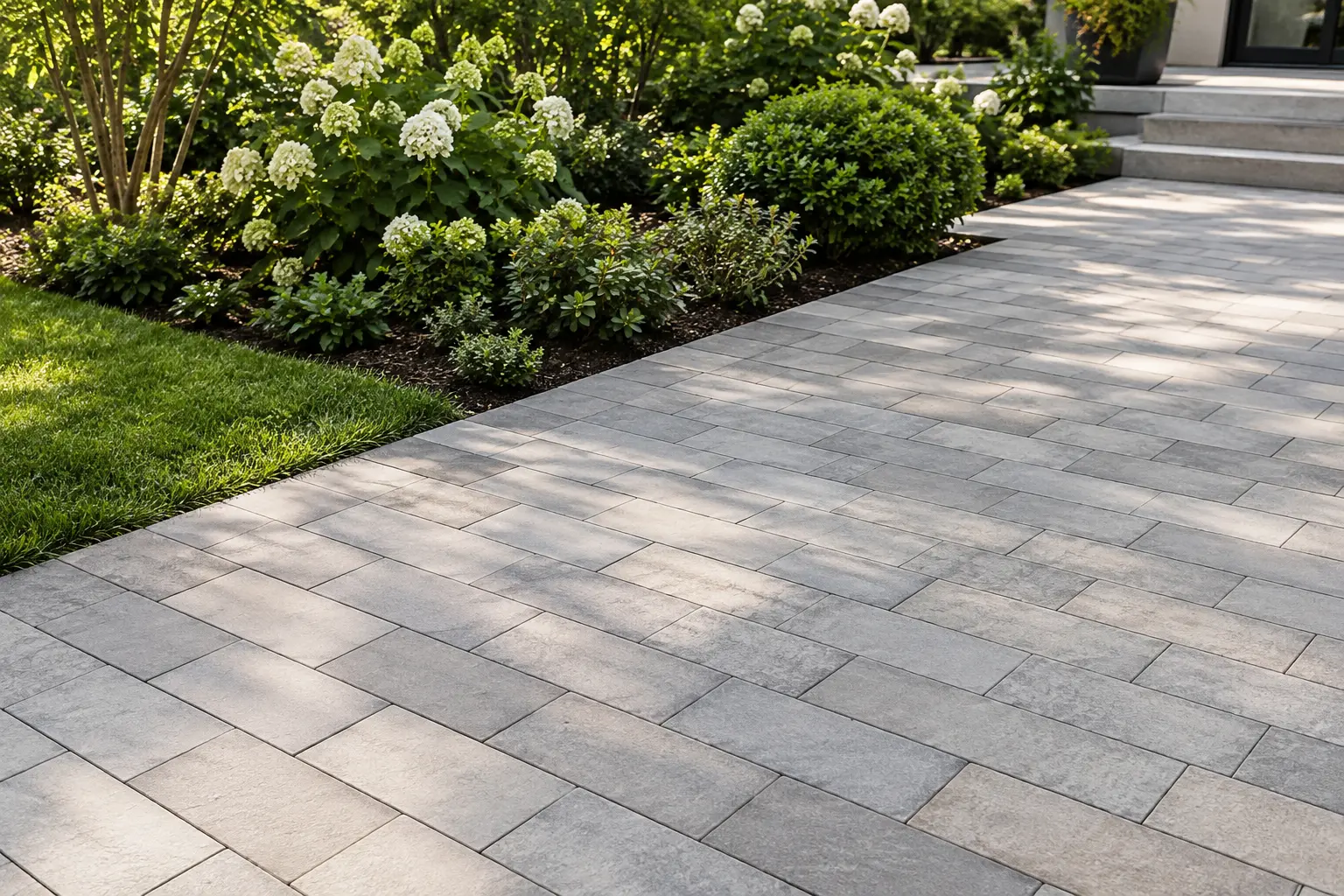
For most patios and walkways, running bond is the easiest paver pattern to lay, and it is the one most often recommended for first-time and DIY projects. It pairs a single paver size with a simple, repeating offset, so there are fewer decisions to make as each row goes down.
The layout is the same one used on most brick walls, which is why it is also called brick pattern or stretcher bond. Rows can run in the direction people walk, across the path, or on a diagonal, depending on the look you want. When the rows follow the direction of travel on a straight path, running bond needs only minimal cutting, mostly at the beginning and end, no matter how long the path gets.
Running bond also adapts well to gentle curves. Narrow rectangular pavers tend to work best on a curve because they follow the bend with smaller gaps along the outside edge.
Running Bond vs. Stack Bond Pavers
Running bond pavers are generally easier to lay than stack bond because stack bond leaves no room for small errors. In a stack bond, every paver sits directly beside and above the next, so all the joints form continuous straight lines in both directions, like a grid.
That grid can look clean and modern, but any slight drift in spacing becomes visible across the entire surface. If one row creeps a fraction of an inch off line, the error carries through every row after it. In running bond, the offset breaks up those long joint lines, so minor variations are much harder to spot.
Stack bond does have one advantage: if the dimensions of the space match the paver size, it can be laid with very few cuts or even none. However, because its joints are not staggered, stack bond is not commonly recommended for patios where pavers may shift. For that reason, it is more often used for accents, borders, and edge courses than for large open areas.
Is a Basketweave Paver Pattern Easy?
A basketweave paver pattern is fairly easy to lay when it is set square to the edges, but only if the pavers have a true 2:1 length-to-width ratio. The pattern is made by setting two pavers side by side in one direction, then two pavers turned 90 degrees, and repeating that across the surface.
For the pattern to close up neatly, the combined width of two pavers, plus the joint, must equal the length of one paver. Not every paver is sized that way. Standard brick-style units are not always exactly twice as long as they are wide, and two widths can fall short of one length, which leads to visible gaps or extra cuts. If your pavers do not have a true 2:1 ratio, running bond is usually the simpler choice, because length-to-width ratios do not affect how its rows fit together.
Like stack bond, basketweave has continuous joints running in both directions, so it tends to provide less interlock than staggered patterns. Turning basketweave on a diagonal creates an attractive diamond effect, but it adds many edge cuts.
Are Herringbone Pavers Hard to Lay?
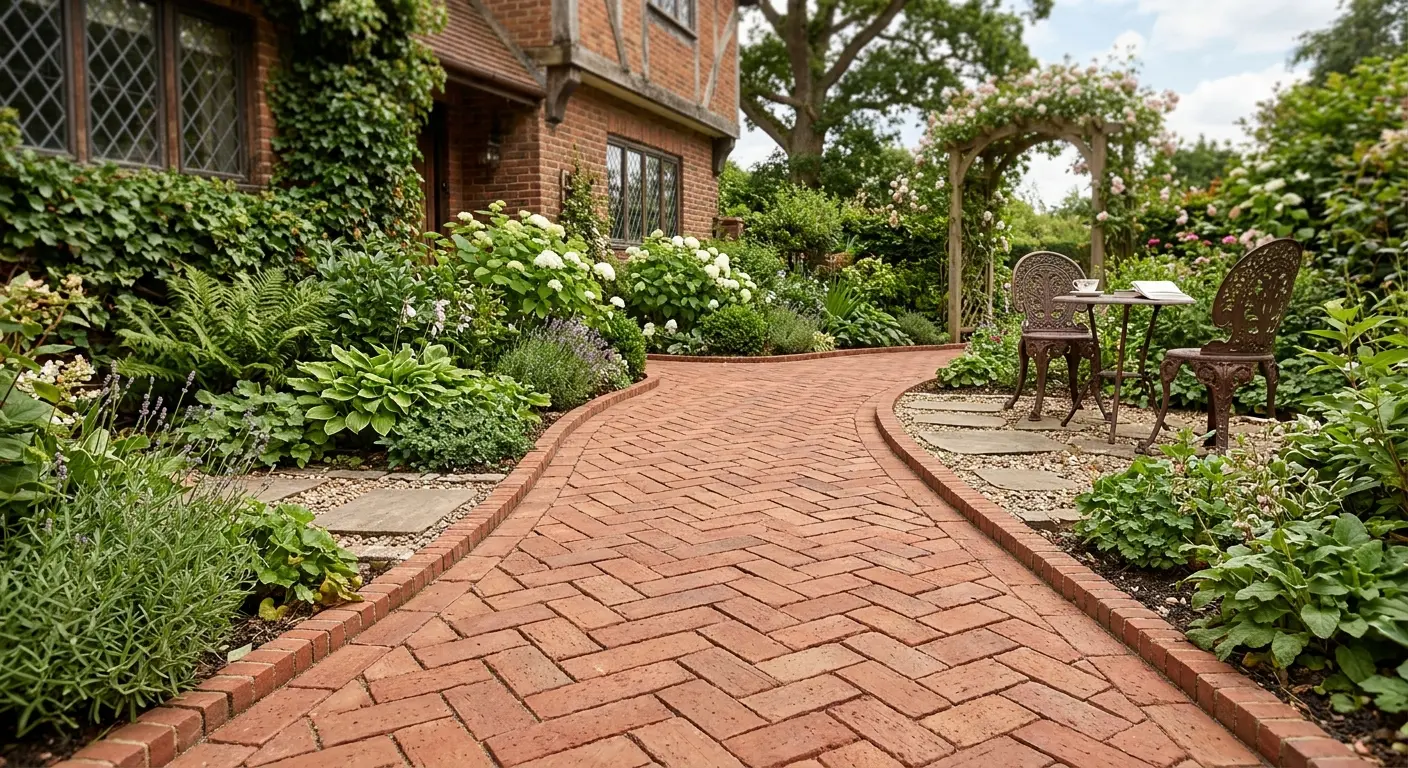
Yes. A herringbone paver pattern is harder to lay than running bond because it requires more cutting and more precise alignment. Pavers are set in a zigzag, with the end of one paver meeting the side of the next at a right angle. The pattern can run at 90 degrees or 45 degrees to the edges.
A 45-degree herringbone usually means cutting at least every other paver along each edge, and both versions use more material than running bond. The pattern is also unforgiving at the start: if the first few pavers are slightly off angle, the error grows as the pattern spreads across the area.
In exchange for the extra effort, herringbone offers strength. Because no joint runs longer than the length plus the width of a single paver, the pavers lock against each other when vehicles brake, turn, and accelerate. Industry testing shows that herringbone patterns offer greater structural capacity and resistance to lateral movement than other laying patterns, which is why they are recommended for areas that carry vehicle traffic.
Does Paver Size Affect the Pattern?
Yes. Paver size and shape affect how easy any pattern is to lay. Small brick-sized pavers are light, easy to adjust by hand, and work with nearly every classic pattern. Large-format pavers cover more ground with fewer pieces, but each unit is heavier and less forgiving.
Large porcelain pavers add one more consideration. Porcelain units can have a very slight natural bow along their long edges. In a standard running bond with a 50% offset, the high point at the center of one paver sits next to the low points where two neighboring pavers meet, which can create uneven edges known as lippage. When large porcelain pavers are set like tile over a concrete slab, installers often follow tile industry guidance, which limits offset patterns using large-format units to a maximum offset of 33% unless the manufacturer specifies otherwise.
A one-third offset is still a running bond pattern, so it keeps the same simple row-by-row rhythm. Recommended offsets and joint sizes can vary by product, so the manufacturer’s instructions for the specific paver should always take priority.
Natural stone pavers, such as travertine, quartzite, and granite, also come in a range of sizes. Some are sold in multi-size sets designed for French or random ashlar layouts, which follow a planned repeat rather than a single offset. These patterns focus less on simplicity and more on creating a natural, varied look.
At the largest end of the size range are full natural stone slabs. Slabs are not laid in a paver pattern, but they can be used for features next to a paved area, such as a fire pit surround or an outdoor kitchen. If you want those features to coordinate with your pavers, you can browse granite and quartzite in our live slab inventory and request a quote for the slabs you like. Slabs are best seen in person as full slabs at our showrooms, and availability can change, so confirm your selections with our team.
Best Paver Pattern for Patios and Driveways
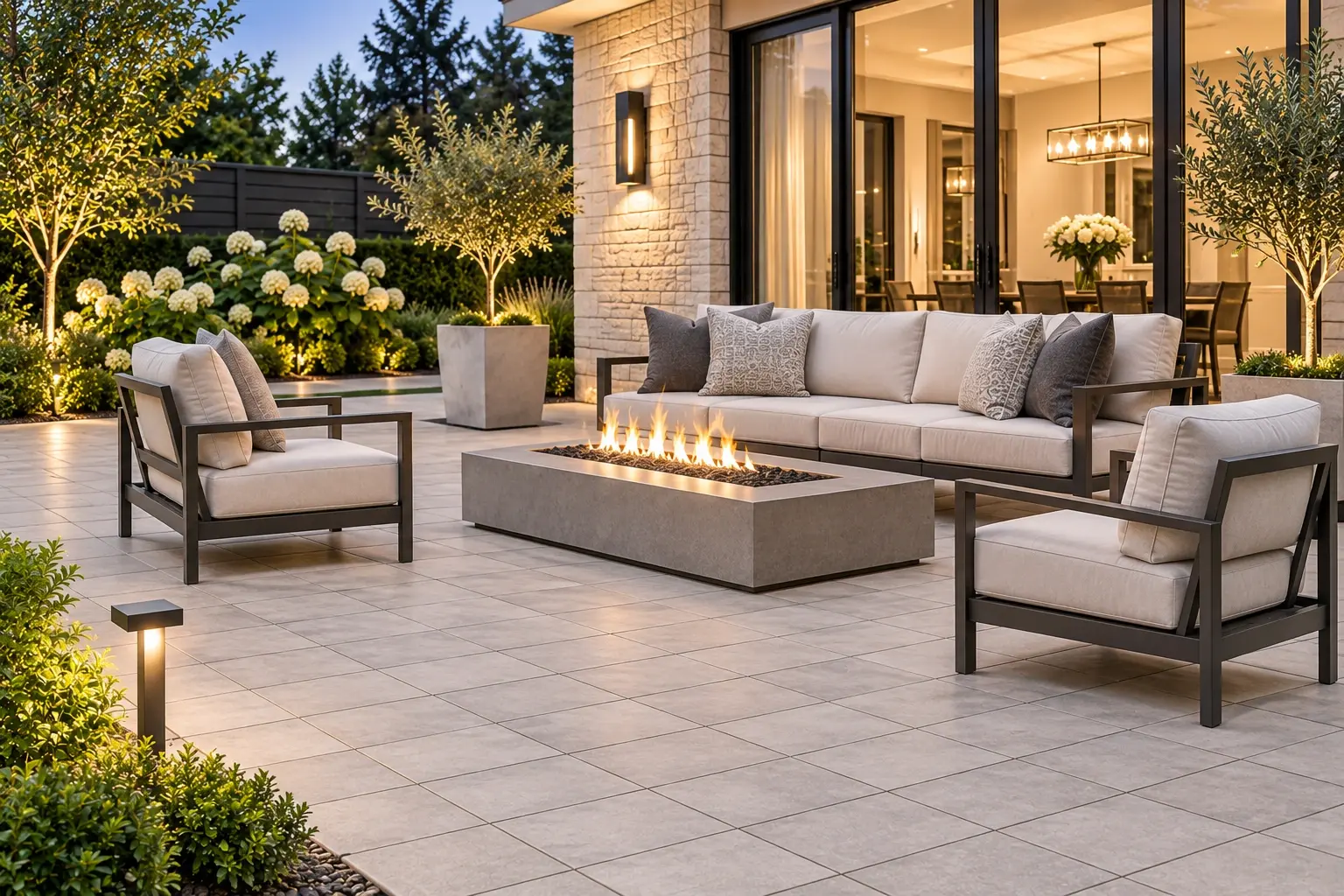
Running bond is usually the best fit for patios and walkways, while herringbone is the recommended paver pattern for driveways. Because the easiest option is not always the right one, the table below compares how the four patterns perform in different settings:
Pattern | Ease of laying | Cutting needed | Best suited for |
Running bond | Easiest | Low, mostly at row ends | Patios, walkways, curved paths |
Stack bond | Moderate | Low if dimensions align | Borders, accents, modern designs |
Basketweave | Moderate | Low when square, high on a diagonal | Patios and garden paths |
Herringbone (90°) | More demanding | Moderate | Walkways, patios, driveways |
Herringbone (45°) | Most demanding | High along edges | Driveways and high-traffic areas |
Many projects also use more than one pattern. A herringbone field framed by a running bond border, for example, pairs strength in the main area with a clean edge. A soldier course, which is a row of pavers set with their short sides against the edge, works well as a border or as a transition where one pattern meets another.
How to Plan a Paver Layout
Plan a paver layout by choosing the pattern first, then sizing the area, sketching the layout, and planning borders and quantities before any pavers are ordered. These early decisions can reduce cutting, waste, and frustration:
- Choose the pattern before buying pavers. The pattern determines which paver shapes, sizes, and quantities you need, so settling on it first helps avoid buying the wrong format.
- Size the area to the paver. Adjusting a walkway or patio width by a few inches so it fits a whole number of pavers can remove an entire row of cuts.
- Sketch the layout to scale. Drawing the pattern on graph paper shows where cuts will fall and whether small slivers will end up along an edge.
- Plan borders early. An edge course can hide small cuts along the field and give the pattern a finished frame.
- Account for cut waste when ordering. Patterns with more edge cuts, such as herringbone, typically use more material than running bond.
- Follow the manufacturer’s guidance. Recommended joint widths, offsets, and setting methods differ from product to product.
Once you have a rough sketch and measurements, you can bring them to our showrooms in Reno, Minden, Fernley, or Sacramento to compare paver sizes and finishes against the pattern you have in mind. If you are hiring a professional installer, discussing the pattern and paver size together at the planning stage helps everyone agree on the final look before work begins.
Conclusion
For most patios and walkways, running bond offers the best balance of simplicity and appearance, which is why it is the usual starting point. From there, the choice depends on the space: herringbone suits driveways and high-traffic areas, stack bond and basketweave work well as accents or in spaces sized to fit them, and large porcelain pavers often look best in a one-third offset. Weighing ease of laying alongside traffic, paver size, and style will point you to the pattern that fits your project.
Seeing pavers in person can make that choice clearer. At Nova Tile and Stone, we carry pavers and exterior stone in a range of sizes, colors, and finishes, so you can picture how each format might look in different layouts. Our team also offers free design consultations to help you think through size, finish, and pattern for your patio, walkway, or driveway.
Frequently Asked Questions
Running bond is generally the easiest paver pattern for beginners. It uses one paver size in offset rows, requires relatively few cuts, and makes small spacing differences less noticeable.
Stack bond looks simpler, but it is usually harder to lay well. Because every joint lines up in a grid, even a slight misalignment shows across the whole surface.
Herringbone, laid at 45 or 90 degrees, is the pattern most often recommended for driveways. Its zigzag joints help pavers lock together and resist shifting under vehicle traffic.
Large porcelain pavers can have a slight bow along their long edges. A 50% offset places high and low points side by side, which can cause uneven edges, while a one-third offset helps reduce that effect.
Yes. Rows that run along a straight path usually need the fewest cuts and draw the eye forward, while rows laid across the path can make it feel wider and slow the visual pace.
Sources
- ANSI A108/A118/A136.1:2026-07, American National Specifications for the Installation of Ceramic Tile (includes A108.02), developed by TCNA | https://webstore.ansi.org/standards/tca/ansia108a118a136202607
- Concrete Masonry & Hardscapes Association, Glossary of Terms for Segmental Concrete Pavement (PAV-TEC-001) | https://www.cmha.org/resource/pav-tec-001/
- Concrete Masonry & Hardscapes Association, Structural Design of Interlocking Concrete Pavement (PAV-TEC-004) | https://www.cmha.org/resource/pav-tec-004/
- Ceramic Tile Education Foundation, Offsets, Grout Joints and Customer Expectations | https://www.ceramictilefoundation.org/blog/offsets-grout-joints-customer-expectations
- HGTV, A Complete Guide to Brick Patterns for Walkways | https://www.hgtv.com/gardening/landscaping-and-hardscaping/brick-patterns-for-walkways
- This Old House, How to Build a Brick Patio | https://www.thisoldhouse.com/patios/how-to-build-a-brick-patio
- This Old House, A Guide to Brick Patterns | https://www.thisoldhouse.com/pathways-sidewalks/guide-to-brick-patterns
Note: Some images on this page may be conceptual renderings created to illustrate design possibilities and may not depict actual installations.