AT A GLANCE
- Ivory, cream, beige, and light gray pavers stay coolest in the sun.
- Light travertine and light porcelain run cooler than gray concrete.
- Honed, tumbled, and textured finishes affect heat less than color does.
- Dense pavers can stay warm into the evening.
- Porcelain rated Exterior, Wet under ANSI A326.3 suits pool decks and patios.
- No paver stays fully cool in midday summer sun.
IN THIS POST
- Why do pavers get hot in the sun?
- Which pavers stay the coolest?
- Is travertine cooler than concrete pavers?
- Do porcelain pavers get hot in the sun?
- Does paver finish affect heat?
- Where should you use cool pavers?
- How to keep pavers cool in summer
- Conclusion
- Frequently Asked Questions
- Sources
The pavers that stay coolest in the sun are light-colored ones, such as pale travertine, light-toned porcelain, and other cream, ivory, or light gray natural stone. Light surfaces have higher solar reflectance, meaning they bounce more sunlight away, while dark pavers absorb more of it and turn it into heat. That makes color the biggest single factor in how hot a paver gets.
Material, finish, moisture, and shade also affect surface temperature. Gray concrete and dark stone tend to run hotter than light stone in the same conditions, and dense pavers can hold heat into the evening.
Why Do Pavers Get Hot in the Sun?
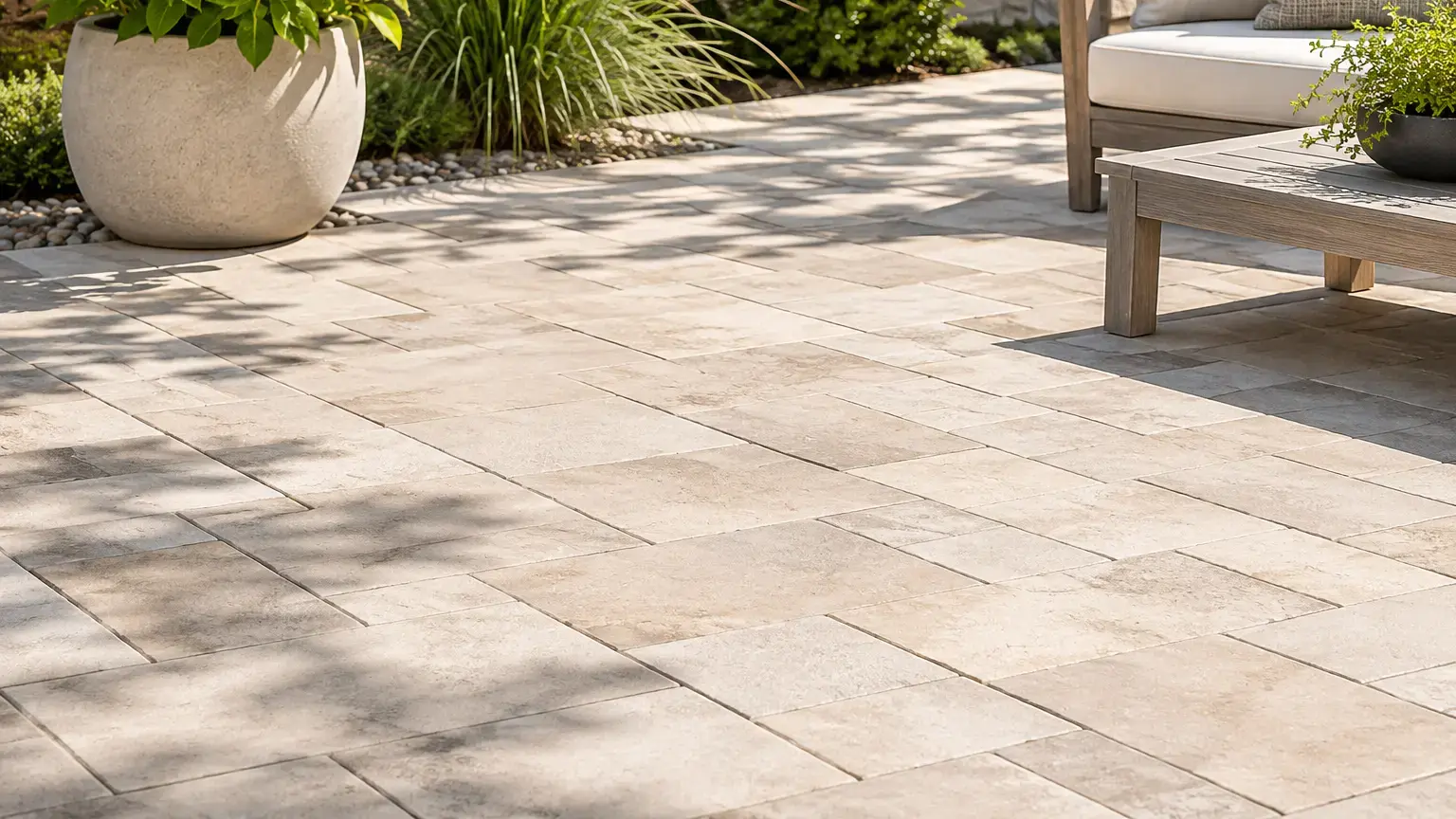
Pavers get hot because they absorb sunlight and turn it into heat, and dark pavers absorb far more than light ones. How much sunlight a paver reflects compared with how much it absorbs is the biggest factor in how hot it gets.
This property is called solar reflectance, or albedo, and it’s measured on a scale from 0 (absorbs everything) to 1 (reflects everything). What makes it less obvious than it sounds is that slightly less than half of sunlight is visible to the human eye. Light-colored surfaces stay coolest because they reflect both visible and invisible sunlight. Researchers have even developed “cool-colored” materials that stay moderately cool in darker shades by reflecting the invisible part of sunlight, which shows that how a surface looks doesn’t tell the whole story.
Reflectance can also change as a paver ages. Concrete, for example, tends to darken as it collects tire and grease stains, so a paver that looks light on day one may absorb more heat years later if grime is left to build up.
Beyond color, several other factors shape how hot a paver feels: how dense it is and how much heat it can store, whether it’s wet or dry, how much shade it gets, and how much air moves across it.
Which Pavers Stay the Coolest?
Light-colored natural stone and light-toned porcelain pavers generally stay the coolest, while gray concrete, red-toned pavers, and dark stone run hotter.
Field research supports this. In a study of common landscape surfaces, researchers used thermal imaging to compare pavers, concrete, asphalt, stone, mulch, and turf side by side across the seasons. In the summer tests, gray pavers had the highest average surface temperature of the materials measured, while an off-white limestone block stayed close to white materials such as white sand and crushed white rock. Among the pavers tested, darker colors ran hotter. The study also found that dense hard surfaces bedded on sand, the way pavers are normally laid, stayed above air temperature into the evening because of the heat they stored during the day.
At Nova Tile and Stone, we carry pavers and exterior stone in travertine, quartzite, granite, and porcelain, all suited to outdoor use. For a sun-exposed patio or pool deck, starting with the lightest shades in these materials gives you the best chance of a comfortable surface underfoot.
Is Travertine Cooler Than Concrete Pavers?
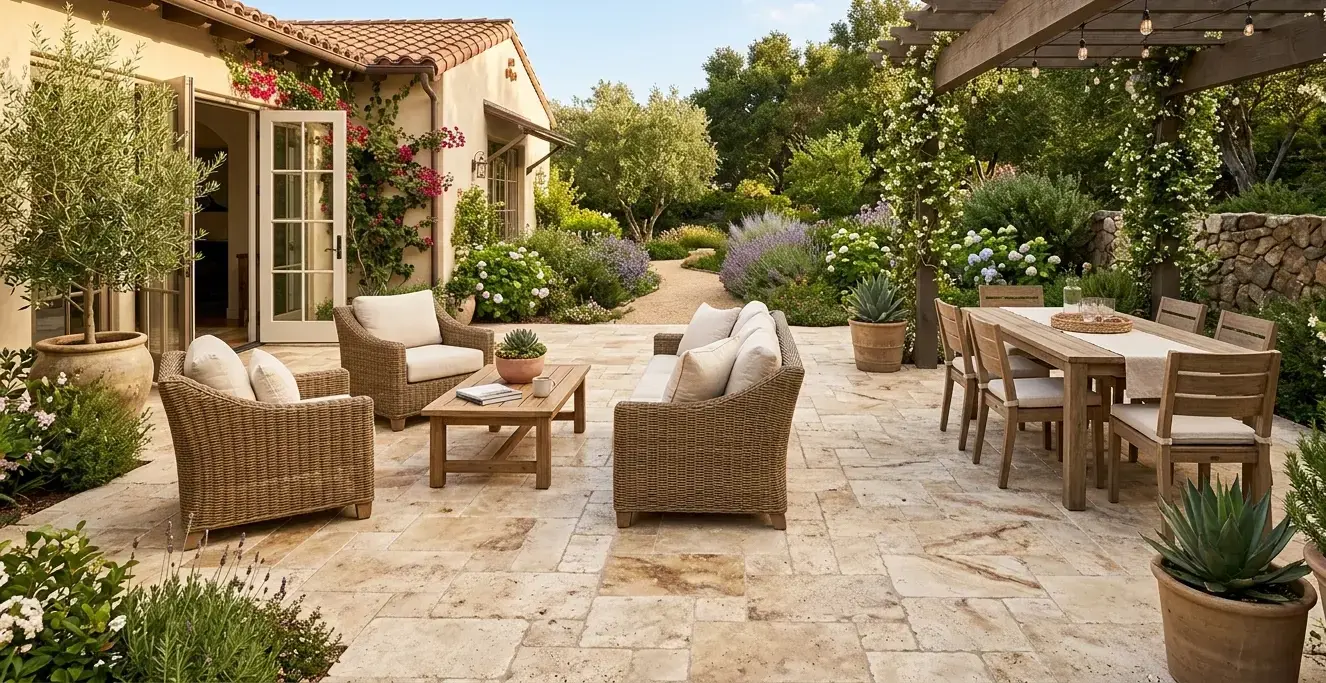
In most comparisons, light travertine runs cooler than standard gray concrete pavers, and color is the main reason. A light-colored concrete paver will run cooler than a charcoal one, so any comparison depends on the exact colors involved.
Research suggests that color isn’t the whole story, however. In a field study comparing travertine-type limestone with concrete blocks, both materials sat in full sun on open ground from July through November. The travertine’s surface heated up less than the concrete’s. The researchers also coated the concrete with a reflective paint matched to the travertine’s reflectance, and they concluded that the stone’s thermal properties, such as its heat capacity, contributed to the difference, not just its reflectance.
That study looked at one specific stone, so it’s a reasonable signal rather than proof that every travertine will outperform every concrete paver. Still, it lines up with what many homeowners notice: light travertine tends to be one of the more comfortable surfaces for bare feet. It does get warm in strong afternoon sun, though, so “cooler” is more accurate than “cool.” If your outdoor plans also include stone surfaces beyond the paving, such as a fireplace surround or a feature wall, you can browse our live slab inventory to compare natural stone slabs, then request a slab quote with the names of the slabs you like.
Do Porcelain Pavers Get Hot in the Sun?
Yes, porcelain pavers do warm up in direct sun, and how warm they get depends mostly on their color. A pale stone-look porcelain behaves much like other light materials, while a dark gray, charcoal, or deep wood-look porcelain absorbs considerably more heat.
Porcelain’s density is one reason it’s so widely used outdoors. According to the ANSI A137.1 standard, a ceramic tile only qualifies as porcelain if it has a water absorption of 0.5 percent or less. That classification says nothing about heat, though. Two porcelain pavers that both meet the standard can feel very different in the sun if one is ivory and the other is charcoal, so for comfort underfoot, the color is the detail to check.
If your area sees freezing winters, also confirm that the porcelain is rated for it. Our explainer on the tile freeze-thaw resistance standard covers how that resistance is tested.
Does Paver Finish Affect Heat?
Yes, to a degree. Smoother surfaces tend to run slightly cooler than rough ones, but color usually has the larger effect. That makes it practical to choose a light color first and then pick a finish for slip resistance and appearance.
Researchers who measured 93 common paving materials over a full summer examined how color, surface roughness, and the size of the units affected how the materials performed in the heat. In that research, smooth, light-colored materials generally stayed cooler than rough, dark ones.
For outdoor walking surfaces, especially around water, slip resistance should be part of the conversation from the start. That often points toward honed, tumbled, or textured finishes for pool decks and patios, but a finish alone doesn’t make a paver slip resistant, so check the product’s rating for wet outdoor areas. For porcelain, the ANSI A326.3 standard gives a quick way to check: products classified in the Exterior, Wet category are intended for level outdoor spaces such as pool decks, patios, and walkways.
Where Should You Use Cool Pavers?
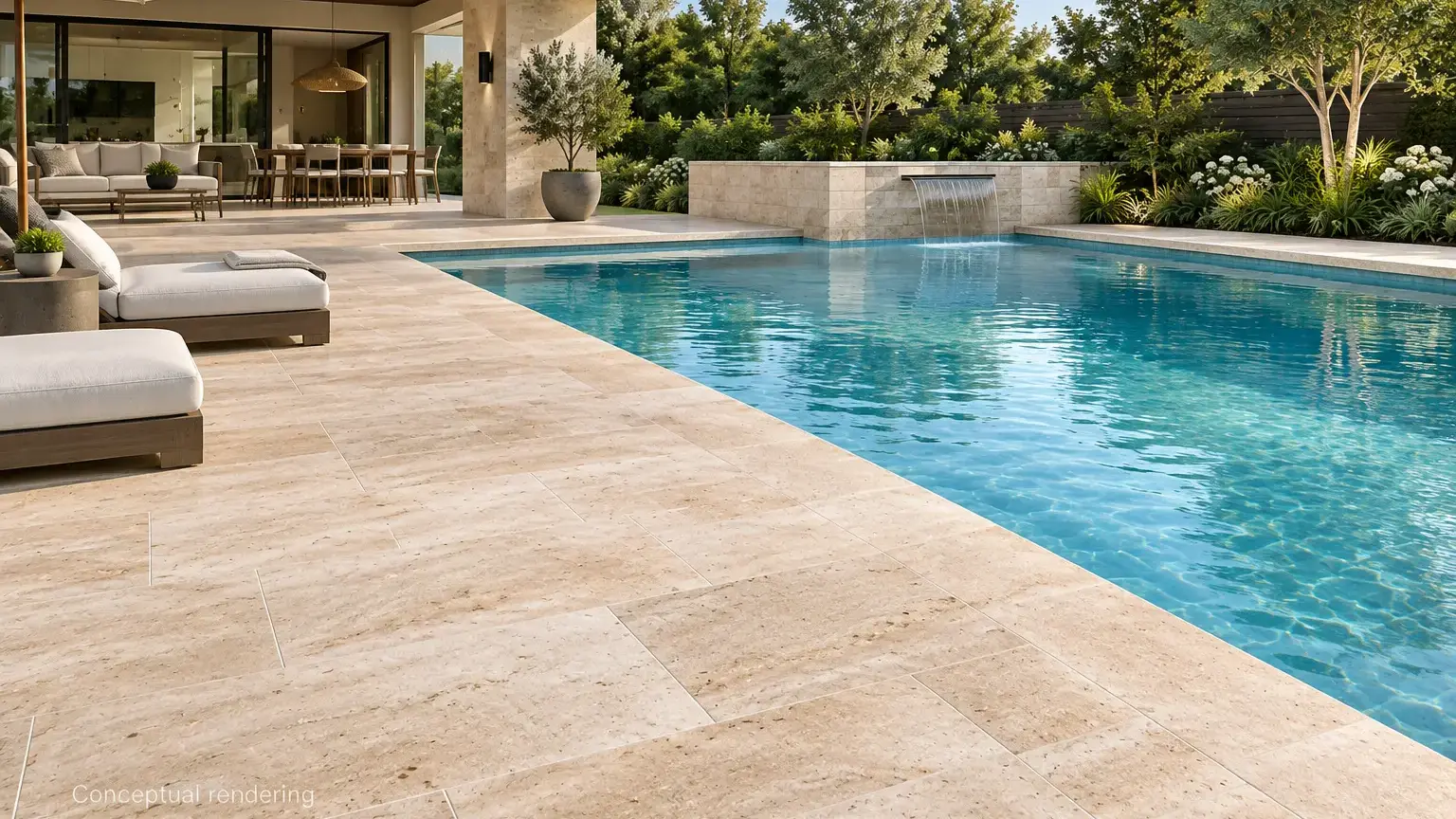
Cool pavers are most worth using anywhere people walk barefoot, sit, or play, especially in spaces that get strong afternoon sun. Pool decks, open patios, play areas, dog runs, and west-facing outdoor spaces are where paver color makes the most noticeable difference.
This is more than a comfort issue. In hot climates, sunbaked surfaces can get hot enough to cause serious contact burns, and a surface at 140°F can cause a second-degree burn in about five seconds. In one Arizona burn center review, most pavement burn cases involved people who fell, people who were down and couldn’t get up, or people walking barefoot, and more than half of the patients were 56 or older. Earlier measurements cited in the same research found that shade lowered peak cement temperatures from about 136 to 140°F down to about 102°F.
Most residential patios in milder climates won’t reach those extremes, but in areas used barefoot, lighter pavers and some form of shade make a real difference.
How to Keep Pavers Cool in Summer
The simplest ways to keep pavers cool in summer are shade, water, and a clean surface, and they work with any material.
Add shade. Blocking the sun before it reaches the paver addresses the root cause of the heat, whether the shade comes from a pergola, a shade sail, a large umbrella, or a tree canopy.
Rinse before use. Paving surfaces that enhance water evaporation are one of the recognized ways to keep pavement cooler, and a quick rinse works on the same principle for a while as the water evaporates. In an Arizona pilot study, conventional paving reached surface temperatures of up to 152°F at midday, while cool pavements stayed 10 to 16°F cooler. There is currently no official standard or labeling program for cool paving materials, so color remains the most practical way to compare products, along with any reflectance data a manufacturer provides.
Keep surfaces clean. Stains and grime slowly darken pavers, so regular cleaning helps them hold on to the reflectance they started with.
Plan the layout. Put the lightest pavers where bare feet go, such as pool surrounds and walkways, and use darker materials as borders, accents, or in shaded zones.
Conclusion
Choosing a paver for a sunny space comes down to a few priorities. Start with color, since it has the largest effect on surface heat. Then weigh material, finish, and slip resistance based on how the area will be used, whether that’s a pool deck, a family patio, or a shaded courtyard. Shade, regular cleaning, and a thoughtful layout make any choice more comfortable on hot days.
Because paver color can look different on a screen than in daylight, comparing options in person helps you judge how light a travertine, quartzite, or porcelain really is. At Nova Tile and Stone, you can compare exterior stone and porcelain options in person at our showrooms in Reno, Minden, Fernley, and Sacramento. Selection varies by location. Free design consultations are also available if you’d like help weighing color, finish, and heat for your project.
Frequently Asked Questions
It depends on color, climate, and sun exposure. In desert heat, conventional dark paving has been measured at over 150°F at midday, while lighter surfaces in the same conditions stay noticeably cooler. Most residential patios in milder climates won’t get that hot, but dark pavers in full afternoon sun can still be uncomfortable to touch.
White and very pale pavers reflect the most sunlight, so they generally stay the coolest. Cream, ivory, and light beige come close and can feel less bright to look at in full sun, which is why many homeowners choose them for pool decks and patios.
Often, yes, on light-colored pavers in moderate heat, but it depends on the color, the time of day, and how long the surface has been in direct sun. Before stepping onto a sunny patio barefoot, touch it briefly with the back of your hand. On very hot afternoons, shoes or sandals are the safer choice, especially on darker pavers.
Not always, because color plays the larger role. Gray concrete runs hotter than light stone, but a light concrete paver can run cooler than a dark granite. Concrete can also darken over time as it collects stains, which gradually increases how much heat it absorbs.
Quartzite is a natural stone suited to outdoor use, and our quartzite slabs are listed as UV resistant, which helps their color hold up in strong sun. For quartzite pavers, check the individual product’s specifications. As with any paver, lighter shades of quartzite will stay cooler than darker ones.
Sources
- ASTM International, Standardization News (written by the Tile Council of North America): Standards and the Ceramic Tile Industry | https://www.astm.org/news/standards-and-ceramic-tile-industry-jf24
- Why Tile (Tile Council of North America): A Significant Step Forward to Reduce Slip and Fall Incidents | https://whytile.com/2022/03/a-significant-step-forward-to-reduce-slip-and-fall-incidents/
- Lawrence Berkeley National Laboratory, Heat Island Group: Cool Science | https://heatisland.lbl.gov/cool-science
- Lawrence Berkeley National Laboratory, Heat Island Group: Cool Pavements | https://heatisland.lbl.gov/coolscience/cool-pavements
- U.S. Environmental Protection Agency: Using Cool Pavements to Reduce Heat Islands | https://www.epa.gov/heatislands/using-cool-pavements-reduce-heat-islands
- Ichinose et al., “Mitigation of Thermal Environment by a Special Paving Material, Katsuren Travertine,” Proceedings of the Symposium on Global Environment (2004), via J-STAGE | https://www.jstage.jst.go.jp/article/proge1998/12/0/12_0_233/_article/-char/en
- Loveday et al., “Seasonal and Diurnal Surface Temperatures of Urban Landscape Elements,” Sustainability (2019) | https://www.mdpi.com/2071-1050/11/19/5280
- Doulos, Santamouris, and Livada, “Passive Cooling of Outdoor Urban Spaces: The Role of Materials,” Solar Energy (2004), via Cool Surfaces Toolkit (Cool Roof Rating Council) | https://coolrooftoolkit.org/knowledgebase/passive-cooling-of-outdoor-urban-spaces-the-role-of-materials/
- Kowal-Vern et al., “‘Streets of Fire’ Revisited: Contact Burns,” Burns & Trauma (2019) | https://burnstrauma.biomedcentral.com/articles/10.1186/s41038-019-0169-9
Note: Some images on this page may be conceptual renderings created to illustrate design possibilities and may not depict actual installations.