AT A GLANCE
- Most pavers sit on compacted crushed stone topped with about 1 inch of sand.
- The base stone is angular, dense-graded aggregate, such as road base or crusher run.
- Bedding sand is typically washed concrete sand that meets ASTM C33.
- Patios and walkways need at least 4 inches of compacted base.
- Residential driveways need at least 6 inches of compacted base.
- Weak soil, poor drainage, or freezing climates call for a thicker paver base.
- Stone dust, pea gravel, and masonry sand aren’t recommended under pavers.
IN THIS POST
- What Is the Best Base for Pavers?
- What Sand Goes Under Pavers?
- What Not to Use Under Pavers
- How Deep Should a Paver Base Be?
- What Paver Base Works for Clay Soil?
- Can You Use #57 Stone for Pavers?
- Are Paver Base Panels Better Than Gravel?
- Do Pavers Need a Concrete Base?
- What Base Do Porcelain and Stone Pavers Need?
- Questions to Ask a Paver Installer
- Where to See Pavers Before You Buy
- Frequently Asked Questions
- Sources
For most paver projects, the recommended base is a compacted layer of angular, dense-graded crushed stone, often called road base or crusher run, topped with about 1 inch of washed concrete sand. Patios and walkways typically need at least 4 inches of compacted base, and residential driveways need at least 6 inches, with more depth for weak soil, poor drainage, or freezing climates. According to the ASTM D2940 standard, dense-graded base aggregate is a blend of coarse and fine crushed particles that packs tightly when compacted.
These layers do most of the structural work in a patio, walkway, or driveway. The base spreads the weight of people and vehicles across the soil, gives water a path to drain, and provides a flat, stable surface for the pavers. When it’s built with the right materials and depth, the surface above is much more likely to stay level over time. When it isn’t, sinking, rocking pavers, and puddles tend to appear, no matter how well made the pavers are.
What Is the Best Base for Pavers?
For most patios, walkways, and driveways, the best base for pavers is compacted, dense-graded crushed stone, because its mix of particle sizes compacts into a firm, stable layer. Industry guidance recommends dense-graded aggregate similar to the road base approved by local transportation departments, or material close to the ASTM D2940 gradation where local road base isn’t available.
The mix of sizes is what makes this material work. Larger angular stones lock together, and smaller particles fill the gaps between them. Depending on the region, the same material may also be sold as processed gravel.
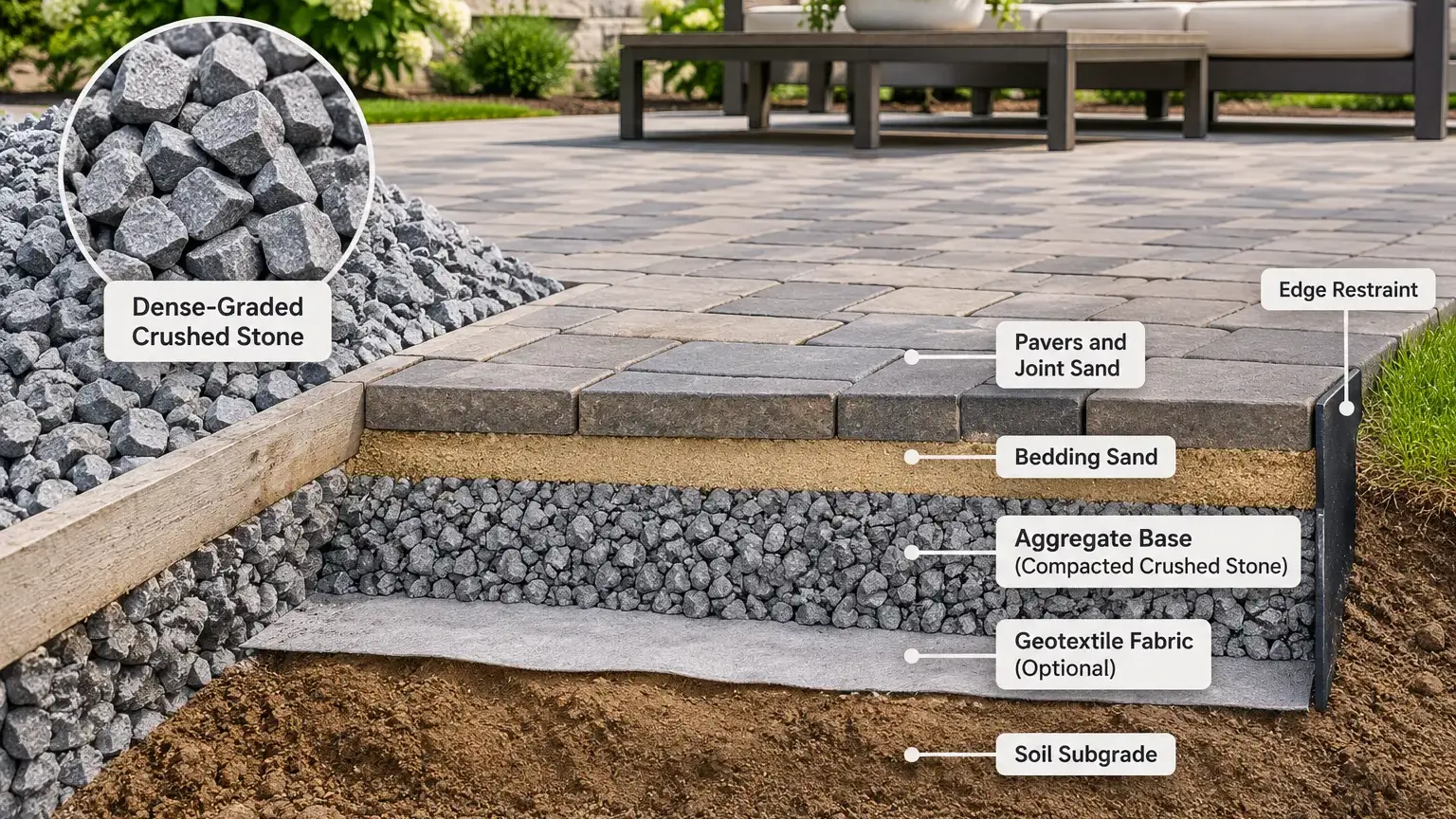
The crushed stone is one part of a layered system. A typical sand-set paver surface includes these layers, from the bottom up:
- Soil subgrade: the native soil, cleared of roots, organic material, and debris.
- Geotextile fabric (optional): a fabric layer that separates the soil from the stone.
- Aggregate base: the compacted crushed stone that carries the load.
- Bedding sand: a thin, even layer that the pavers settle into.
- Pavers and joint sand: the visible surface, with sand filling the gaps between pavers.
- Edge restraints: aluminum, steel, plastic, or concrete borders that keep the pavers from spreading outward.
Because each layer has a specific job, skipping one or swapping in a different material can affect how the whole surface performs.
What Sand Goes Under Pavers?
Washed concrete sand is the type of sand most often used under pavers, laid as a thin bedding layer on top of the crushed stone base. The washed concrete sand used for bedding typically meets the ASTM C33 standard for concrete aggregates, and industry guidance adds a limit of about 1% very fine particles passing the No. 200 sieve. Washing removes most of those fines, which helps the sand drain and stay stable.
Bedding sand does more than level the surface. It beds each paver, helps start the interlock between units, adds to the structure of the pavement, and lets water that seeps through the joints drain away.
This layer is usually about 1 inch thick, and it isn’t meant to make up for an uneven base. Dips or high spots in the stone below tend to show through to the paver surface over time.
Joint sand is a separate material. It can be the same concrete sand or a finer sand, and polymeric sand is a common choice because it firms up after being activated with water.
What Not to Use Under Pavers
Stone dust, limestone screenings, pea gravel, river rock, and masonry sand are generally not recommended under pavers, because they don’t compact, lock together, or drain the way crushed stone and concrete sand do. Some guides still suggest stone dust, but industry guidance advises against it. Here’s why each one tends to cause problems:
- Stone dust and limestone screenings: They’re often unevenly graded, can break down over time with moisture and wear, and can leave depressions in the paver surface.
- Pea gravel and river rock: Rounded stones roll against each other instead of locking together, so they don’t form a stable base.
- Masonry sand as bedding: It’s too fine for the bedding layer, though finer sand can work in joints.
- Materials with a lot of dust: Aggregates with excess fine particles drain poorly and can lose stability when wet.
How Deep Should a Paver Base Be?
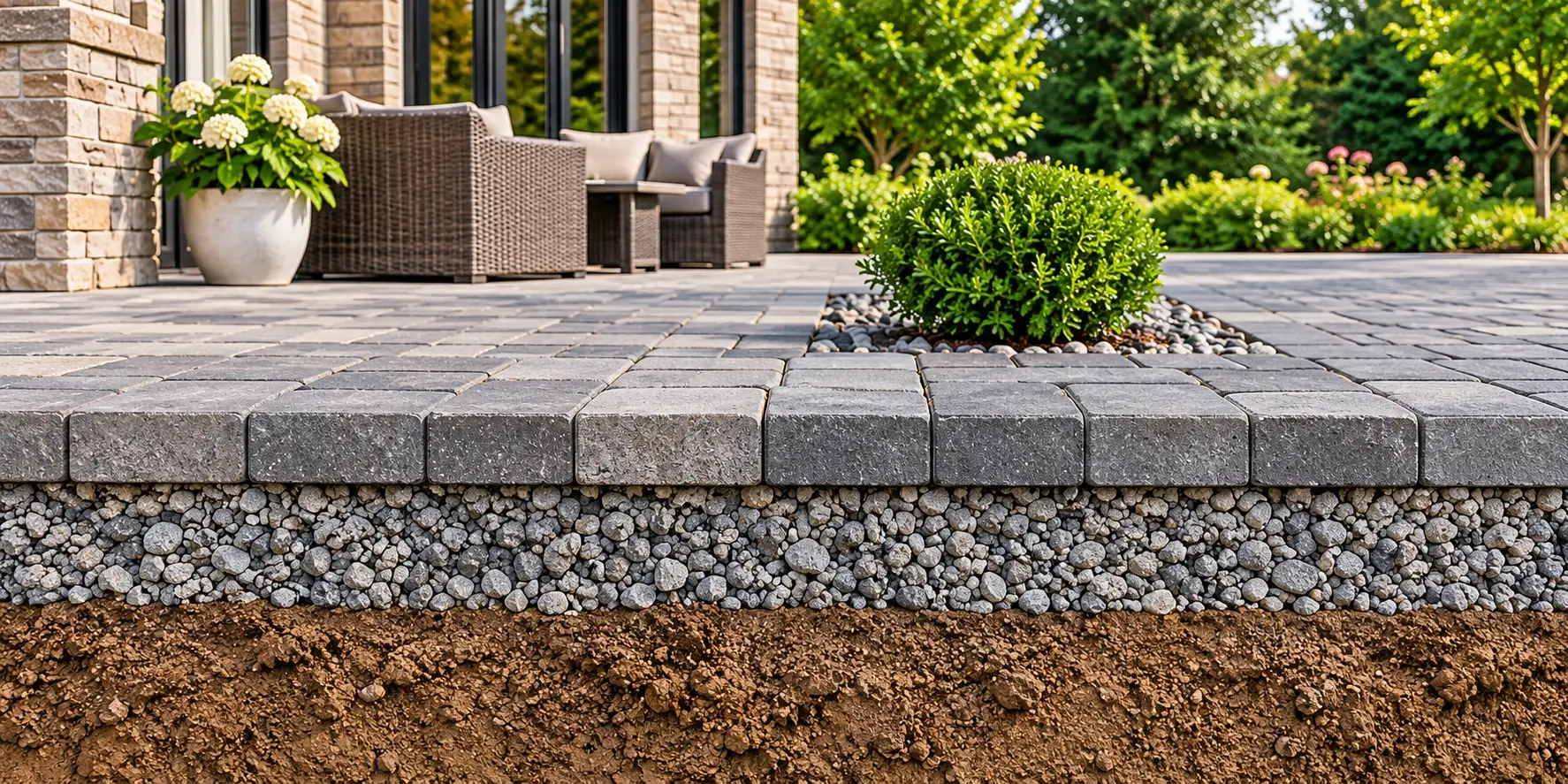
Most patios and walkways need at least 4 inches of compacted base, and residential driveways need at least 6 inches. Industry construction guidelines set these as the minimum compacted base thickness over well-drained soil, and colder climates and continually wet or weak soils call for thicker bases.
Those minimums assume ideal conditions: strong soil, good drainage, and a climate without freezing. As a rough estimate, industry engineers suggest increasing the minimum base thickness by about 50% for each of those conditions a site lacks. For a driveway lacking all three, that works out to roughly 15 inches of base. For streets and heavy-duty pavement, a qualified civil engineer should determine the design.
This is why two patios that look alike on the surface can have very different bases underneath. Depth also only helps if the stone is thoroughly compacted, since loose base material can settle after the pavers are down and leave dips in the surface.
What Paver Base Works for Clay Soil?
Clay soil and poor drainage usually call for a thicker crushed stone base, often with geotextile fabric beneath it and a clear path for water to drain away. Clay and silty soils hold water and can push up into the stone base, so the fabric is used to keep the two separated. It’s also used where soil stays saturated part of the year or goes through freeze and thaw, since it helps the base hold its strength longer.
Water management is the other half of the equation. Paver surfaces are built with a slight slope so rain runs off rather than collecting, and sites with heavy clay may need added drainage along the edges. When water can’t drain properly, it can lead to staining and efflorescence on the surface, and eventually to uneven settling and rutting.
Can You Use #57 Stone for Pavers?
You can use #57 stone or other clean, open-graded gravel under standard pavers in some cases, but only with clear limits. Clean #57 stone has angular pieces with little or no fine material, so water passes through it easily, and it’s the standard base for permeable pavers.
Current industry guidance restricts this approach to residential foot-traffic areas like patios, pool decks, sidewalks, and walkways, not driveways or commercial projects. It also calls for extra measures, such as fabric lining to keep surrounding soil out of the stone and added drainage where the soil drains slowly.
The trade-off is maintenance. Joint sand tends to migrate down into the open stone over time, so the joints may need periodic refilling. In return, this type of base has the potential to reduce frost heave.
Are Paver Base Panels Better Than Gravel?
Paver base panels aren’t a direct replacement for a compacted crushed stone base in every situation, and gravel remains the option backed by established industry guidance. Panels are lightweight plastic or foam sheets designed to take the place of some or all of the stone layer, which is why they appeal to people who want less digging and hauling.
Industry guidance on them is still catching up. As of 2025, guidance on panel and foam base systems was still being developed within the paver industry, so there isn’t yet a widely published standard to compare them against. If you’re considering panels, check the panel manufacturer’s limits on traffic, soil, and drainage, and confirm the paver manufacturer allows them for your pavers.
Do Pavers Need a Concrete Base?
Many paver projects don’t need a concrete base, since sand-set pavers over compacted aggregate are common for patios, walkways, and driveways. Mortar-set pavers typically need a concrete slab, and bitumen-set pavers need a concrete base or an asphalt base over compacted aggregate. Sand-set pavers create a flexible pavement that can handle minor movement and is relatively easy to repair. A mortar-set system typically requires a concrete slab with an aggregate drainage layer beneath it, and bitumen-set pavers sit over a concrete base or an asphalt binder base on compacted aggregate.
Each approach comes with trade-offs:
- Sand set: It has the lowest initial cost and allows easier repairs, but it generally needs more ongoing maintenance.
- Mortar set: It has a higher upfront cost and needs little long-term maintenance, but repairs are more difficult.
- Bitumen set: It sits in the middle on cost and can accommodate minor movement, but it tolerates little variation in paver thickness.
The right method depends on the paver material, its thickness, the expected traffic, and the local climate, so it’s worth checking the paver manufacturer’s recommendations before choosing one. Comparing the thickness and finish of different tile and natural stone options early on can also help narrow down which setting methods make sense for your project.
What Base Do Porcelain and Stone Pavers Need?
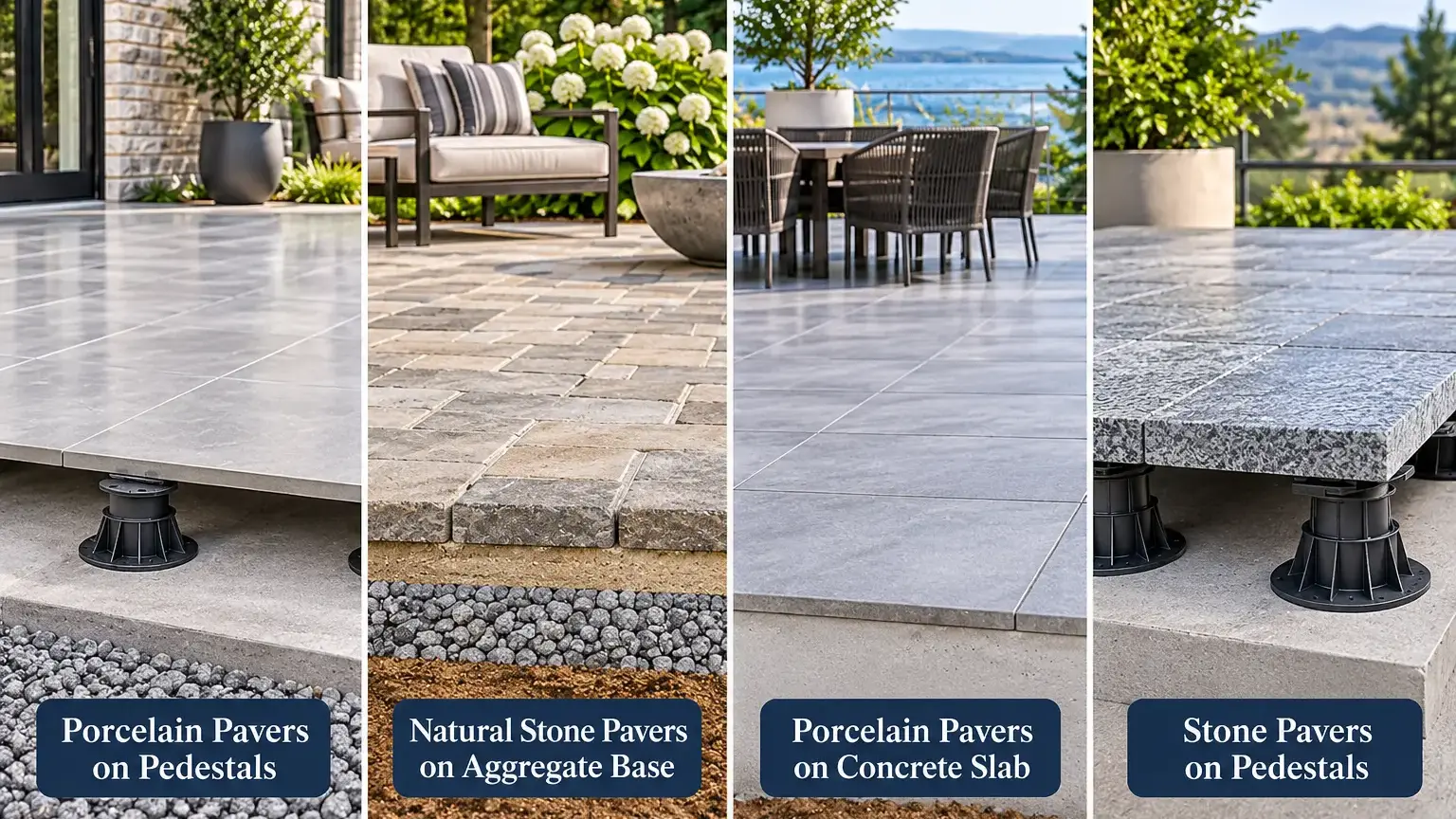
Porcelain and natural stone pavers can both be set on a compacted aggregate base, a concrete slab, or pedestals, but each paver’s thickness and its manufacturer’s instructions decide which option fits. Because the two materials are made differently, they’re matched to bases in slightly different ways.
Porcelain pavers are a newer category. According to the ANSI A137.3 standard, gauged porcelain pavers are at least 20 mm (about 3/4 inch) thick, and the standard recognizes both on-ground and pedestal installations for them. Because dedicated installation standards are still limited, the paver manufacturer’s recommendations carry extra weight. Pedestal systems raise pavers on adjustable plastic or metal supports over a concrete slab or a waterproofed roof deck, and they need a plan for draining water from the surface below.
Natural stone pavers vary more by stone type and thickness. Granite pavers, for example, are often 1 to 3 inches thick and can be set on thin-set mortar, a sand and gravel bed, or pedestal supports at each corner. Choosing the right stone and support system depends on the stone’s strength and durability, its thickness tolerances, the expected loads, and its exposure to weather.
When comparing porcelain and natural stone pavers at our showrooms in Reno, Minden, and Sacramento, ask for each product’s thickness and recommended installation methods, since those details shape the base your installer will plan.
Questions to Ask a Paver Installer
Ask a paver installer which base material, depth, bedding sand, and drainage plan they’ll use, since the base is buried once the pavers go down. These questions can help you understand what you’re paying for:
- What base material will you use, and does it match local road base specifications?
- How thick will the base be, and how does that account for my soil, drainage, and climate?
- What sand will go in the bedding layer?
- Does my soil call for geotextile fabric?
- How will water drain away from the surface?
- Which setting method do the paver manufacturer’s instructions recommend?
Clear, specific answers are a good sign the base is being planned for your site rather than following a one-size-fits-all approach.
Where to See Pavers Before You Buy
Seeing pavers in person at a showroom is one of the easiest ways to compare materials, colors, finishes, and thicknesses before a project starts. At Nova Tile and Stone, we carry pavers and exterior stone in a range of materials, colors, and finishes, and you can visit one of our showrooms to see them up close.
Since a paver’s material, size, and thickness can influence the base and setting method, it helps to have those details in hand before talking with your installer. Our team can share product details like size, thickness, and finish, or you can book a free design consultation to talk through options for your outdoor space.
Frequently Asked Questions
It isn’t recommended. Soil and grass can shift, hold water, and settle unevenly, which often leads to sunken or loose pavers. A compacted stone base provides the even support that bare ground can’t.
Not as the main support. Sand is meant to be a thin bedding layer, while the compacted crushed stone beneath it carries the load.
It can, depending on the project. Industry guidelines allow up to 100% recycled concrete aggregate under pedestrian pavers, though it can increase the chance of efflorescence. For driveways and other vehicle areas, recycled material is generally limited to no more than half of the base, mixed with quarried aggregate.
When the base itself is the problem, the long-term fix usually involves removing the pavers and sand, rebuilding the base, and relaying the surface. One advantage of interlocking concrete pavers is that they can often be reused during these repairs.
They can if the slab is in sound condition. When pavers are sand-set over concrete, the slab needs drainage holes, typically around the perimeter and at low points, so water doesn’t collect in the sand layer.
Sources
- Concrete Masonry & Hardscapes Association, Proper Concrete Paver Base and Depth | https://www.cmha.org/news-and-insights/proper-concrete-paver-base-and-depth-what-to-know-and-why-it-matters
- Concrete Masonry & Hardscapes Association, PAV-TEC-002 Construction of Interlocking Concrete Pavements | https://www.cmha.org/resource/pav-tec-002/
- Concrete Masonry & Hardscapes Association, PAV-TEC-012 Snow Melting Systems for Interlocking Concrete Pavements | https://www.cmha.org/resource/pav-tec-012/
- Concrete Masonry & Hardscapes Association, PAV-TEC-017 Bedding Sand Selection for Interlocking Concrete Pavements in Vehicular Applications | https://www.cmha.org/resource/pav-tec-017/
- Concrete Masonry & Hardscapes Association, PAV-FAQ-002 Installing Standard Interlocking Concrete Pavers on Open-Graded Aggregates | https://www.cmha.org/resource/pav-faq-002/
- Concrete Masonry & Hardscapes Association, 2025 Midyear Meeting Recap | https://www.cmha.org/2025-midyear-meeting-recap/
- TileLetter (National Tile Contractors Association), Patios and Pavers | https://www.tileletter.com/patios-and-pavers/
- Mason Contractors Association of America, Brick Paver Installation Methods | https://masoncontractors.org/Default?pageID=11528
Note: Some images on this page may be conceptual renderings created to illustrate design possibilities and may not depict actual installations.