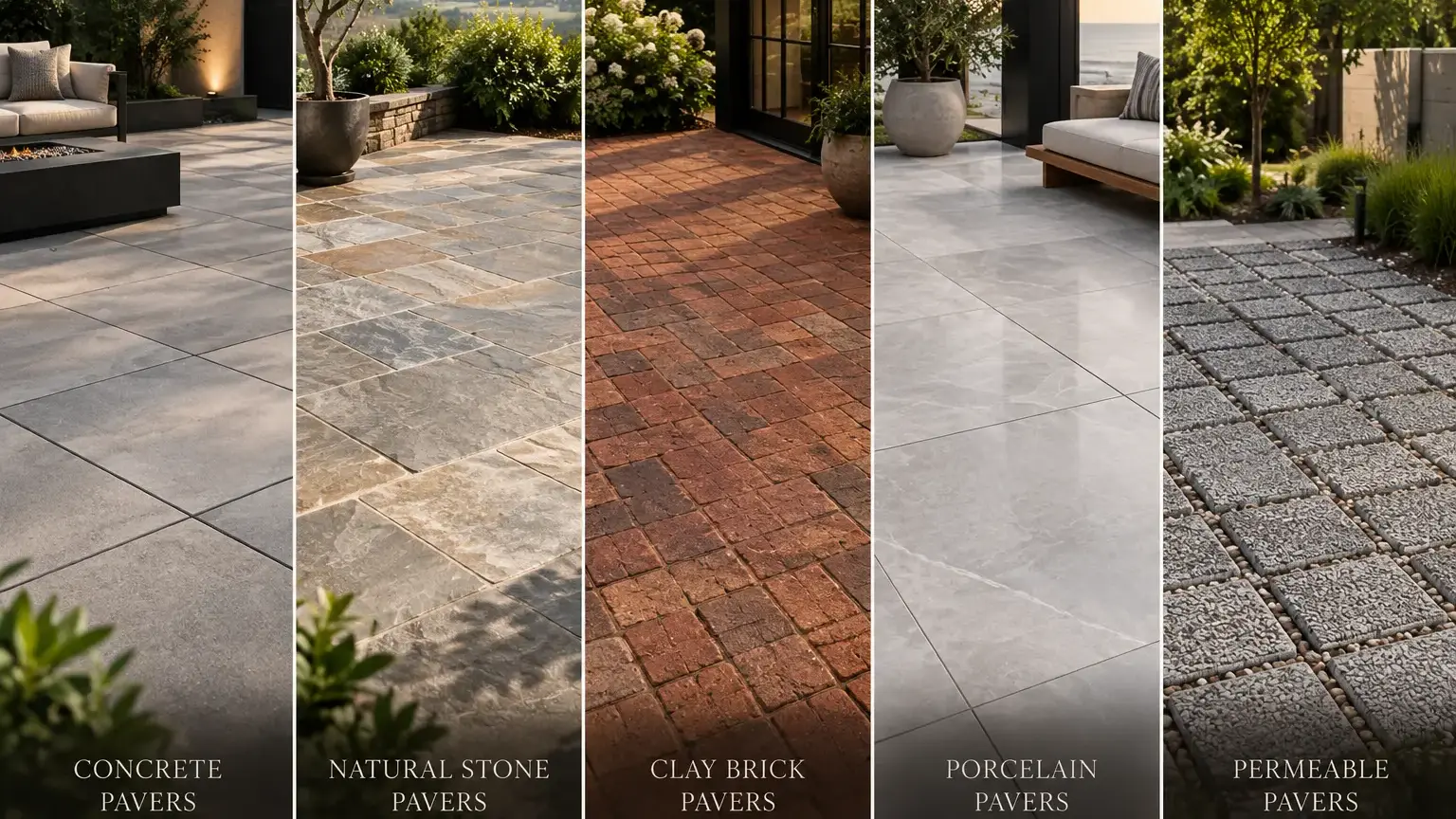
What are the different types of pavers? The main types of pavers are concrete, natural stone, clay brick, porcelain, and permeable pavers:
- Concrete pavers – manufactured, affordable, widest range of colors and shapes
- Natural stone pavers – quarried stone such as flagstone, granite, travertine, bluestone, and limestone, each with its own texture and durability
- Clay brick pavers – kiln-fired, classic appearance, with products available for pedestrian and vehicular applications
- Porcelain pavers – dense, low-porosity, resistant to frost and staining, low maintenance
- Permeable pavers – designed with open joints and a drainage-focused base to let water pass through rather than run off
Pavers themselves are individual units set into a patio, walkway, driveway, or pool deck rather than poured as one continuous surface, which is what separates them from concrete slabs or asphalt. Because each unit is set separately, a cracked or stained paver can be replaced without tearing up the whole surface, and the layout can be adjusted with different shapes, colors, and patterns. Choosing among the five types above comes down to cost, durability, appearance, and how much maintenance the surface will need over time.
Here's a closer look at each category.
Concrete Pavers
Concrete pavers are manufactured units made from a cement mix and coloring agents, cast into a wide range of shapes and sizes. Concrete pavers may be colored throughout or manufactured with a separate, color-rich face layer, depending on the product.
Concrete is generally the most affordable paver material and offers the widest selection of colors, textures, and interlocking shapes, which makes it a common default for patios, walkways, and driveways alike. Industry specifications call for different paver thicknesses depending on use: roughly 2 3/8 inches for pedestrian areas and residential driveways, and about 3 1/8 inches for pavement carrying regular vehicular traffic. The tradeoff is a more uniform, manufactured look compared to the natural variation of quarried stone, though textured and tumbled finishes can narrow that gap.
Natural Stone Pavers
Natural stone pavers are quarried rather than manufactured, so no two pieces look exactly alike. This category covers several distinct materials, each with its own character:
- Flagstone refers to flat pieces of natural stone split into irregular shapes, commonly used for a rustic, informal look on patios and pathways.
- Granite is dense and highly wear-resistant, often chosen for driveways and high-traffic areas.
- Travertine is a popular choice for pool decks, particularly in lighter colors and textured finishes. Surface temperature and wet slip resistance vary, so confirm that the selected product and finish are suitable for the intended poolside application.
- Bluestone and limestone are also popular around pools and patios, valued for their color range and durability, though smoother polished finishes are generally discouraged near water because they can become slippery when wet.
Natural stone tends to cost more than concrete or brick, largely due to quarrying and the labor involved in cutting and fitting irregular pieces. It's also porous, which means most types, travertine included, benefit from periodic sealing to resist staining.
Clay Brick Pavers
Where natural stone appeals through variation, brick offers the opposite: a consistent, uniform look that has stayed popular for centuries. Brick pavers are made from molded clay fired in a kiln, giving them a classic, traditional appearance. They're valued for consistent coloring and a timeless look, and they're a common choice for walkways, patios, and historic-style homes. Clay brick pavers can be used for walkways, patios, and driveways when the selected product and pavement system are designed for the expected traffic loads.
Porcelain Pavers
For homeowners who want minimal upkeep rather than natural variation or a traditional look, porcelain is generally the strongest option. Porcelain pavers are a type of dense ceramic tile, fired at very high temperatures, which vitrifies the material into a glass-like, low-porosity structure. Under the ANSI standard that defines ceramic tile classifications, a tile only qualifies as porcelain if its water absorption tests at 0.5 percent or less, a threshold that explains its strong resistance to frost damage, staining, and moisture infiltration, and why it generally skips the sealing that natural stone requires. It also tends to fade less over time, and it usually costs more upfront than concrete but less in long-term upkeep.
Permeable Pavers
While the materials above are chosen mainly for looks and durability, permeable pavers solve a different problem entirely: what happens to water once it hits the surface. These systems are designed to let water pass through rather than run off, draining into the ground below. They rely on open joints filled with permeable aggregate and a base structure engineered to manage stormwater, which makes them useful in areas with drainage concerns or where reducing runoff is a priority.
The Concrete Masonry & Hardscapes Association notes that these systems store water in the gaps between aggregate and allow it to infiltrate the soil below rather than generating surface runoff, which is why they are often used to meet stormwater regulations for driveways, walkways, and parking areas. Because the joint material has to stay porous, permeable systems typically call for a different jointing approach than standard sand-filled joints, and the joint fill may need more frequent topping off over time to keep it working as intended. Our four showrooms offer an opportunity to see different natural stone options and finishes in person. You can also explore Nova Tile and Stone's offerings to find materials suited to your project.
Matching Paver Type to the Project
The best paver material depends heavily on how the surface will be used:
- Driveways need the most structurally durable option and a deeper compacted base to handle vehicle weight, which is why concrete and granite are common choices.
- Patios have more flexibility for aesthetics, since foot traffic is lighter, making natural stone, brick, and decorative concrete all reasonable options.
- Pool decks call for materials with suitable wet slip resistance and comfortable surface temperatures. Travertine, bluestone, and textured concrete are common options, but suitability depends on the specific product, finish, and sun exposure.
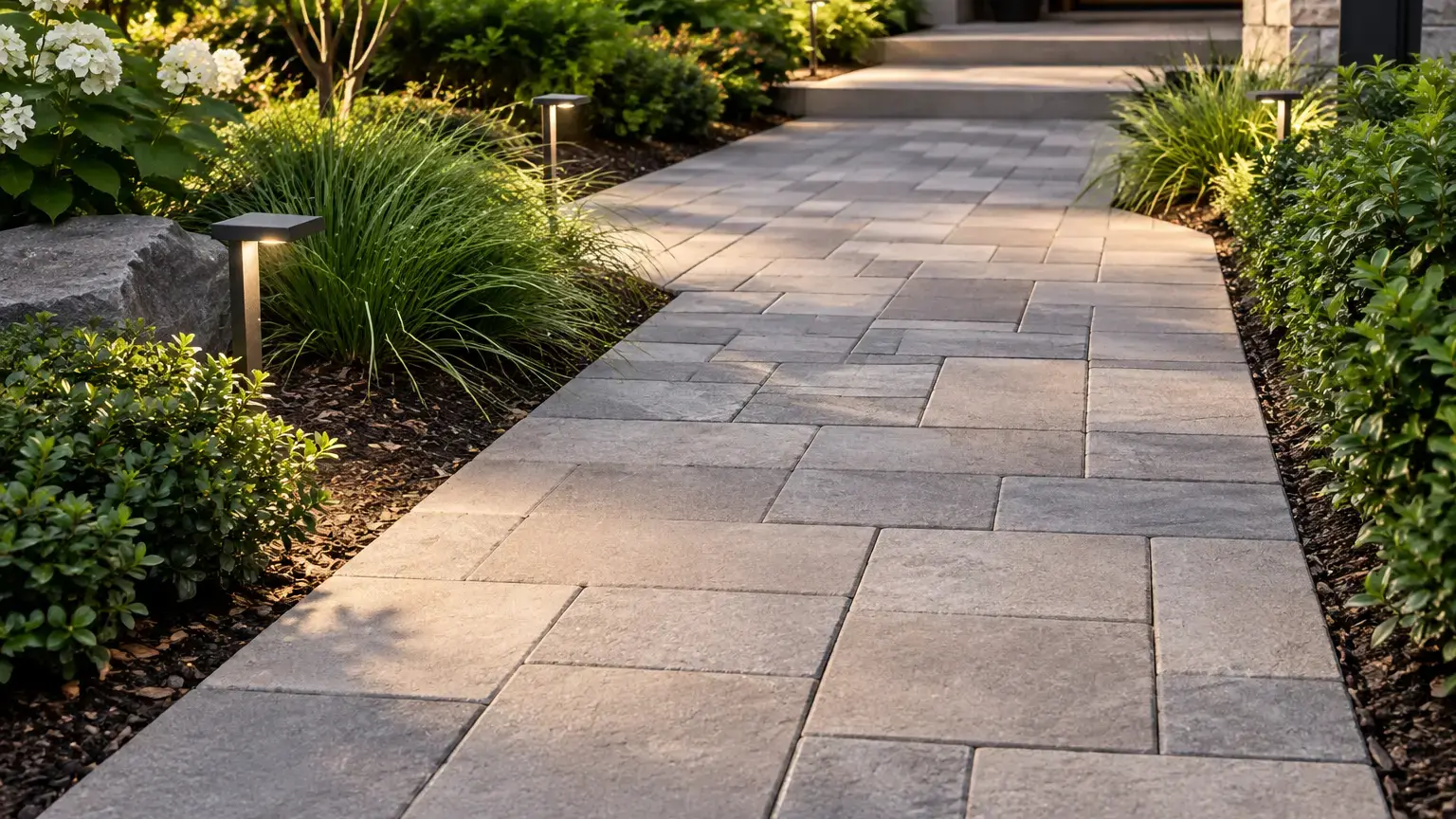
- Walkways can generally use lighter-duty materials and thinner base depths than driveways, since they see foot traffic rather than vehicle loads.
- Areas with drainage concerns, such as low-lying yards or spaces subject to stormwater rules, are where permeable pavers become the deciding factor over any of the materials above.
Material choice also shapes design options. Different pavers lend themselves to different laying patterns, and pairing paver colors, shapes, and layouts is often what distinguishes a basic paved area from a more considered one, whether that means mixing tones within the same material or choosing an interlocking pattern suited to heavier-use areas like a driveway.
Climate is another factor. In regions with freeze-thaw cycles, proper base preparation and drainage matter as much as the paver material itself, since trapped moisture that freezes and expands is a leading cause of cracking and heaving over time.
Installation Basics
Regardless of material, paver longevity depends heavily on what's underneath. Minimum compacted aggregate base depths typically scale with expected use: about 4 to 6 inches for pedestrian walkways, 6 to 8 inches for residential driveways, and 8 to 12 inches or more for streets and parking areas, with thickness adjusted further for soil conditions, drainage, and climate. The aggregate base is compacted in layers, and the excavation area needs to extend beyond the finished paver edge to properly support that base.
For conventional sand-set pavers, a bedding layer of sand, typically about an inch thick, sits between the compacted base and the pavers. Permeable interlocking concrete pavement uses open-graded aggregate bedding and joint material instead, following the system specifications. Edge restraints around the perimeter are considered essential, since they keep pavers from gradually shifting or spreading outward under repeated use. Drainage slope also has to be built into the base so water moves off the surface rather than pooling.
Because base preparation has such a direct effect on how well pavers perform over the following years, a step-by-step overview of the installation process is worth reviewing before starting a DIY project, and larger or load-bearing installations are generally better handled by an experienced installer.
Maintenance and Sealing
Sealing needs follow directly from what's outlined above: natural stone benefits from it, porcelain generally skips it, and concrete falls somewhere in between depending on the finish and how much staining exposure it gets.
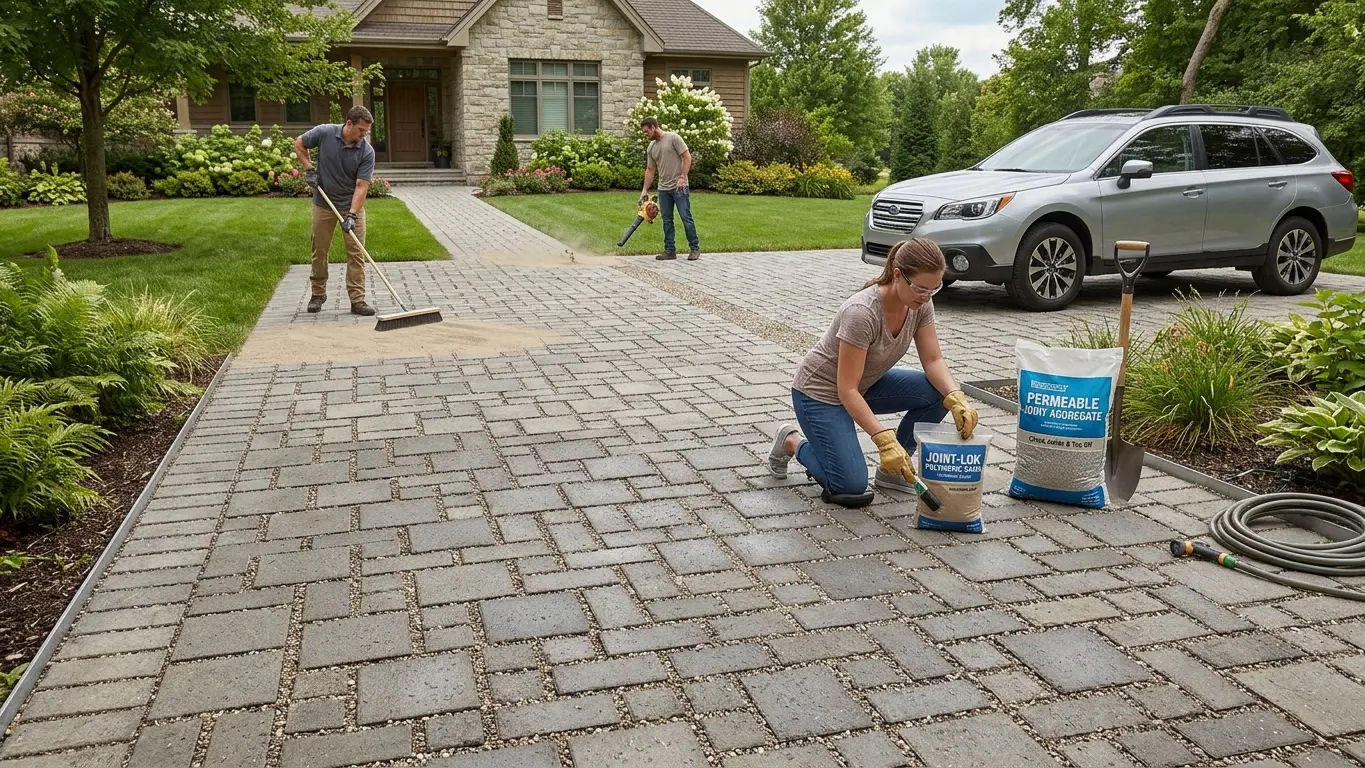
Polymeric sand has become a common choice for filling paver joints because it combines fine sand with a binding agent that hardens once activated with water. It holds pavers in place, resists erosion better than plain jointing sand, and helps deter weed growth in the joints. It isn't recommended for heavily textured paving surfaces, though, since the polymer can stick to deep grooves and leave a hazy residue.
Routine maintenance includes cleaning the surface and checking joints for material loss or weed growth. Replenish joints with the material specified for the system. Permeable paving also requires sediment removal to maintain infiltration, which may include vacuum cleaning.
Conclusion
Choosing among the different types of pavers ultimately comes down to three questions. How much traffic and weight does the surface need to carry? What climate does it have to withstand? And how much long-term upkeep is acceptable? Concrete and porcelain tend to win out on the maintenance question, natural stone wins on individuality, and permeable systems answer a question the others don't, which is what to do with the water.
There is no single best material across every situation. A driveway and a pool deck have close to opposite requirements, so starting from how the space will actually be used, rather than from appearance alone, leads to a surface that holds up over time.
For questions about selecting the right stone or tile material for an outdoor or indoor project, Nova Tile and Stone offers free design consultations at its four showroom locations in Reno, Sacramento, Minden, and Fernley.
To close out the material comparisons above, here are answers to a few common questions about paver types.
Frequently Asked Questions
Granite is typically the toughest natural stone option, and well-installed concrete pavers hold up nearly as well thanks to their interlocking design and the thicker units made for vehicular loads.
Generally, yes, since quarrying and fitting irregular pieces by hand adds labor cost that manufactured concrete doesn't carry.
No. Sealing mainly applies to natural stone, since porcelain's low water absorption means it typically skips that step entirely.
Flagstone is one specific natural stone paver style, cut in flat, irregular pieces, while "pavers" is the umbrella term that also includes concrete, brick, and porcelain.
For a pool deck, choose pavers with suitable wet slip resistance and consider how hot the surface becomes in direct sun. Travertine, bluestone, and textured concrete may be options, but suitability depends on the specific product, finish, and site conditions.
Note: Some images on this page may be conceptual renderings created to illustrate design possibilities and may not depict actual installations.