The right hardscape pattern depends on what the surface has to withstand: driveways need an interlocking layout like herringbone to handle vehicle weight, patios benefit from mixed paver sizes instead of one repeated size, and pool decks depend more on UV-resistant material than on the pattern itself.
A driveway laid in a simple running bond is prone to shifting and rocking at the tire tracks under repeated vehicle weight. The same pavers arranged in herringbone resist that movement far better, which is exactly why interlocking layouts exist for anything that carries a vehicle.
Pattern choice is a functional decision, not a finishing touch. A driveway, a patio, and a pool deck each put different demands on a layout, and picking the one that photographs well instead of the one built for the job is a mistake that shows up years later, not on installation day.
The Driveway Test: Why Interlocking Wins
Vehicle weight is the reason a driveway pattern cannot be chosen on looks alone. Herringbone locks each paver against its neighbors in two directions, which spreads that weight across the surface instead of concentrating it on a few pieces that can eventually work loose.
The Concrete Masonry and Hardscapes Association classifies interlocking pavement as durable enough to carry everything from patios and driveways to roads, ports, and airports. That same source defines a concrete paving slab as a unit over 100 square inches, generally up to 48 inches per side, needing roughly 1.18 inches of thickness to support that larger footprint. A smaller interlocking paver does not need that added thickness, since it gets its strength from the pattern itself, which is exactly why herringbone earns its complexity on a driveway.
Granite is rated for outdoor floor use across the board, which is the profile a driveway needs. It is durable, but proper care will still help preserve its appearance over the years the driveway sees traffic. Travertine can technically go outdoors too, but it is not marked UV resistant, so a full-sun driveway is more likely to show fading in travertine than in granite or porcelain over the same stretch of years.
Porcelain shares granite's outdoor, floor, and UV resistant ratings, and it holds its exact color and finish from the first paver to the last since it is manufactured rather than quarried. That consistency matters more on a driveway than it does on a patio, uneven tone across two feet of daily tire traffic stands out more than the same variation spread across a seating area.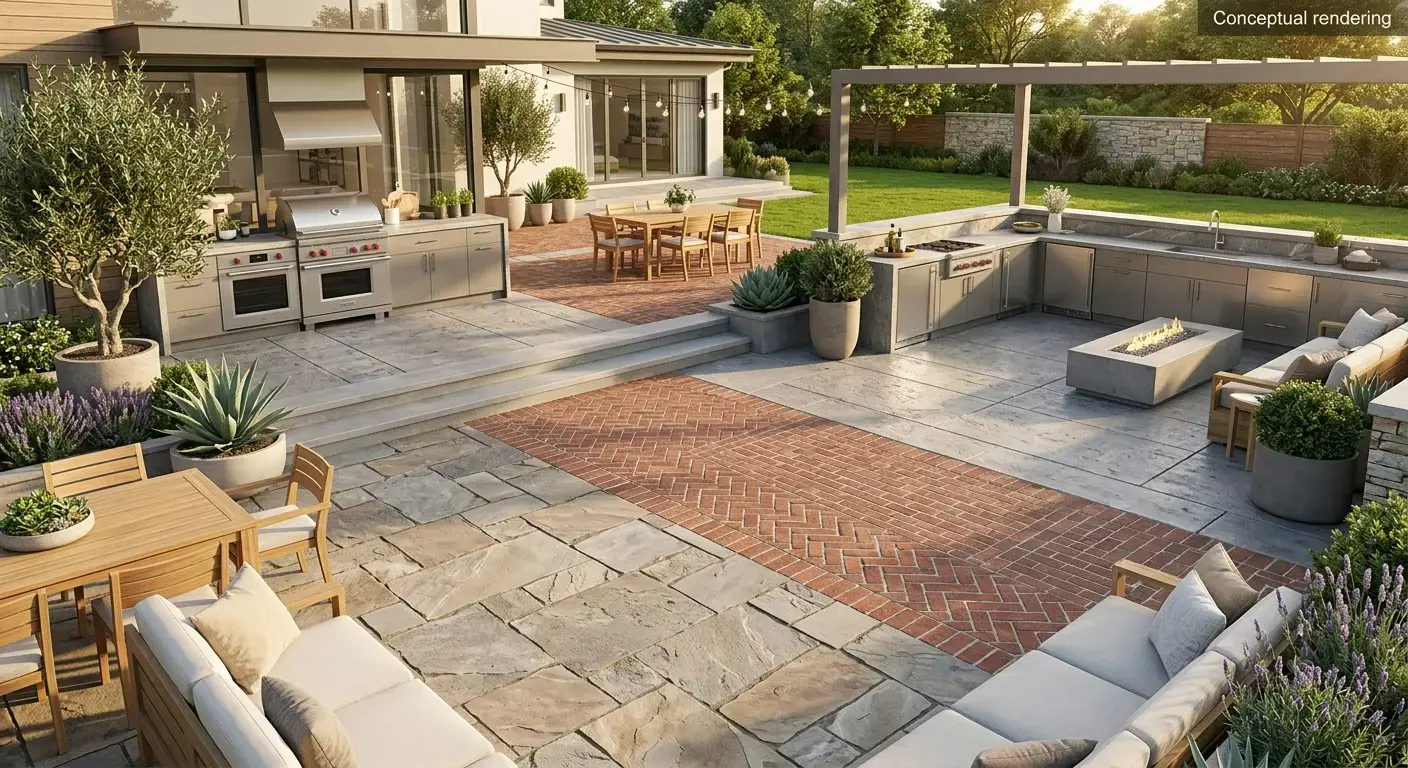
Patios Ask For Range, Not a Repeated Grid
A patio has more open floor area than a driveway, and a single paver size repeated edge to edge across that whole surface reads as a parking lot rather than a living space. The pavers and exterior stone lineup carried by Nova Tile and Stone pairs small, medium, and large format pavers for this exact reason, mixing scale in one layout instead of repeating one module.
Quinten O'Dea, a landscaping contractor featured in a National Association of Landscape Professionals piece, said larger paver formats have become the trend specifically on bigger patios. The same interview noted the opposite problem at the smaller end, oversized units do not fit a narrow space the way they fit a larger one.
Natural stone's built-in variation actually favors a mixed layout over a strict grid, since no two pieces match exactly anyway and a repeating pattern only draws attention to that inconsistency. Porcelain pavers, cut to uniform dimensions, hold up better in a strict grid or herringbone precisely because every piece starts out identical.
Granite, quartzite, and travertine are all available in a leathered or honed finish, which softens the surface underfoot compared with a polished tile, an easy detail to miss when choosing a patio material from a photo instead of standing on it.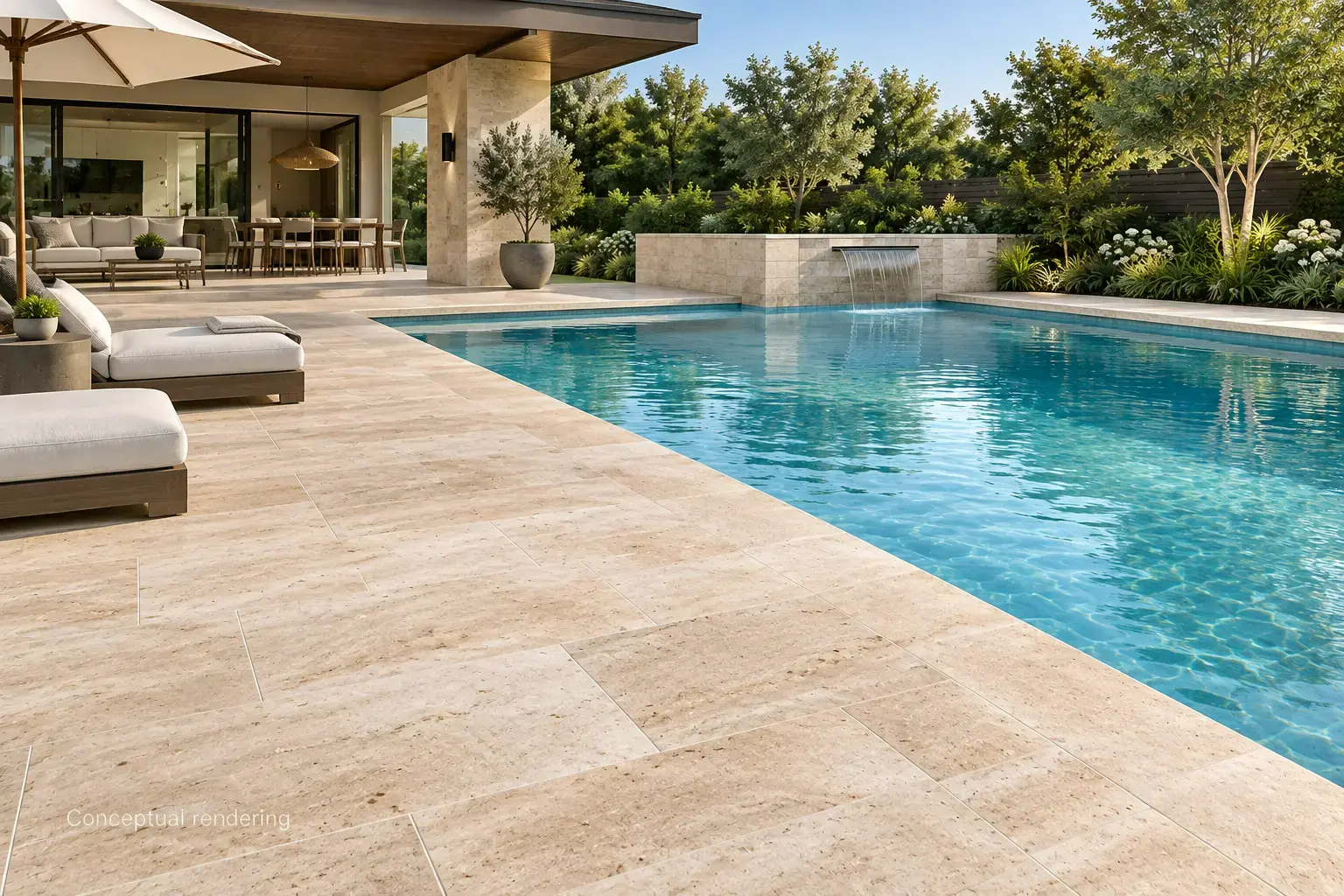
Pool Decks Come Down To Material As Much As Pattern
Pool decks fail for a different reason than driveways or patios, constant moisture and direct sun, not weight. That shifts the decision toward material first and pattern second, since the wrong material shows wear regardless of how the pieces are laid.
Quartzite is UV resistant, which is the property that matters most for a surface sitting in full sun for years. It is UV resistant, but performance may vary by color and finish, so viewing it under real daylight tells you more than a photo will.
Travertine is also rated for outdoor floor use, but it is not marked UV resistant, so a travertine pool deck in a yard that gets sun most of the day is more likely to shift in tone over time than a quartzite one in the same spot. That does not rule travertine out, it just means the classic look carries a maintenance trade-off quartzite does not. Granite shares quartzite's UV resistant rating and works structurally, but its heavier, more uniform look fits fewer pool aesthetics than either stone-look option.
Coping and the surrounding deck do not have to match exactly, but staying within one material family, quartzite coping with a quartzite deck, or the same pairing in granite, avoids two materials with different wear patterns meeting at the pool's edge.
Bundle availability shifts as stone moves through the showroom floor, so checking the current slab inventory before settling on quartzite or travertine saves a redesign later. Once a bundle looks right for the job, requesting a slab quote is the next step, with nothing committed on the spot.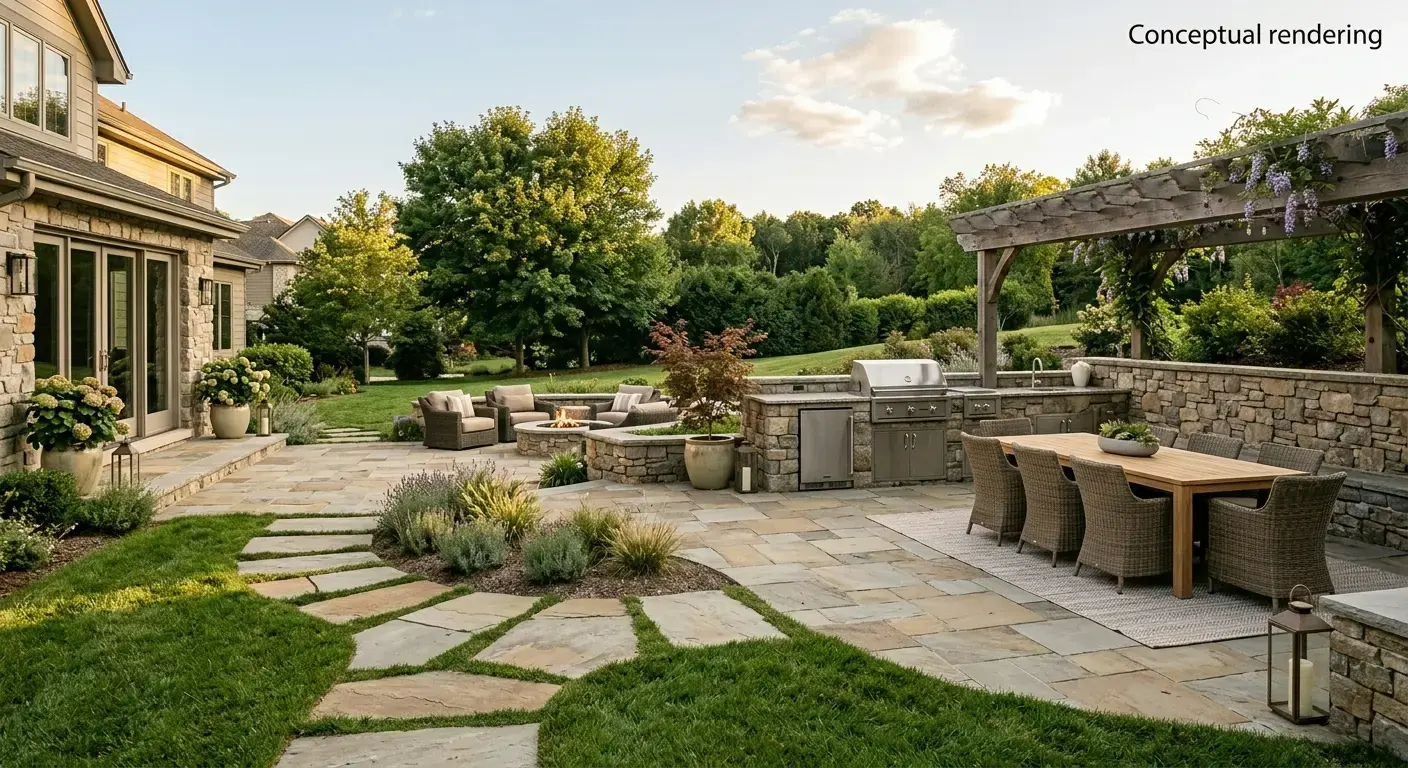
Walkways Don't Need The Complicated Layout
A walkway is the one hardscape application where restraint wins. O'Dea's point about oversized units not fitting a smaller footprint applies directly here, a running bond or simple stack pattern in a mid-size paver reads as intentional, where a dramatic French pattern or herringbone on a three-foot-wide path just looks busy.
O'Dea also flagged tumbled-edge pavers directly, noting that look was popular for years but tends to age poorly compared with a sharp, clean edge. That preference holds just as true on a walkway as it does on the larger patios he was originally describing.
A front entry walkway carries more visual weight than a side or garden path, since it is the first surface a visitor's eye lands on, so a slightly more detailed layout earns its place on a front entry in a way it would not on a path leading to a side gate.
Porcelain pavers in a range of finishes are browsable in our online tile and paver selection, which is a reasonable starting point for narrowing down color before deciding on layout. Porcelain holds a crisp edge and consistent tone across a run, which matters more on a narrow path where every joint line sits close to eye level.
Comparing Options Before You Commit
Continuity across the whole property matters more than perfecting any single surface in isolation. A pool deck laid in quartzite pairs cleanly with a granite driveway nearby, since both share the same UV resistant profile and read as one considered palette instead of three separate decisions.
The same logic extends to a stacked stone accent near a pool cabana or an outdoor kitchen wall built from the same material as the coping. A property with three or four surfaces pulling from one family of materials reads as designed, one where each area was chosen in isolation usually does not.
A single paver or a small floor display rarely shows how a pattern reads at full scale, herringbone especially changes character once it covers real square footage instead of a small board. Walking a showroom floor that displays larger sections solves that problem in a way no online photo can.
Walking the floor in Reno, Sacramento, Minden, or Fernley is the fastest way to compare a herringbone layout against a French pattern side by side, something no website replicates. Find the nearest location to plan a visit.
Conclusion
A pattern chosen from a single showroom display board rarely accounts for slope, drainage, or how much of the yard actually gets full sun each day. Those site-specific details change which material and which layout actually make sense, and a short walk of the actual space catches details a floor plan sketch misses.
A free design consultation with Nova Tile and Stone is the direct way to walk through which combination fits an actual space rather than a generic one. Bring the measurements and photos of the space in question, the answer for a wide suburban driveway will not be the same as a narrow city lot, and no article can account for that difference on its own.
Frequently Asked Questions
Yes. An interlocking layout like herringbone spreads vehicle weight across the surface instead of concentrating it on a few pavers, which is part of why interlocking pavement is used for everything from driveways to airport surfaces, not just decorative walkways.
A single repeated size across a large open area tends to read as a parking lot rather than a living space. Mixing small, medium, and large formats in one layout breaks up that grid effect, which is part of why larger paver formats have become popular specifically on bigger patios.
For a pool deck, yes. Constant sun and moisture wear down the wrong material regardless of the pattern, so a UV resistant option like quartzite is worth deciding on before finalizing how the pieces are laid out.
No. A walkway has less open space to work with, and an oversized or elaborate pattern like French pattern or herringbone can look out of proportion on a narrow path, where a straightforward layout in a mid-size paver reads as intentional instead.
Seeing pattern layouts in person, ideally under natural daylight in a showroom, shows differences in scale and color that photos do not capture, and a free design consultation can walk through which layout fits the specific driveway, patio, or pool deck in question.
Note: Some images on this page may be conceptual renderings created to illustrate design possibilities and may not depict actual installations.