To make a small yard work, use one main hardscape material across the patio, paths, and low walls, choose a light, warm neutral tone, and give built-in features like a seat wall more than one job. Fewer materials mean fewer visual breaks, so the space reads as one open area. Granite, quartzite, travertine, and porcelain all suit outdoor use.
A University of Florida IFAS Extension guide to the basic principles of landscape design explains why. A visible line forms wherever two different materials meet on the ground, such as a brick patio against a lawn, and the guide notes that using one material repeatedly throughout the yard builds unity. Every extra material in a small yard adds more of those lines.
Our recommendation for small backyards, walled courtyards, and narrow side yards is to choose a single lead stone or porcelain from our tile and stone selection and let it cover most of the ground, with plants and furniture supplying the contrast.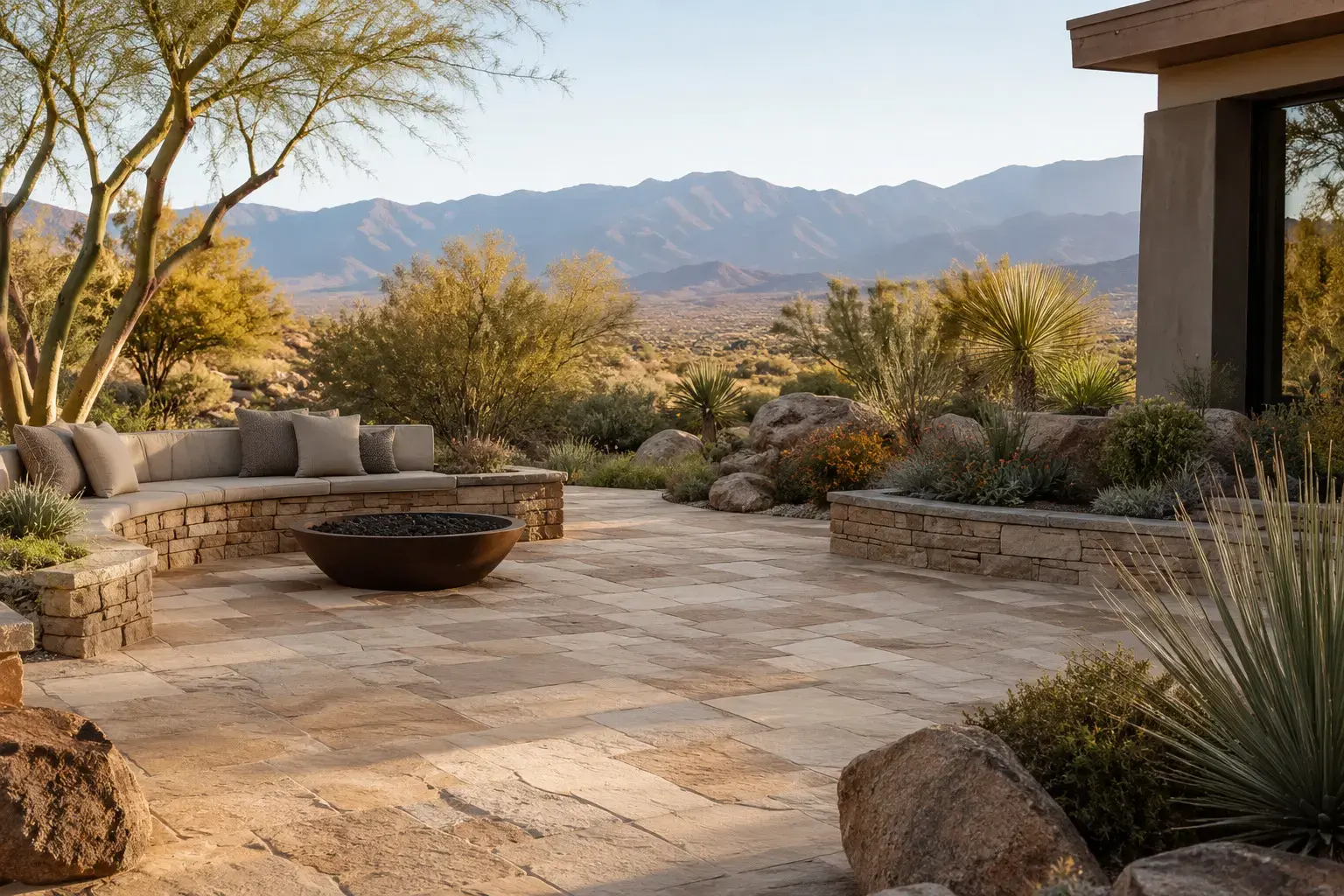
Why One Stone Beats a Mix in a Tight Space
In a small yard, everything is seen at once. A large backyard can absorb a flagstone path, a brick edge, and a concrete patio because each sits in its own zone, but a 20-by-30-foot yard puts all three in the same glance.
Design guidance backs this up. An Oklahoma State University Extension fact sheet on landscape design says simplicity comes from limiting the variety of colors, textures, and construction materials in a space, and that overcomplicating a design breaks its rhythm and focus.
The same fact sheet warns that simplicity can go too far and turn monotonous. That is why we say one lead material, not one material only: let the stone cover the patio and paths, then let plants, furniture, and one accent carry the contrast.
Repetition is what makes the single-stone approach work. The Oklahoma State fact sheet describes rhythm as the predictable repetition of materials and other elements, and says it helps a landscape achieve unity.
In practice, that means the same stone underfoot from the back door to the far corner. When the patio, the path to the side gate, and the step down to the lawn all match, the yard stops reading as three small areas and starts reading as one.
Color and Finish Choices That Open Up a Small Yard
Once the material is settled, color has a strong effect on how big the yard feels. A Washington State University Extension article on small-space gardens recommends lighter, warm-colored pavers to make a garden appear larger and more inviting. That means warm neutrals such as cream, beige, or soft sand, not strong reds or terracotta, since the same article notes that bright, warm colors advance and make an area look smaller.
Our take: start with the lightest tone you like in your chosen stone, then check it against the house. The same WSU article says the smaller and more enclosed the garden, the more it should reflect the home’s color, geometry, and texture, so a beige travertine beside a cream stucco wall can read as one piece.
Finish adds a second layer. The UF/IFAS guide notes that fine texture makes distances seem greater and a space feel more open, while rough texture makes things feel closer, and that texture applies to hardscape such as patios, walls, and walkways.
With one material, you can use that idea through finish alone. A leathered surface near the back door and a smoother honed surface toward the far end keeps the stone consistent while giving the eye a sense of distance. The same guide notes that a material repeated through the yard can still hold interest when its size, texture, or color varies slightly.
For anything people walk on, we’d stick with honed or leathered and keep polished finishes for vertical faces. Color and finish both shift between a sample photo and real daylight, so visit the showroom closest to you and look at your top two tones side by side before deciding.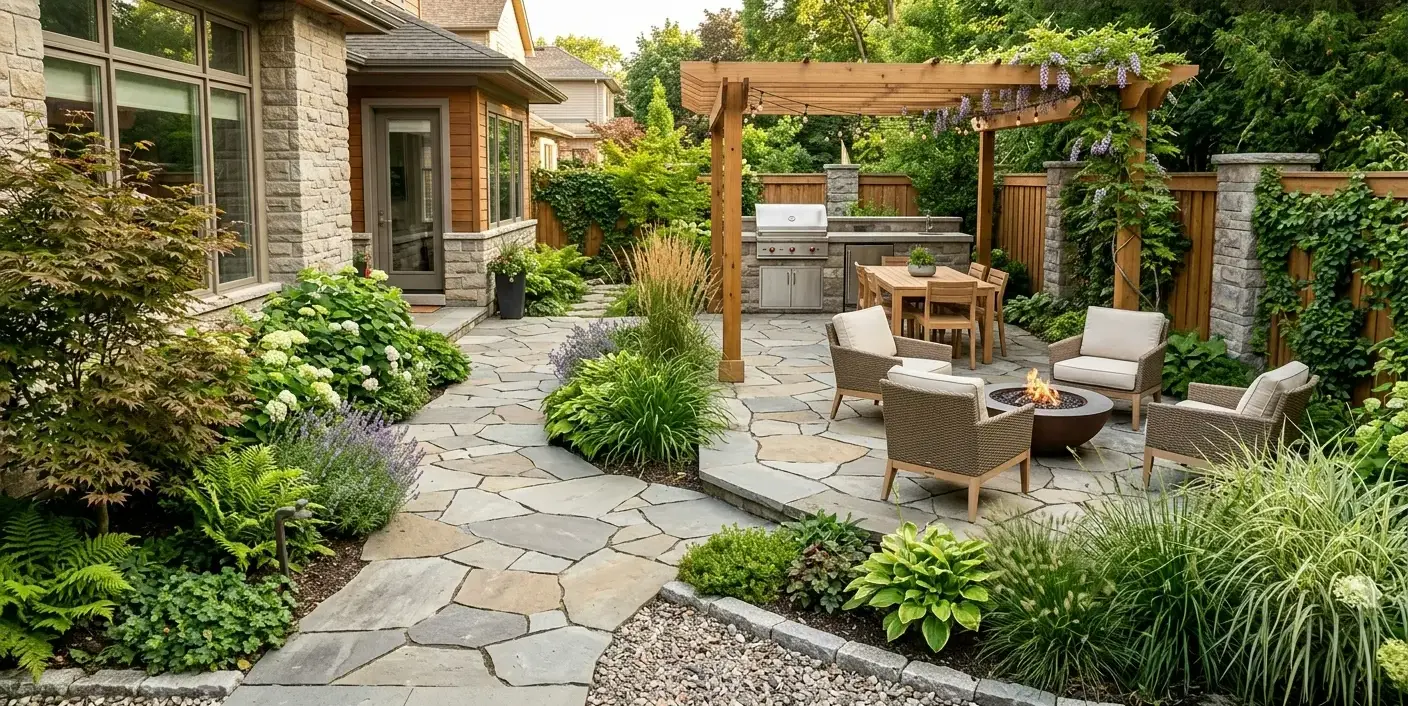
Give Every Stone Surface Two Jobs
A small yard has no room for features that do only one thing. The WSU article puts it plainly: every element in a small space should serve at least double duty, such as a retaining wall that also works as a seating bench and a divider between garden rooms.
That is where stone earns its place. A low seat wall faced in stacked stone, in a tone that matches your pavers, can hold back a planting bed, give guests a place to sit, and mark the edge of the patio all at once, with no extra chairs crowding the floor.
The top of that wall is the piece people touch, so it deserves a solid surface. Granite and quartzite are both good fits for outdoor use, and our live slab inventory photographs every bundle on our floor, so you can pick a slab that complements the pavers for your fabricator to cut into a cap or bench top, and request a quote on a specific bundle.
Level changes are another way to stretch space. The WSU article notes that a change in elevation of even two steps can make a small garden feel more spacious, and that wider steps add to the effect. Steps in the same stone as the patio keep that change from breaking the single-material look.
One caution: double duty works only if the yard still has open floor. Pick the one or two built-in features you will actually use, and leave the rest of the stone as open space.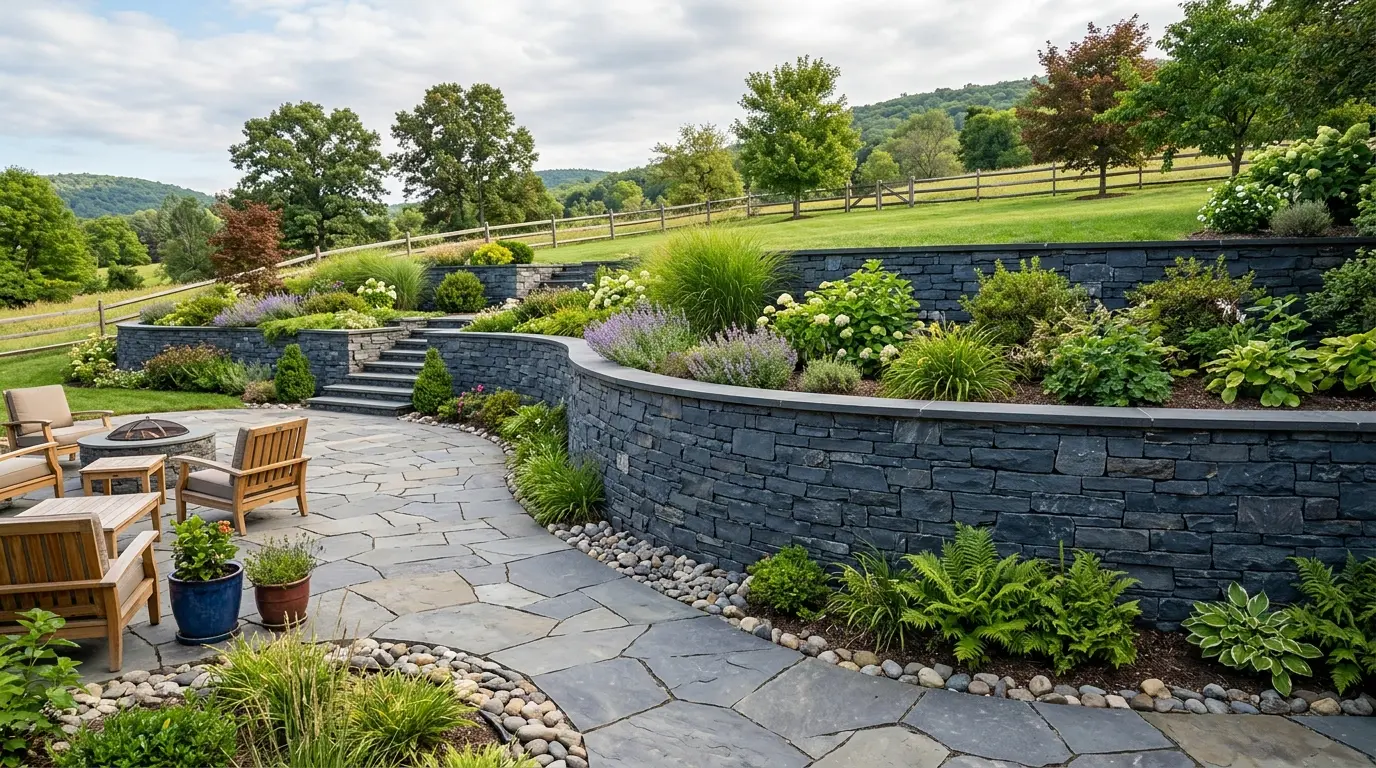
Match the Stone to the Kind of Small Space
Granite, quartzite, travertine, and porcelain are the four materials in our lineup rated for outdoor use, and all four are rated for indoor floors too. Which one leads depends less on the stone itself and more on the kind of small space you have.
For a walled courtyard that opens off the living room, let the indoor floor set the choice. Garden designer Debora Carl, in Garden Design’s tips for small outdoor spaces, suggests repeating interior colors and materials outside, because blurring the line between indoors and out can make both the house and garden seem larger.
Porcelain makes that simple. It comes in travertine look, limestone look, concrete look, and wood look, so the courtyard can closely match the room it opens from, and it is UV resistant, though performance may vary by color and finish.
For a compact backyard built around a seat wall, granite or quartzite gives you one stone for the pavers and the wall cap. Both are good fits for exterior stone applications, and granite’s UV resistance helps a light tone hold its color in full sun, though results vary by color and finish.
For a cottage-style garden or any yard where you want the lighter, warm tones the WSU article recommends, travertine is a natural place to start. Its honed, leathered, and specialty finishes suit the coarse-to-fine finish idea above. In Reno, Minden, and Fernley, where winters bring freeze-thaw cycles, ask at our showroom which travertine suits those conditions and how to care for it over time.
One rule holds for every small space: marble, dolomite, and quartz stay inside the house, since none of them are suited to outdoor use.
Conclusion
A small yard is often seen from inside the house as much as from the yard itself. The UF/IFAS guide treats the yard as an extension of the house and suggests placing the most-used features close to the back door, right where the view from inside lands.
Before choosing a stone, stand at the back door, the kitchen window, and wherever you sit most, and take a photo from each spot. Those photos show exactly how much paving the eye takes in at once, which is the real test of whether one material is working.
Bring them to a free design consultation at Nova Tile and Stone along with rough measurements of the yard. With the actual views in front of us, we can narrow the choice to one lead material, a finish plan, and the stone for any seat wall or steps.
If porcelain is on your list, bring home tile samples and set them on the patio at different times of day. A light tone that looks right at noon can read very differently in evening shade, and a small yard shows that difference everywhere at once.
Note: Some images on this page may be conceptual renderings created to illustrate design possibilities and may not depict actual installations.
Frequently Asked Questions
We recommend one lead material, with two or three as the ceiling, so the patio, paths, and steps read as a single space.
Lighter, warm neutral pavers, such as cream, beige, or soft sand, rather than strong reds or terracotta. A Washington State University Extension article recommends lighter, warm-colored pavers to make a small garden appear larger and more inviting. Check the tone against your house too, since a small yard should echo the home’s colors.
Yes. Granite, quartzite, travertine, and porcelain are all rated for both indoor floors and outdoor use, so one material can run from the living room to the patio, with a honed or, for natural stone, leathered finish on the patio side even if the indoor floor is polished. Repeating interior materials outside can make both spaces feel larger.
Build the seating into the hardscape. A low seat wall faced in stacked stone that matches your pavers can hold back a planting bed and give guests a place to sit, and a granite or quartzite cap gives it a solid top.
Honed and leathered finishes both work well for walking surfaces. Using leathered near the house and honed farther out can add a sense of depth while keeping one material throughout.