Choose large format pavers for open, straight-edged spaces like rectangular patios, rectangular pool decks, and straight walkways, and choose small format pavers for curved paths, fire pit areas, narrow side yards, and the coping around curved or freeform pools. The deciding factor is the shape and use of each space, not the paver style that happens to be popular this year.
Large format pavers are bigger pieces that cover more ground with fewer seams, while small format pavers are smaller pieces that follow curves and tight edges with less cutting. The Concrete Masonry & Hardscapes Association's overview of segmental pavement lists larger paving slabs as a separate category from standard pavers.
Travertine and quartzite are both a good fit for either size. Before you browse our full selection of tile, stone, and outdoor materials, measure each outdoor area and sketch its outline, marking every curve, step, and edge.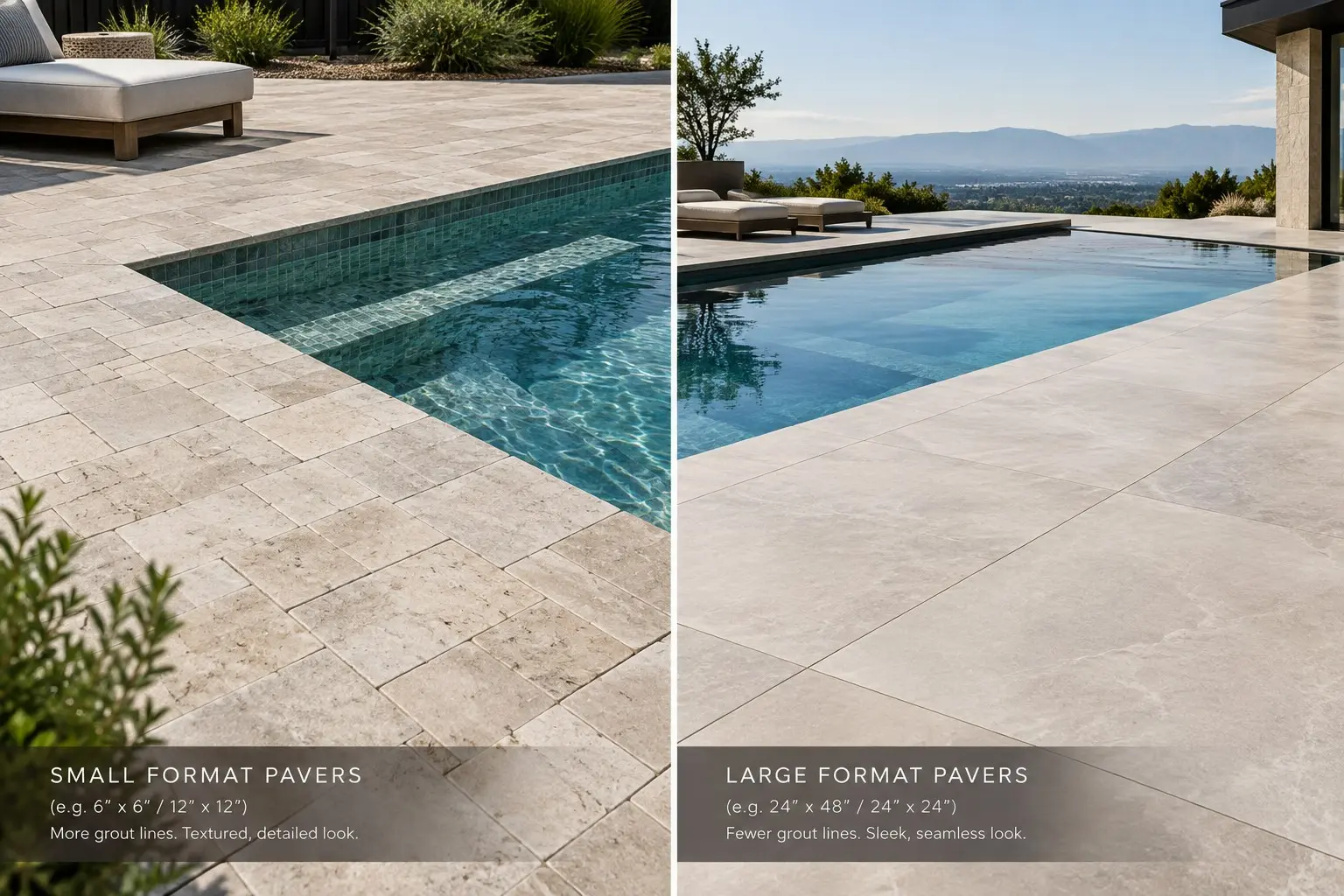
What Is the Difference Between Large and Small Format Pavers?
The two sizes solve different problems, and the difference shows up most in how each one handles edges. This side-by-side view covers the points that usually decide the choice.
Large format pavers | Small format pavers | |
Best spaces | Rectangular patios, rectangular pool decks, straight walkways, covered patios | Curved paths, fire pit areas, narrow side yards, curved or freeform pool coping |
Overall look | Open, calm, modern | Textured, traditional, relaxed |
Seams across the surface | Fewer | More |
Fit on curves and tight spaces | Needs more cutting | Follows the line with less cutting |
How much stone character shows | More veining and color movement in each piece | More variety from piece to piece |
A simple way to read the table: straight lines favor large pieces, and curved or narrow lines favor small ones. The rest of this guide walks through how to apply that rule to each part of your yard.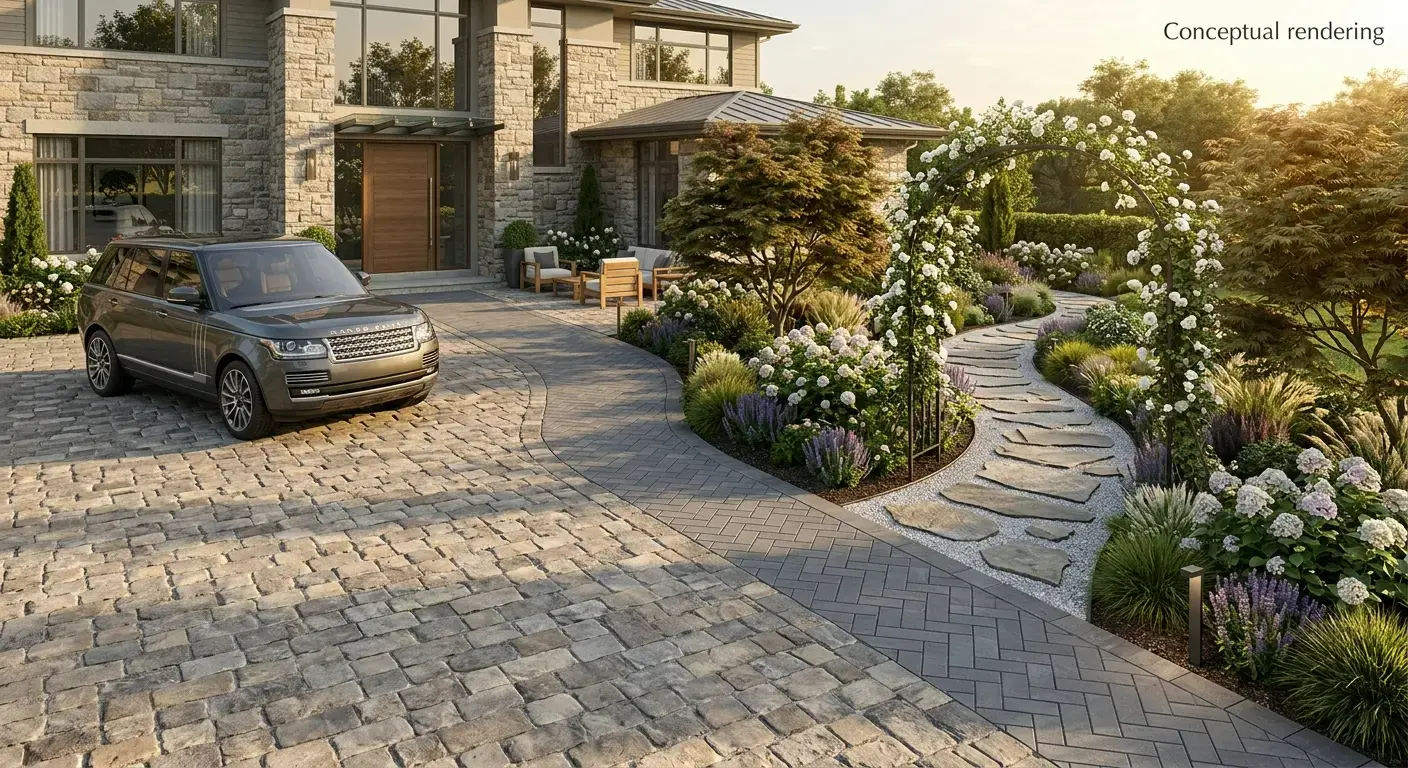
Which Paver Size Fits My Space?
Straight edges point to large format. A rectangular patio, a squared-off pool deck, or a courtyard with four clean corners lets big pieces run edge to edge with fewer cuts.
Curves point to small format. A round fire pit area, a winding garden path, or a planting bed with a soft edge needs pieces small enough to follow the line without being trimmed into odd shapes.
Narrow spaces follow the same logic. On a side-yard walkway about three feet wide, large pieces often have to be cut down to fit the width, so small format is the better match for that space.
The front walk is a good test. A straight walk from the driveway to the door suits large pieces, while a walk that bends around a tree or flower bed calls for small ones.
How the space gets used matters, too. A dining patio looks calmer with fewer seams, and a slow garden path gains character from the extra texture of small pieces.
If your sketch mixes straight and curved edges, bring it to a free design consultation, where our design team can help you narrow down options zone by zone.
When Should You Choose Large Format Pavers?
Go with large format for a dining patio, a rectangular pool deck, a covered patio off the living room, and any space where furniture sits for long stretches. Fewer seams cross the surface, so the area reads as one open floor instead of a busy grid.
Rectangular pools belong in this group. The coping on a rectangular pool runs in straight lines, so it follows the same straight-edge rule as the deck and pairs naturally with large-format pieces around it.
Natural stone shows more of its character at this size. A large piece displays more veining and color movement at once, and every bundle in our live slab inventory is photographed, so you can look at that variation before you visit.
Large format also suits a small square patio. A handful of large pieces keeps a compact space from filling up with lines, and the same goes for stepping stones set through gravel or lawn, where a few big pieces lead across the yard without paving the whole area.
Plan for one trade-off. The CMHA's comparison of pavers and poured concrete notes that individual pavers can be removed and replaced, but each piece of natural stone has its own variation in tone and veining, so a replacement may not match exactly, and on a large piece that difference covers more area.
For that reason, ask about a few extra pieces from the same selection when you choose large format. Spares from the same batch are simpler than looking for a close match later.
Finish carries more weight across a big surface. Honed and leathered finishes have a matte, less reflective look than polished, which makes either one our recommendation for open, sunny patios.
When Do Small Format Pavers Work Better?
Small format is the pick for fire pit circles, winding paths, the gaps between planting beds, and pools with curved or freeform edges. Anywhere the edge curves or the space narrows, small pieces keep the layout true to the shape you sketched.
A fire pit circle shows the difference best. Small pieces follow the round edge of the pit more easily, while large pieces would need more cutting to fit the curve.
Curved and freeform pools work the same way. Coping on a kidney-shaped or free-flowing pool has to bend with the edge, and small pieces follow that bend with less trimming than large ones.
Coping is part of our Pavers and Exterior Stone offerings, so plan the coping and the deck together rather than as two separate decisions. Settling the pool's shape first tells you which size each part needs.
Home style plays a part, too. A cottage garden, a rustic ranch yard, or a Spanish-style courtyard pairs well with small format, while large format fits a more modern home.
Curves are hard to judge on paper. Talk through a curved layout with our design team at our Reno or Minden showroom before you commit to it.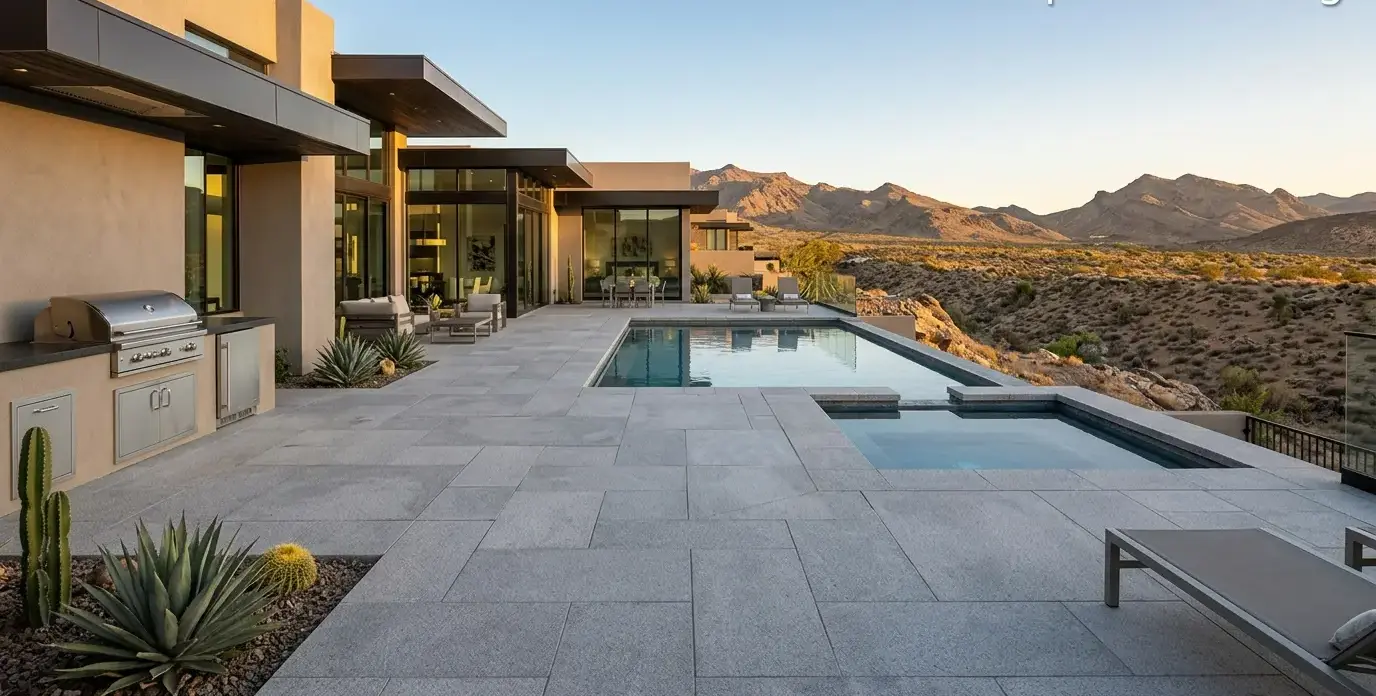
Should I Use Travertine or Quartzite Pavers?
Both stones are a good fit for pavers and exterior stone applications, so pick the stone for the conditions first and the size second. Sun exposure is the first thing to check.
For the sunniest patio in the yard, quartzite is our first pick. Quartzite is UV resistant, but performance may vary by color and finish, so compare the exact colors you are considering in person before you choose.
For a patio under a pergola or a large shade tree, travertine is a good fit in either size. Its warm, earthy look and natural pitting also suit small format along a garden path.
Our travertine paving comes in polished, honed, and leathered finishes. For uncovered outdoor areas, honed or leathered is the better choice, since both have a matte surface, while polished is better kept for covered spaces.
Care is simple for both. The Natural Stone Institute's care tips note that cleaners containing lemon or vinegar can dull calcium-based stones such as travertine, and the same guidance advises against acidic cleaners for quartzite, so one gentle, non-acidic cleaner covers both stones.
Once you have a few favorites in either stone, request a quote on the specific slabs and note any bundle numbers you liked.
Can You Mix Large and Small Pavers in One Yard?
Yes, and a yard with more than one outdoor area often benefits from both. A large-format dining patio off the kitchen paired with a small-format path to the side gate lets each zone use the size that suits its shape.
Keep the stone the same when you mix sizes. Travertine in two sizes, or quartzite in two sizes, keeps the yard looking connected, while changing both stone and size at once pulls the zones apart visually.
A freeform pool beside a rectangular dining patio is a good example. Small-format coping follows the curved pool edge, large format covers the straight-edged patio, and one stone ties the two together.
Switch sizes at a natural break, such as a step, a gate, or the edge of the patio. A change in the middle of an open surface tends to look unplanned.
A mixed layout is easier to plan with a clear sketch of the whole yard, so work out where each size begins and ends with our design team at the showroom nearest you.
Conclusion
Start with the outdoor area you use most, whether that is the dining patio, the pool deck, or the path to the front door. Once that main space has its size and stone, the remaining zones can follow its lead.
Before your visit, write down each zone's rough dimensions, what each zone is used for, and where the edges curve or step. Bring those notes and a few phone photos of the yard to our Sacramento or Fernley showroom, and the team at Nova Tile and Stone can help you narrow down materials and paver sizes for each zone.
Note: Some images on this page may be conceptual renderings created to illustrate design possibilities and may not depict actual installations.
Frequently Asked Questions
Neither size is better everywhere. Large format suits straight-edged areas like dining patios and rectangular pool decks, while small format suits curved paths, fire pit circles, and curved or freeform pools.
It depends on the pool's shape. Coping on a rectangular pool runs in straight lines and pairs well with large-format pavers, while coping on a curved or freeform pool follows the bend more easily in small format.
Yes, especially on a square patio with straight edges. A handful of large pieces keeps a compact space from filling up with lines, while small pieces are the better fit when the patio has curves or planting beds.
For uncovered outdoor areas, honed or leathered finishes are the better choice because both have a matte, less reflective surface. Polished finishes are better kept for covered spaces.
Bring the rough dimensions of each outdoor area, a note on how each space is used, a sketch showing curves, steps, and edges, and a few photos of the yard. Those details make it easier to match each zone to large or small format pavers.