Quartzite Slabs: A Driveway Surface Rated for the Outdoors
Quartzite slabs bring exceptional hardness and confirmed outdoor suitability to driveway surfaces, giving homeowners a natural stone option built for sun, traffic, and seasonal weather. Quarried from dense metamorphic rock, quartzite sits among the hardest natural stones available for exterior use, and it falls within an outdoor-approved material category alongside granite, travertine, and porcelain.
This guide covers why quartzite slabs for durable exterior driveways hold up outdoors, how finish selection affects traction underfoot and under tire, and what to weigh before choosing stone driveways for a home's entrance, motor court, or connecting walkway.
For homeowners across Fernley, Reno, Minden, and Sacramento, quartzite offers a natural alternative to poured concrete or manufactured pavers, with color depth and veining that few materials replicate. Sealing schedules and finish selection still shape long-term results, since no natural stone holds up indefinitely without any care at all. Browse slab options to compare quartzite alongside other exterior-rated stone before narrowing down a driveway plan.
Why Quartzite Excels for Driveway Applications
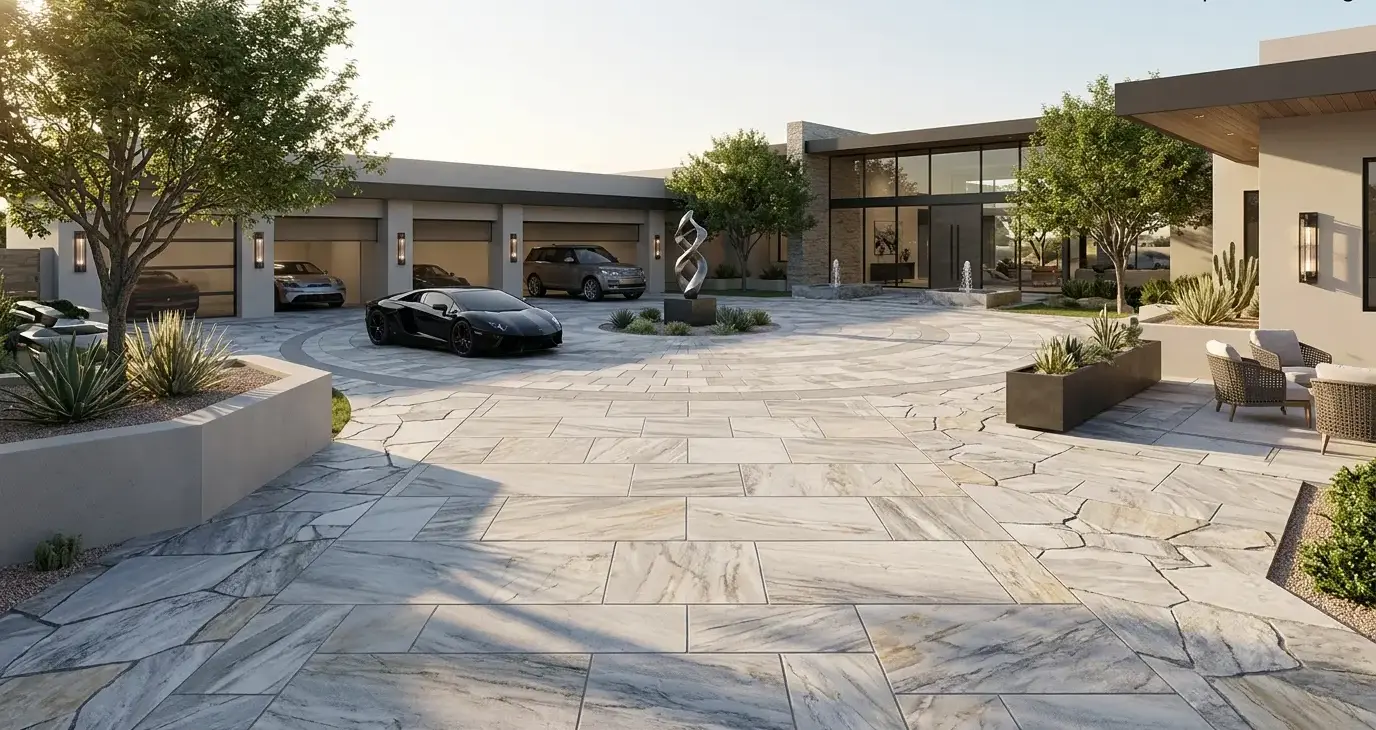 Conceptual rendering
Density is the main reason quartzite performs well in exterior, high-traffic settings. Formed under intense heat and pressure, the stone resists the wear that comes from vehicle weight, foot traffic, and repeated exposure to sun and moisture across changing seasons.
Quartzite also sits within Nova's UV-resistant material group, meaning it generally holds color better under direct sun than many alternative surfaces. Homeowners should still confirm the exact product's UV rating with a specialist, since sun tolerance can vary between individual slabs and finishes.
Heat tolerance is another advantage worth noting for exterior applications, though heat-resistant does not mean immune to thermal shock. Rapid temperature swings, such as a cold hose spray hitting a sun-heated surface on a summer afternoon, can stress any dense stone over time regardless of hardness. Scheduling a consultation helps homeowners plan finish and care routines around their specific climate conditions before committing to a driveway layout.
Color consistency and long-term appearance depend partly on finish choice as well. A textured or leathered surface tends to disguise minor surface wear more effectively than a high-gloss polish exposed to constant outdoor traffic.
Climate plays into this decision too. In drier, high-desert regions like Fernley and Reno, dust and grit can gradually dull a polished surface, while a leathered or flamed finish tends to mask that wear more gracefully across repeated seasons
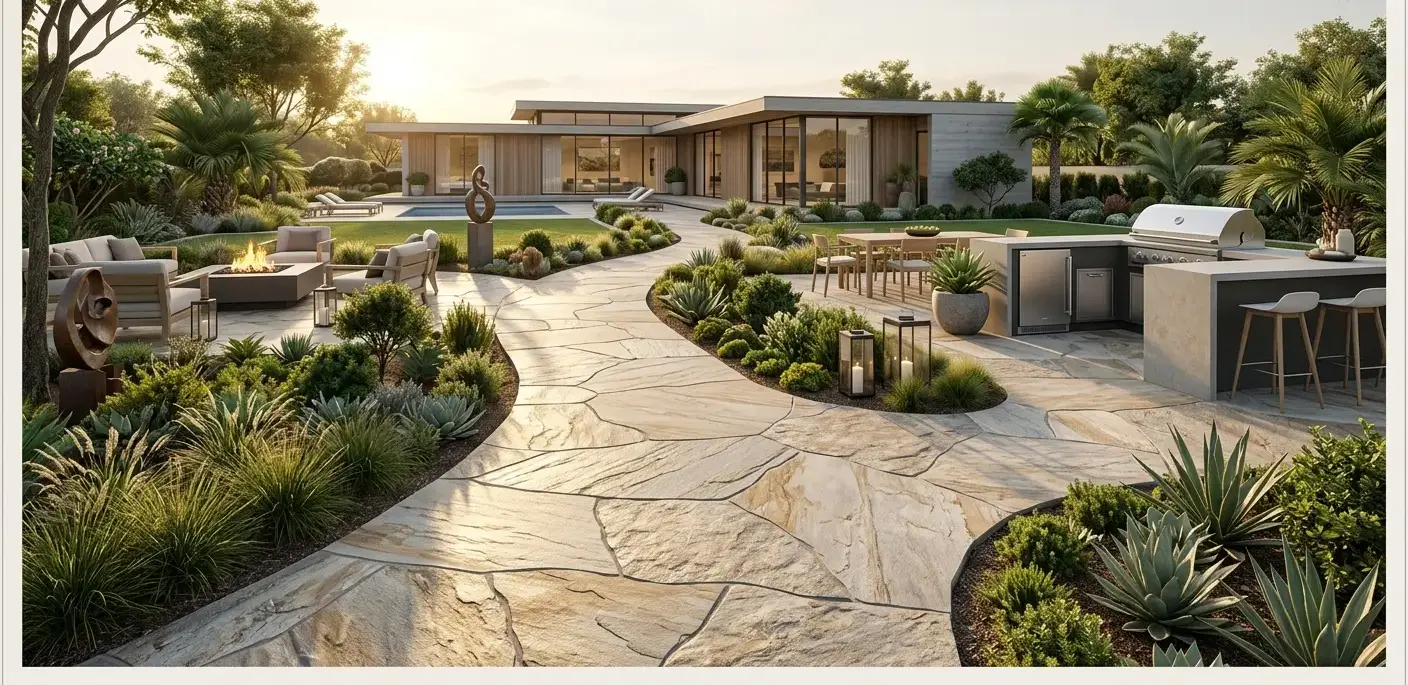 Conceptual rendering
Key benefits of quartzite driveway slabs:
- Exceptional density suited to heavy vehicle and foot traffic
- UV-resistant coloring, with sun ratings that vary by specific product
- Heat tolerance for sun-exposed surfaces, though thermal shock is still possible
- Distinct natural veining not replicated by engineered materials
- Outdoor-approved classification alongside granite, travertine, and porcelain
- Requires a periodic sealing routine rather than a single, permanent treatment
| Advantages | Considerations |
Extremely hard and dense for exterior wear | Needs periodic sealing to maintain performance |
Naturally UV-resistant coloring | Sun rating still varies by specific slab |
Distinctive veining unmatched by engineered stone | Slip resistance depends heavily on finish choice |
Suited to driveways, walkways, and courtyards | Heat-resistant, but not immune to thermal shock |
Advantages and considerations:
Where Quartzite Fits in Driveway and Landscape Design
Quartzite's outdoor-rated performance opens up several exterior applications beyond a simple driveway slab, extending naturally into motor courts, garden walkways, and broader landscape design work around a home's entrance. Because the stone reads as substantial rather than decorative, it tends to anchor an entrance the way a poured surface rarely can on its own.
Slab format and layout also shape how a driveway ultimately reads visually. Larger format slabs reduce the number of visible joints across a motor court, while a mix of sizes can still deliver a cohesive natural stone look across a larger exterior footprint.
Motor Courts and Entry Driveways
A quartzite motor court sets a strong first impression, pairing natural stone tones with the surface toughness that daily vehicle traffic demands. Polished and honed finishes are smooth, so they give less grip when wet than textured surfaces.
Many exterior driveway projects lean toward flamed, bush-hammered, or leathered finishes instead for everyday reliability. Wet traction on hard-surface walkways is measured with test methods such as the [NFSI wet-SCOF standard], which explains why finish selection matters as much as the underlying stone itself.
Walkways and Garden Paths
Beyond the driveway itself, quartzite slabs for durable exterior driveways often extend into connecting walkways, tying the entrance together with a consistent stone palette from the street to the front door. A textured or leathered finish suits these pedestrian paths well, particularly where the walkway sees seasonal rain, sprinkler overspray, or shaded, slower-drying sections.
Consistent slab thickness across a driveway and its connecting walkway also simplifies planning, since homeowners can order matching material for both areas in a single project rather than sourcing pathway stone separately later on.
Pairing Quartzite with Architectural Landscape Design
Architects and landscape designers increasingly treat driveway stone as a design feature rather than pure infrastructure, and quartzite's natural veining supports that broader design approach. Industry resources such as ASTM stone standards track how exterior material specifications continue to evolve. Design events like the surfaces industry showcase reflect how much attention exterior stone selection now receives from design professionals working on residential entrances and hardscape projects alike.
Selecting quartzite for a driveway project:
- Assess the property's climate, including sun exposure and freeze-thaw cycles.
- Proper base preparation, slab thickness and cut size is critical to prevent cracking under heavy loads.
-
Choose a textured finish such as flamed, bush-hammered, or leathered for better wet traction, then confirm the specific slab’s slip-resistance results.
- Confirm sealing needs and frequency for the specific slab selected.
- Review available slab thickness and format for the project's overall scope.
- Request a slab quote once dimensions and finish are set.
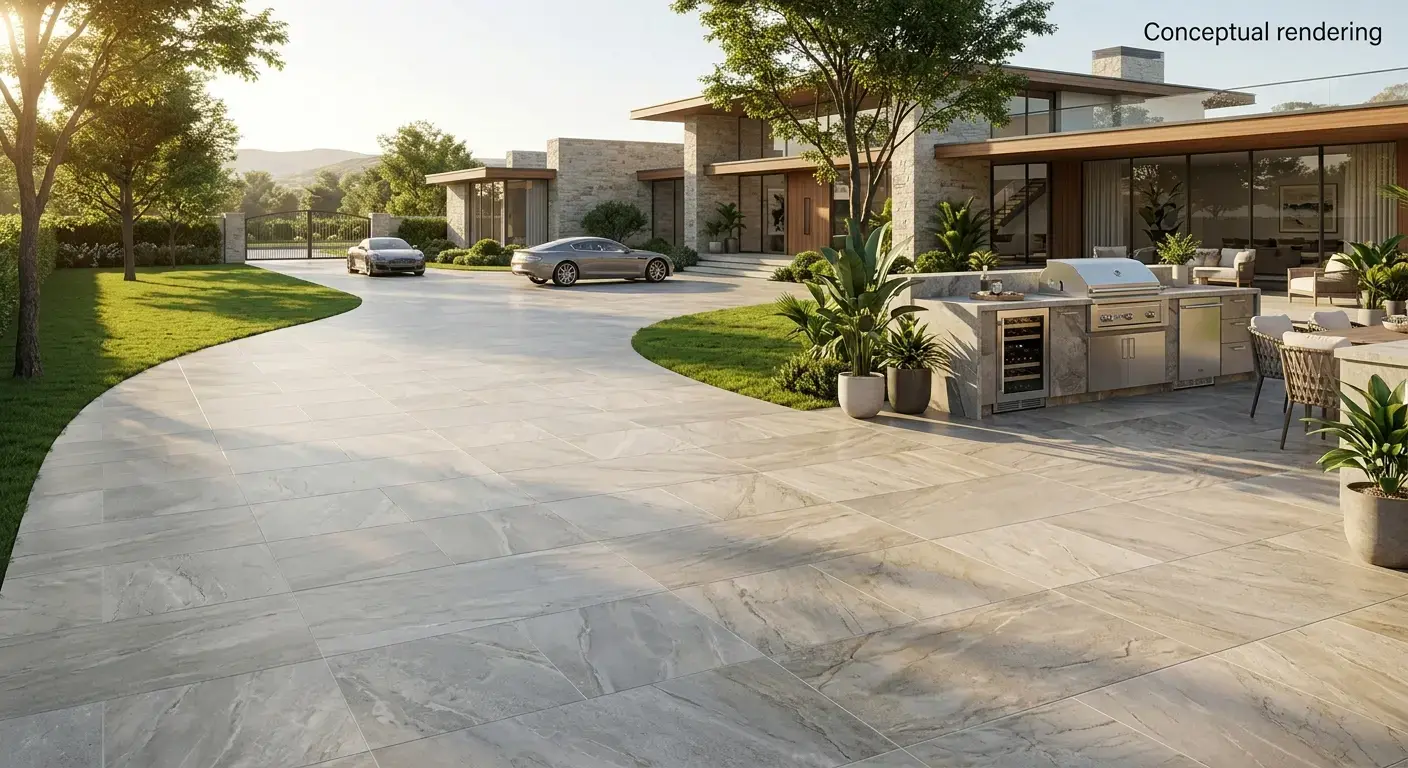 Conceptual rendering
Nova Tile and Stone: Expert Guidance for Stone Driveways
Selecting quartzite for an exterior driveway involves more than picking a color that looks appealing in a photograph or a brief showroom glance. Nova Tile and Stone's specialists help homeowners match finish, thickness, site preparation, and sealing plans to the climate and traffic patterns of a specific property.
Timelines also factor into planning. Driveway-scale slab orders often involve coordinating quantity, format, thickness, size, and finish well before any broader landscape work and preparation begins, so an early consultation gives homeowners more flexibility in scheduling delivery around a larger exterior project.
The Fernley showroom displays quartzite alongside granite, travertine, and porcelain, letting homeowners compare veining, tone, and finish options in person under natural light before committing to stone driveways at scale. Visit our showrooms to see full slabs rather than relying on a small digital preview.
Quartzite Driveway Thickness and Cut Size Guidelines
Driveway Type | Recommended Thickness |
Equivalent Cut Size
|
Notes
|
Residential (cars) | 4–5 cm | 18″ × 18″ / 24″ × 24″ | Modular sizes distribute load evenly; most common choice |
Heavy vehicles / SUVs | 5–6 cm | 18″ × 36″ / 24″ × 36″ | Larger slabs possible, but require added thickness |
Commercial / trucks | 6–8 cm | 24″ × 48″ / 30″ × 30″ | Maximum strength; only with reinforced base |
Contractors and design professionals managing multiple driveway projects across the region can also apply for trade account to streamline ongoing slab orders and communication. To learn more about the company behind these showrooms and its regional footprint, homeowners can meet the Nova team online at any time.
Shipping arrangements for driveway-scale slab orders can be discussed directly with a Nova specialist during a consultation, alongside guidance on finish, thickness, and sealing choices suited to each property's climate and traffic level.
Homeowners comparing quartzite against other outdoor-rated stone, such as granite or travertine, often find it useful to view several slabs side by side rather than relying on memory or a single reference photo. A specialist can walk through veining variation, finish texture, and how each option is likely to weather over years of exterior exposure.
Conclusion
Quartzite slabs offer a hard, outdoor-rated stone option for driveways, motor courts, and connecting walkways, with UV-resistant coloring and veining that few materials match. Proper finish and sealing choices still shape long-term performance across changing seasons. For homeowners weighing stone driveways across Fernley, Reno, Minden, or Sacramento, browsing the complete collection is a practical starting point before finalizing a driveway plan. Book a free consultation now to talk through finish, sealing, and sizing for a specific driveway project.
Note: Some images on this page may be conceptual renderings created to illustrate design possibilities and may not depict actual installations.
Frequently Asked Questions
Yes. Quartzite falls within Nova's outdoor-approved stone category, alongside granite, travertine, and porcelain, making it a suitable choice for exterior driveways, motor courts, and connecting walkways in most residential settings.
Yes. Quartzite requires a periodic sealing routine to help maintain stain and moisture resistance over time. Sealing frequency depends on the finish selected and the property's overall climate exposure throughout the year.
Textured finishes such as flamed, bush-hammered, or leathered generally offer better wet traction than polished or honed surfaces, which are smoother. Exact slip resistance varies by slab, so a specialist can help match finish to expected foot and vehicle traffic patterns.
Quartzite sits within an outdoor, UV-resistant material category, so it generally holds color well under sun exposure. Homeowners should still confirm the exact product's sun rating, since tolerance can vary by individual slab.
Both are outdoor-approved natural stones suited to exterior use. Quartzite is generally denser, though travertine also performs well outdoors and is not limited to shaded or covered exterior areas.
Curious About Something Else?
Visit our Showrooms Now!
12835 Old Virginia Rd Suite 24, Reno, NV 89521
Store hours:
Mon. - Fri. : 7:30 am - 6:00 pm
Saturday: 9:00 am - 3:00 pm
Sunday: Closed
6100 Warehouse Way, Sacramento, CA 95826
Store hours:
Mon. - Fri. : 7:30 am - 5:00 pm
Sat. - Sun. : Closed
2548 Business Pkwy, Minden, NV 89423
Store hours:
Mon. - Fri. : 7:30 am - 6:00 pm
Saturday: 9:00 am - 3:00 pm
Sunday: Closed