Porcelain and natural stones such as granite, quartzite, and travertine are all good fits for outdoor floors, so the choice comes down to how each paver is built and verified. For porcelain, check that the paver is 2 cm thick and made to the ANSI A137.3 paver specifications; for natural stone, check that it meets the ASTM specification for its type, such as C616 for quartzite.
We recommend settling those checks before comparing color. In 2022, the Tile Council of North America (TCNA) announced a revised ANSI A137.3 standard with new specifications for 2 cm porcelain pavers after three years and hundreds of hours of research.
Natural stone paving got its own guide in April 2025, when ASTM published C1950. The sections below cover each check in turn: thickness, support, stone testing, porcelain certification, and size, then where to see our pavers in person.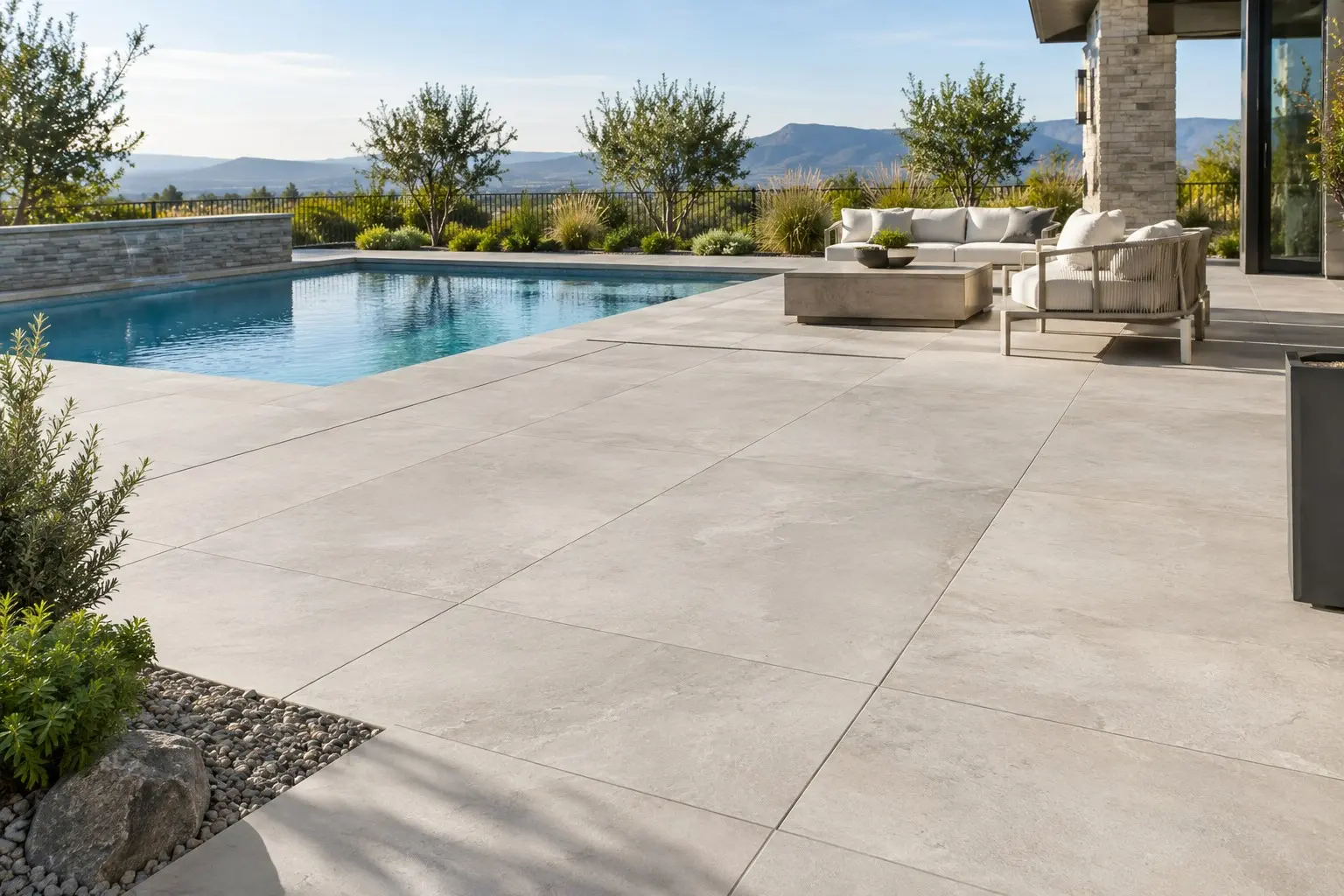
Why Porcelain Pavers Got Their Own Specifications
The demand came first. TCNA's announcement pointed to rising interest in pool surrounds, patios, walkways, and outdoor kitchens, and to how widely 2 cm porcelain pavers were already in use. Its standards director described interest in outdoor living as growing exponentially in the years before the update.
The committee then focused on strength and impact. TCNA explained that 2 cm porcelain pavers are often used in unbonded or raised flooring applications, meaning the paver often isn't bonded to a solid surface below it.
Our takeaway: when a product is sold as a porcelain paver, ask whether it's made to the paver criteria in ANSI A137.3. A thin porcelain tile with an outdoor look is not the same product.
Thickness Tells You What a Porcelain Paver Is Built For
TCNA's listing for the current ANSI A137.3 edition sorts gauged porcelain into thickness groups with separate strength criteria, and the thickest products get a group of their own. Thin products from 3.5 to 6.5 mm cover walls, countertops, and floors, while products 20 mm and thicker, the range that includes 2 cm pavers, are judged by their own criteria.
TCNA describes the standard as quality criteria for buyers as well as for specifiers, installers, and manufacturers, so a paver buyer is part of its intended audience. At 20 mm, a paver is about three times as thick as the 6.5 mm upper limit for thin gauged floor tile, which is why we treat paver thickness as a starting filter rather than a detail.
The same listing defines gauged as a thickness chosen for a specific installation and use, and the standard also sets criteria for how accurate and consistent that stated thickness must be. When a porcelain paver and a thinner porcelain tile share a look, check the stated thickness first, because it tells you which one was made to be a paver.
How Will the Paver Be Supported?
Support changes what a paver has to withstand. The published ASTM C1950 guide covers selection, design, and installation of exterior stone paving systems in one document, and we read that as a clear signal that a stone paver and the system beneath it should be chosen together.
That question belongs in the buying conversation. Before settling on a thickness, know whether the paver will be unbonded, raised on supports, or set in a solid bed, and share it with our team when you select your pavers.
For porcelain, the 2022 specifications were written with the unbonded and raised cases in mind. That is one more reason to confirm a porcelain paver meets them.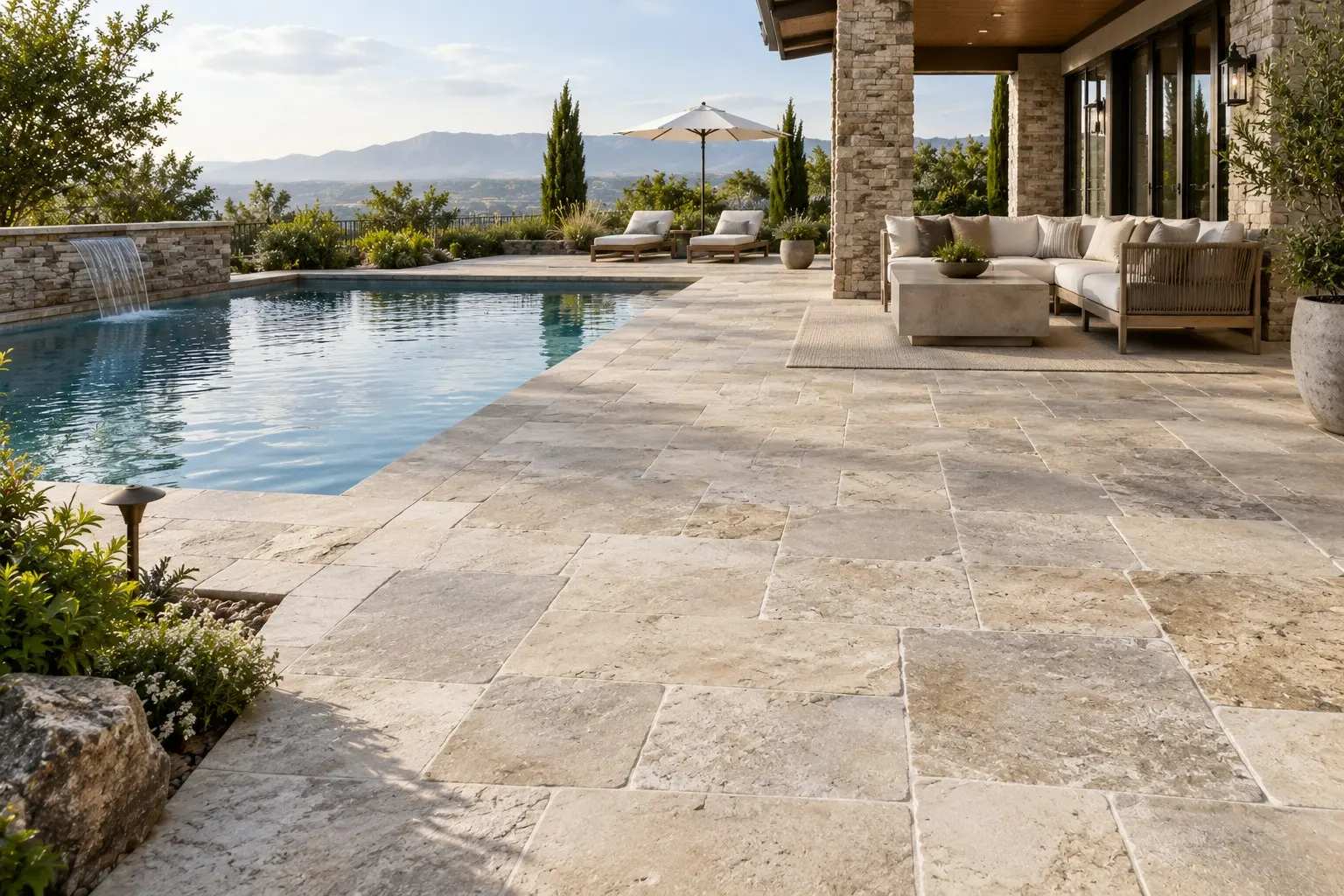
What Should a Natural Stone Paver Be Tested For?
Natural stone has its own specifications, written by stone type: ASTM C615 for granite, C616 for quartz-based stone such as quartzite, and C1527 for travertine. Knowing which one applies is the first step for any stone paver.
Take quartzite as an example. ASTM C616 classifies quartz-based stone into three groups, with quartzite as Type III, and sets requirements for absorption by weight, density, compressive strength, modulus of rupture, and abrasion resistance. The specification also excludes molded, cast, or artificially aggregated units, so a cast paver with a stone look is not covered by it.
Together they cover water absorption, strength under load and in bending, and resistance to wear, all of which a paver faces every day. Our advice: ask whether the stone meets the ASTM specification for its type, and treat a clear answer as worth more than a pretty photo.
Stone type still shapes the shortlist. Among the natural stones we carry, granite, quartzite, and travertine are a good fit for outdoor floors, while marble and dolomite are not stones we recommend outside.
Is Your Porcelain Paver Really Porcelain?
A paver standard only helps if the product is porcelain in the first place. TCNA warns that some sellers advertise and sell tile as porcelain even when it does not meet the porcelain definition of 0.5% water absorption or less under the ASTM C373 test.
To counter that, the Ceramic Tile Distributors Association and TCNA launched the Porcelain Tile Certification Agency (PTCA). Manufacturers can have products independently tested and then print the PTCA certification mark on packaging and marketing materials.
Our advice: ask whether a porcelain paver carries the PTCA mark or has comparable independent test results. It is a quick way to confirm the material before you compare anything else. TCNA names IPA Laboratories as the designated PTCA testing lab, and certification covers the material rather than the paver format, so pair it with the thickness check above.
What Size Paver Counts as Large Format?
Our pavers run from small to large format, and that label is looser than most buyers expect. For years, the tile trade treated 15 inches as the large format line, but a Stone World column by the Ceramic Tile Education Foundation's academic director notes that neither ANSI nor the TCNA Handbook ever defined it that way.
ANSI terminology added in January 2024 now defines a large format tile as one made to ANSI A137.1 with a facial dimension greater than 23 inches. A 2 cm porcelain paver falls under ANSI A137.3 instead, so that definition doesn't settle what large format means for a paver.
That is why we compare pavers by their actual dimensions rather than the label. Two pavers both sold as large format can differ by a wide margin, and size changes how many joints show across a patio.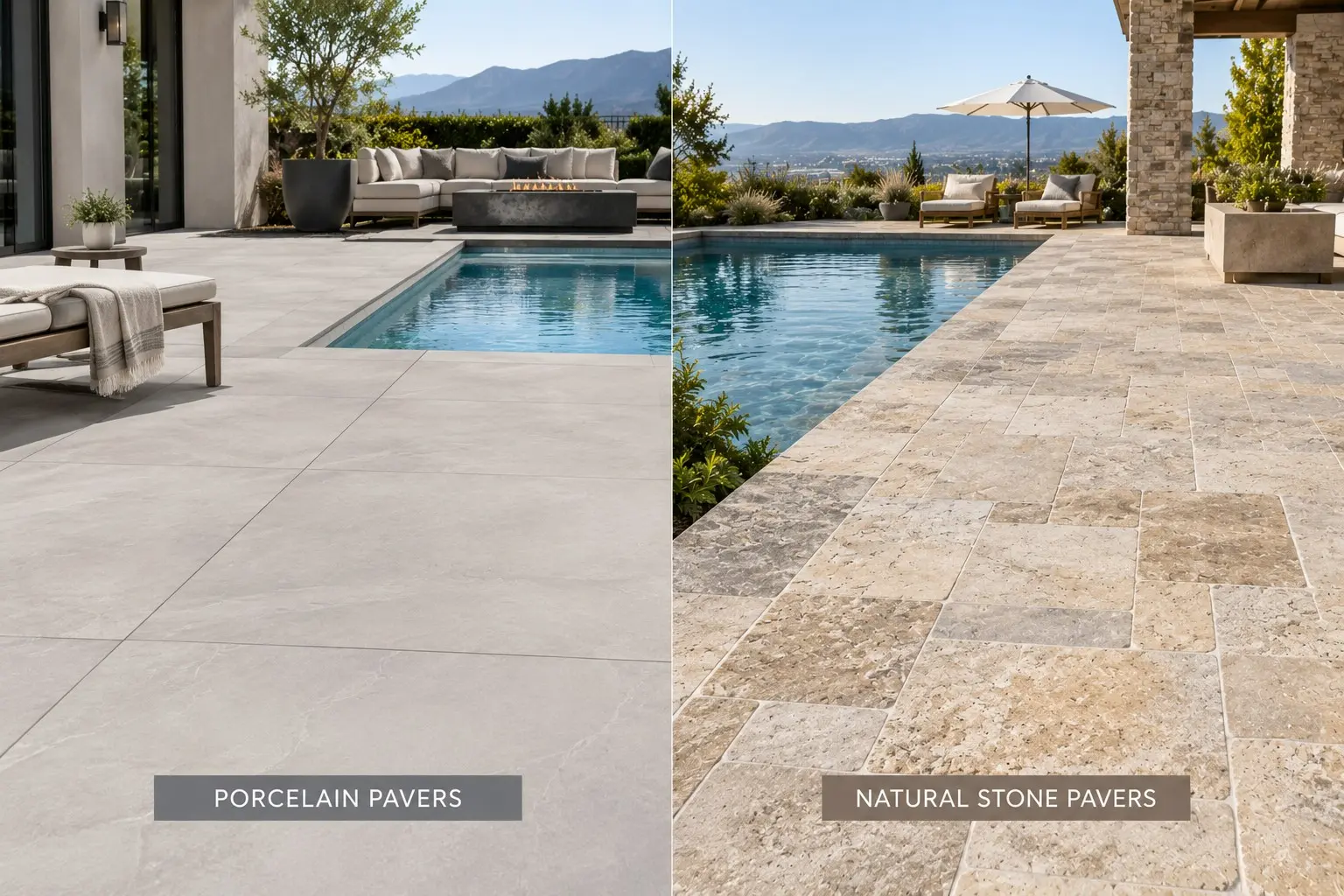
Porcelain or Natural Stone: Which Paver Fits Your Project?
Both options sit within our Pavers and Exterior Stone range, so compare like with like. A porcelain paver should meet the ANSI A137.3 criteria for 20 mm products, and a natural stone paver should meet the ASTM specification for its stone type, so neither choice rests on looks alone.
Pick natural stone when variation is the point. Each granite, quartzite, or travertine paver varies in tone, veining, and movement, so no two sections of a patio read exactly alike.
Pick porcelain when you want a consistent look or a style stone can't give you outdoors. Porcelain can be made in travertine, slate, limestone, wood, and concrete looks, and it is a good fit for outdoor floors.
Both come with limits worth knowing. Porcelain, granite, and quartzite are UV resistant, but performance may vary by color and finish, and every one of these surfaces is durable, though proper care helps preserve its appearance.
Conclusion
Our Pavers and Exterior Stone offering pairs small to large format pavers with pool coping and stacked stone, and you can explore everything we carry before narrowing it down.
To judge porcelain in person, stop by the showroom nearest you and take tile samples home. A complimentary design consultation with Nova Tile and Stone runs about 45 minutes with no obligation, and our specialists pull samples matched to your space.
If you lean toward natural stone pavers, our live slab inventory shows how much a single stone can shift from bundle to bundle, the same natural variation a stone paver carries, and you can request details on a specific bundle once one stands out. For anything else, contact our team, and bring the questions from this post: the stated thickness, the standard a porcelain paver meets, the PTCA mark, and the ASTM specification for a stone.
Note: Some images on this page may be conceptual renderings created to illustrate design possibilities and may not depict actual installations.
Frequently Asked Questions
Porcelain pavers covered by the ANSI A137.3 paver specifications are 2 cm thick, which places them in the standard's group for products 20 mm and thicker. That is about three times the 6.5 mm upper limit for thin gauged porcelain floor tile.
No. ANSI A137.3 sets separate strength criteria by thickness, and the 2 cm paver specifications were written with unbonded and raised applications in mind. Check the stated thickness and whether the product is made to the paver criteria.
ASTM C616 covers quartz-based dimension stone, with quartzite classified as Type III. It sets requirements for absorption, density, compressive strength, modulus of rupture, and abrasion resistance.
We don't recommend marble or dolomite for outdoor use. For outdoor pavers, granite, quartzite, travertine, and porcelain are better fits.
Porcelain is UV resistant, but performance may vary by color and finish. Seeing a tile sample outdoors in your own light is a practical check before you choose.