AT A GLANCE
- Pavers are separate units with sand-filled joints.
- Pavers come in concrete, natural stone, brick, and porcelain.
- Stamped concrete is one poured, patterned slab.
- Stamped concrete usually costs less than pavers.
- Concrete pavers reach 8,000 psi vs. 3,000 to 4,000 for poured slabs.
- Pavers flex with the ground; stamped concrete tends to crack.
- Pavers can be reset; stamped concrete patches often show.
IN THIS POST
- What are pavers?
- What is stamped concrete?
- How much do pavers and stamped concrete cost?
- Which is more durable?
- Are Pavers or Stamped Concrete Better in Cold Climates?
- Which needs less maintenance?
- Which is better for your project?
- Conclusion
- Frequently Asked Questions
- Sources
Pavers are individual units of concrete, natural stone, brick, or porcelain laid over a compacted base with sand-filled joints, while stamped concrete is a single poured slab that is colored and pressed with a pattern to resemble stone, brick, or wood. Stamped concrete usually costs less to install, but pavers tend to handle ground movement and freeze-thaw cycles better and are easier to repair because individual units can be lifted and reset without leaving a visible patch.
The two also differ in strength. According to the ASTM C936 standard, interlocking concrete pavers must reach an average compressive strength of at least 8,000 psi with average water absorption of no more than 5%, while typical residential concrete flatwork is poured at 3,000 to 4,000 psi.
Below, we compare pavers and stamped concrete on cost, cracking, cold-weather performance, maintenance, and the projects each one suits best, including patios, driveways, and pool decks.
What Are Pavers?
Pavers are individual paving units laid side by side over a compacted aggregate base and a thin bedding layer, with sand swept into the joints to lock them together. Because each unit is separate, the finished surface behaves as a semi-flexible system rather than one rigid piece.
Pavers come in several materials:
Concrete pavers are factory-made in molds, so their size and thickness are very consistent.
Natural stone pavers, such as granite, quartzite, and travertine, are cut from quarried stone and vary naturally in color and veining.
Porcelain pavers are thick porcelain tiles made for outdoor use. Under the industry's porcelain tile definition, they have a water absorption of 0.5% or less.
Clay brick pavers offer a traditional look and tend to hold their color well.
Concrete pavers are made under controlled factory conditions to meet the interlocking concrete paver standard, which sets the strength and water absorption minimums noted above and requires freeze-thaw testing, with a saltwater version of the test for pavers that will be exposed to deicers. Low absorption matters because less water inside a paver means less internal pressure when that water freezes.
What Is Stamped Concrete?
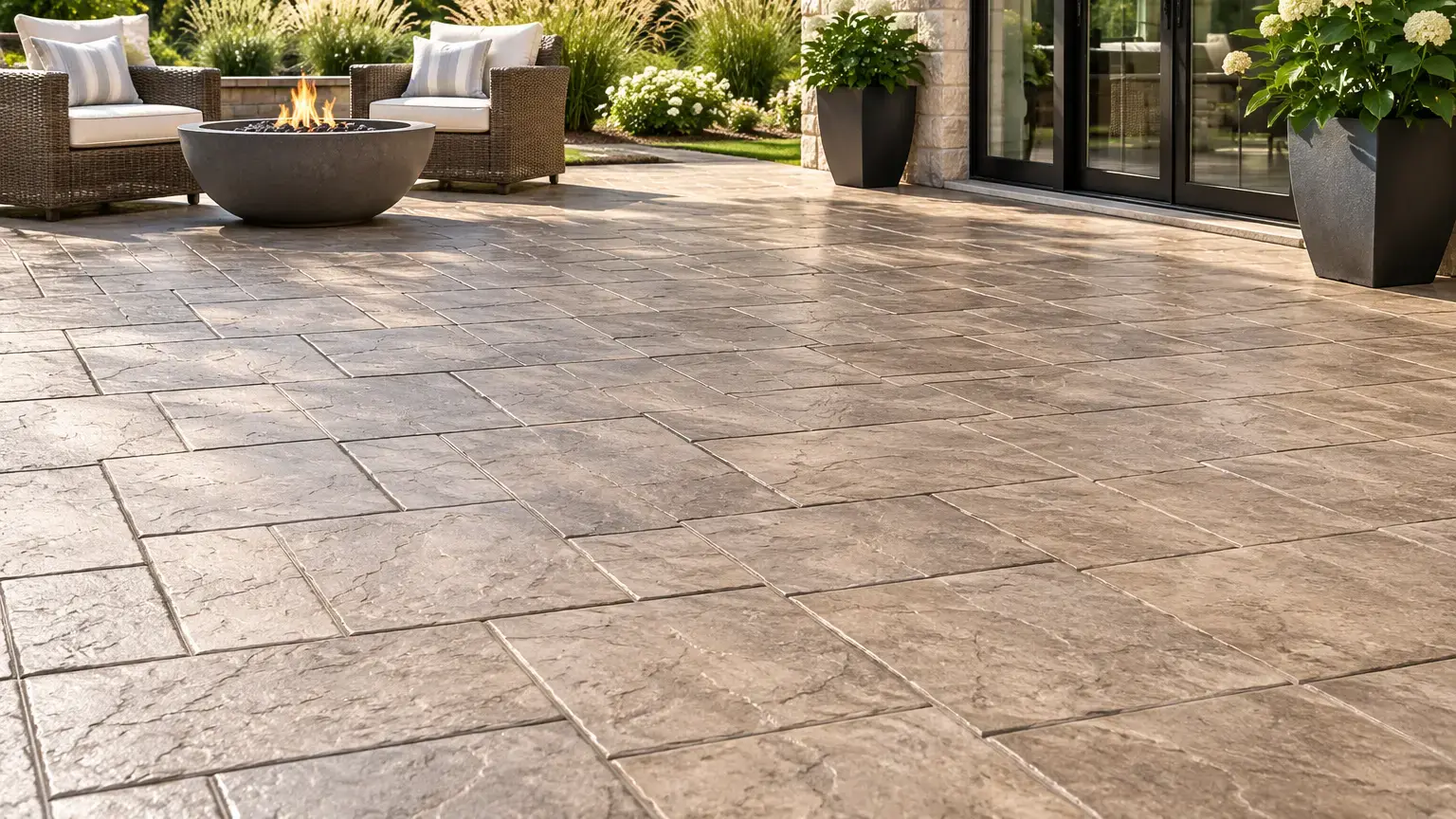
Stamped concrete is poured concrete that is colored, textured, and imprinted with a pattern before it hardens, so it can resemble slate, flagstone, brick, or wood. It is installed as one continuous slab, typically divided by control joints.
The process usually follows a set sequence. Color is either mixed into the concrete or broadcast onto the fresh surface as a color hardener. A release agent is applied so the stamping mats lift cleanly, and it often adds a darker accent color in the low spots. Crews then press the mats into the surface, wash off excess release, let the slab cure, and apply a sealer.
The concrete itself is the same mix used for standard patio and driveway concrete, which falls in the strength range noted above. Drying shrinkage is a normal property of this material, so control joints are cut or tooled into the slab to make shrinkage cracks form along planned lines rather than randomly. Once the pattern is stamped and the slab cures, the design and color are set, so later changes usually mean resurfacing or replacing sections.
How Much Do Pavers and Stamped Concrete Cost?
Stamped concrete usually costs less to install than pavers, though the gap narrows as stamped designs add colors, borders, and detailed patterns. Pavers take more labor because each unit is placed by hand over a carefully prepared base.
National installed cost estimates show that basic stamped concrete is typically the lower-cost option, and that paver pricing depends heavily on material:
Surface | Relative installed cost |
Stamped concrete | Lowest for basic designs; rises with added colors and patterns |
Concrete pavers | Among the more affordable paver options |
Brick pavers | Slightly higher than concrete pavers |
Natural stone pavers | Among the highest |
Porcelain pavers | Wide range, depending on the finish |
Pricing also varies by region, and local labor rates, site access, slope, and excavation needs can move the final cost in either direction. The upfront price is also only part of the picture. Sealing, cleaning, and repairs add to the lifetime cost of both surfaces, and the way each one is repaired can change which option costs less over the long term.
Which Is More Durable, Pavers or Stamped Concrete?
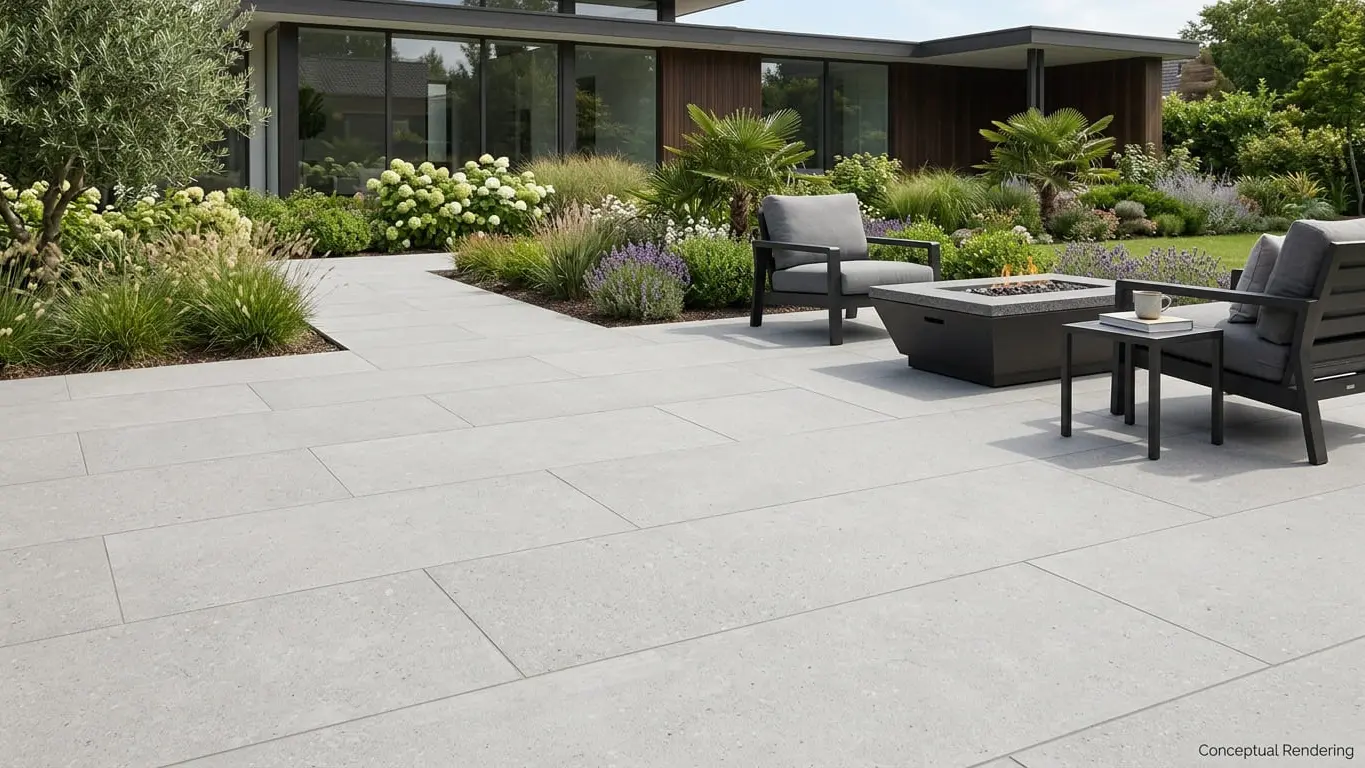
Pavers are generally considered more durable because they resist the visible cracking that is common in a rigid concrete slab. A stamped slab cannot flex when the ground beneath it shifts, while pavers can move slightly as a system, so minor settling tends to show up as a small dip rather than a break across the surface.
Poured concrete shrinks as it dries, and temperature swings and heavy loads add more stress. Control joints help direct that cracking, but they do not eliminate it. On a stamped surface, a crack that runs across the pattern can be hard to hide.
Engineers describe concrete slabs as rigid pavement and paver systems as semi-flexible. Each paver shares load with its neighbors through the sand-filled joints, so the surface can keep functioning even after minor settling.
Pavers are not problem-free. A poorly compacted base can lead to sunken areas, and individual units can loosen or shift if edge restraints fail. In both cases, base preparation has a large effect on how well the surface holds up. Material choice matters as well, so when comparing the outdoor pavers and exterior stone we carry at Nova Tile and Stone, check each product's spec sheet to confirm it is suited to foot traffic or vehicle loads.
Are Pavers or Stamped Concrete Better in Cold Climates?
In cold climates with repeated freezing and thawing, pavers generally have an advantage because they can shift with frost movement instead of cracking. Stamped concrete can perform well in cold climates too, but it depends more on a sound concrete mix and proper curing.
Freeze-thaw damage starts with water. When moisture inside a material or a crack freezes, it expands and pushes outward. Cracked or poorly sealed concrete can let water in, and repeated cycles can widen cracks and cause spalling, where the surface flakes or chips away. Deicing salts can add to that wear.
Concrete pavers made to the freeze-thaw requirements described earlier are tested for repeated freezing, including with deicing salts. Natural stone varies more by type, since stone that absorbs water readily may be more susceptible to damage in freezing weather. Porcelain pavers also vary by product, so check each paver's absorption and frost-resistance information on the manufacturer's spec sheet before choosing it for a cold-climate project.
For stamped concrete, the sealer does much of the protective work in cold areas by helping keep water and deicing chemicals out of the surface.
Which Needs Less Maintenance, Pavers or Stamped Concrete?
Stamped concrete needs less day-to-day attention, while pavers need more small, routine tasks but are generally easier to repair. Both surfaces need regular cleaning and periodic sealing, and stamped concrete calls for more involved work when the sealer wears or the slab cracks.
Paver upkeep usually includes:
- Sweeping and rinsing the surface, and scrubbing stains with a mild detergent or a concrete-safe degreaser.
- Topping up joint sand where wind or runoff has washed it out.
- Pulling weeds that sprout from windblown seeds in the joints. Polymeric joint sand, which hardens after it is wetted, can help limit this.
- Optional sealing to help resist stains and fading. Follow the sealer manufacturer's instructions, and reseal when water no longer beads on the surface.
Stamped concrete upkeep centers on the sealer. Rather than following a fixed schedule, it is common industry practice to reseal based on condition, such as when the color looks faded or water no longer beads on the surface. Resealing too often can cause buildup that is costly to strip, so more is not always better.
Repairs are where the two differ most. A damaged or sunken paver can be lifted, the base corrected, and the same unit set back in place, which usually leaves no visible patch. Repairing stamped concrete often means filling cracks or cutting out and re-pouring a section, then trying to match the original color and pattern, which can be difficult. Since repairs are easiest when replacement pavers match the originals, it helps to compare colors and finishes in person before you buy, which you can do at our showrooms in Reno, Minden, and Sacramento.
Pavers or Stamped Concrete: Which Is Better for Your Project?
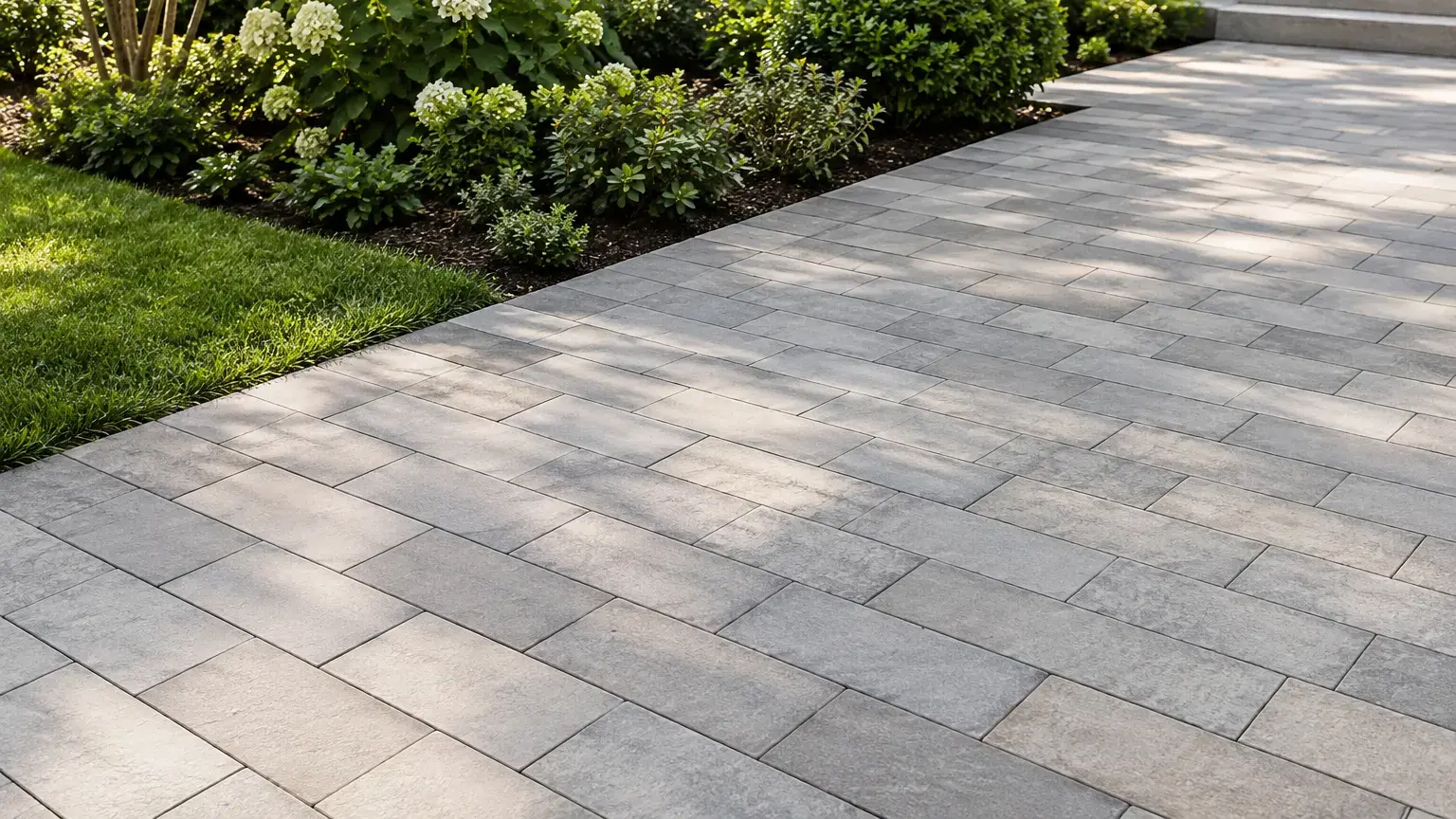
Neither surface is better in every case, and the right choice depends on budget, climate, soil conditions, and how much upkeep you are comfortable with. Stamped concrete often suits large, simple areas on a tighter budget, while pavers often suit sites with shifting soil, freezing winters, or a need for easy future repairs.
Factor | Pavers | Stamped concrete |
Upfront cost | Higher | Lower for basic designs |
Response to ground movement | Flexes as a system | Prone to cracking |
Repairs | Lift and reset units | Patch or re-pour sections |
Routine upkeep | Joint sand, weeds, cleaning | Cleaning and resealing |
Design changes later | Units can be rearranged or reused | Pattern is set once poured |
Patios and walkways. Both work well. Stamped concrete gives a seamless look at a lower starting price, while pavers offer a wide range of shapes, colors, and stone types and are easier to fix if tree roots or settling cause trouble.
Driveways. Vehicle loads raise the stakes. Interlocking concrete pavers designed for driveways, set on a thicker base, handle concentrated loads well. A stamped driveway needs proper thickness and joint spacing, and cracks on a driveway are usually more visible because of the size of the slab.
Pool decks. Wet bare feet make traction the main concern. Sealed stamped concrete can become slick when wet, so slip-resistant additives in the sealer are recommended for outdoor areas and need to be included again with each reseal. With pavers, texture and finish vary by product, so check the slip-resistance information on the spec sheet before choosing one for a pool surround.
Conclusion
Pavers and stamped concrete can both create attractive, durable outdoor surfaces, but they age in different ways. Stamped concrete typically costs less upfront and gives a seamless look, but as a rigid slab it is prone to cracking, and repairs can be hard to blend with the original pattern. Pavers usually cost more to install, yet their semi-flexible design handles ground movement and freeze-thaw cycles well, and individual units can be lifted and reset when problems come up.
If long-term repairability and cold-weather performance matter most, pavers are often worth the higher upfront cost. If you want a large, simple surface on a tighter budget and are comfortable resealing every few years, stamped concrete can be a practical fit. At Nova Tile and Stone, we carry pavers and exterior stone, including natural stone and porcelain options suited to outdoor use. You can see these materials in person at one of our showrooms, and a free design consultation can help you compare colors, sizes, and finishes for your patio, walkway, driveway, or pool deck.
Frequently Asked Questions
For the initial installation, usually yes. Basic stamped concrete typically costs less per square foot than pavers, although complex multi-color stamped designs can come close to paver pricing. Repair and resealing costs over the years can narrow the difference further.
Both can work. Interlocking concrete pavers set on a properly built base handle vehicle loads and ground movement well, and damaged units can be replaced individually. A stamped concrete driveway can cost less upfront but needs proper thickness and control joints, and cracks tend to be more noticeable on a large slab.
Pavers often have a longer service life because they tolerate shifting soil and frost movement, and worn or broken units can be swapped out without replacing the whole surface. Stamped concrete can also last many years when it is well built, sealed, and maintained.
It can be, especially with a glossy sealer. Adding a slip-resistant additive to the sealer improves traction, and it should be included each time the surface is resealed, which matters most around pools and on outdoor steps.
Sealing is optional for most pavers. A sealer can help resist stains and fading and help hold joint sand in place, but it adds a recurring task. Follow the sealer manufacturer's instructions, and reseal when water no longer beads on the surface or the color looks faded.
Sources
- ASTM International, ASTM C936/C936M Standard Specification for Solid Concrete Interlocking Paving Units | https://store.astm.org/c0936_c0936m-26.html
- American National Standards Institute, ANSI A137.1 Porcelain Tile Definition (The Eminence of Porcelain Tile) | https://blog.ansi.org/porcelain-ceramic-tile-ansi-a137-1-astm-definition/
- Concrete Masonry & Hardscapes Association, Construction of Interlocking Concrete Pavements (PAV-TEC-002) | https://www.cmha.org/resource/pav-tec-002/
- Concrete Masonry & Hardscapes Association, Pavers vs. Concrete: Myths, Facts, and What Homeowners Need to Know | https://www.cmha.org/news-and-insights/pavers-vs-concrete-myths-facts-and-what-homeowners-need-to-know/
- Natural Stone Institute, The Importance of Testing When Specifying Natural Stone | https://continuingeducation.bnpmedia.com/courses/natural-stone-institute/the-importance-of-testing-when-specifying-natural-stone/4
- American Society of Concrete Contractors, Best Practices in Decorative Concrete: Sealing Stamped Concrete | https://ascconline.org/Portals/ASCC/DCC%20Best%20Practices%20In%20Decorative%20Concrete%20-%20Sealing%20Stamped%20Concrete%20March%202025%20in%20CI%20Magazine.pdf
- American Society of Concrete Contractors, Concrete Sealer Expectations and Maintenance Guide | https://ascconline.org/Portals/ASCC/DCC_Sealer_Guide_Trifold_2012.pdf
- Journal of Light Construction, Q&A: Preventing Cracks in Concrete Slabs (answered by a Portland Cement Association representative) | https://www.jlconline.com/how-to/foundations/q-a-preventing-cracks-in-concrete-slabs_o/
- This Old House, All About Concrete Pavers | https://www.thisoldhouse.com/masonry/all-about-concrete-pavers
- Bob Vila, Cost of Pavers vs. Concrete | https://www.bobvila.com/articles/cost-of-pavers-vs-concrete
Note: Some images on this page may be conceptual renderings created to illustrate design possibilities and may not depict actual installations.