AT A GLANCE
- Core patterns: running bond, herringbone, basket weave, stack bond.
- Herringbone is the strongest paver pattern.
- Running bond is the easiest pattern to lay.
- Porcelain pavers suit stack bond or a one-third offset.
- Travertine often uses the four-size Versailles pattern.
- Diagonal and curved layouts may need 20%+ extra pavers.
IN THIS POST
- What are the most common patio paver patterns?
- Which Is Better: Herringbone, running bond, or basket weave pavers?
- Which paver patterns work best with porcelain, travertine, and stone?
- What is the best pattern for your patio's size and shape?
- What is the strongest paver pattern?
- Should a paver patio have a border?
- How many extra pavers do you need for each pattern?
- Conclusion
- Frequently Asked Questions
- Sources
Paver patio design patterns are the layouts used to arrange concrete, clay, porcelain, or natural stone pavers across a patio surface. The four most common patterns are running bond, herringbone, basket weave, and stack bond. Herringbone offers the strongest interlock, running bond is the easiest to lay, basket weave gives a classic woven look, and stack bond creates a clean modern grid.
According to industry guidance for interlocking concrete pavement, herringbone laid at 45 or 90 degrees is the recommended pattern where vehicles drive, because its staggered joints resist sideways movement.
Beyond strength, the best pattern also depends on the patio's shape, the look you want, and how much cutting and extra material the layout requires. The sections below cover each of these factors.
What Are the Most Common Patio Paver Patterns?
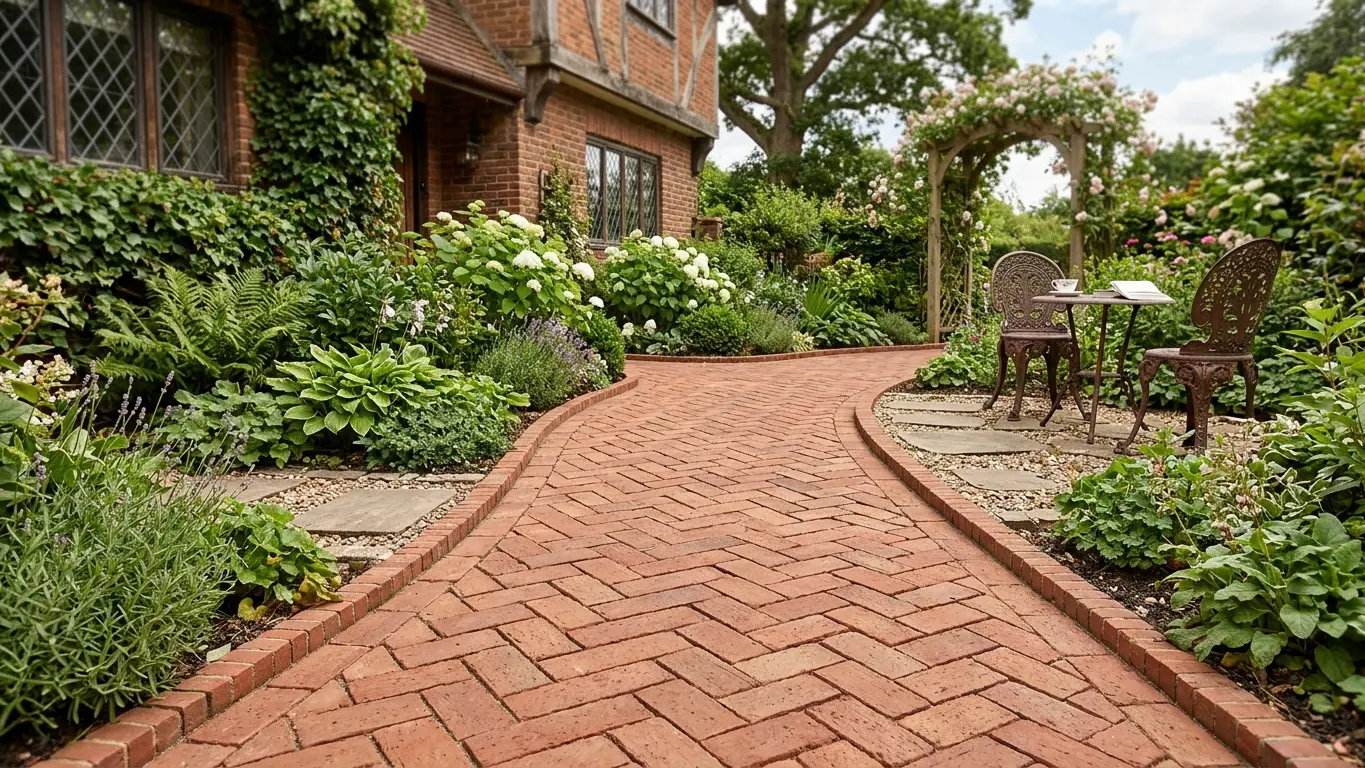
Running bond, herringbone, basket weave, and stack bond are the most common patio paver patterns. Most other layouts build on these four, either by combining them or by mixing several paver sizes.
Running bond. Each row is shifted half a paver from the row before it, the same way bricks are laid in a wall. It is simple, tidy, and works in both traditional and modern spaces.
Herringbone. Pavers are set in an L shape so the end of one unit meets the side of the next, creating a zigzag. It can be laid at 90 degrees to the patio edge for a stair-step look or at 45 degrees for a more dramatic diagonal. Herringbone is lively to look at and has a long history in paving, going back to ancient Roman paving.
Basket weave. Pairs of pavers alternate direction, one pair running one way and the next pair turned, which gives a woven effect. It has a classic garden feel, but it has continuous joints in both directions, so it is not as structurally strong as running bond or herringbone. You can see these differences side by side in this visual guide to the main brick paving patterns.
Stack bond. Pavers line up end to end with every joint aligned in both directions, forming a clean grid. It suits modern homes and large-format pavers. Because nothing is staggered, it offers the least interlock when pavers are set in sand.
Multi-size patterns. Some patterns combine several paver sizes in a repeating module. The French or Versailles pattern is a well-known example that uses four sizes of squares and rectangles, and it is common with natural stone such as travertine. These layouts look relaxed and old-world, and they hide small size differences between units well.
Circles and fans. Circular kits and fan patterns create a focal point, such as under a fire pit or table. They can fill a whole patio or sit inside a field of another pattern.
Which Is Better: Herringbone, Running Bond, or Basket Weave Pavers?
No single pattern is better for every patio. Herringbone is the strongest of the three but usually needs the most cutting, running bond is the easiest to lay while still interlocking well, and basket weave has the least interlock of the three. The best fit depends on whether looks, budget, or durability matters most for your patio.
Pattern | Look | Interlock | Cutting at edges | Good fit for |
Running bond | Clean, linear, classic | Good | Low, mostly at row ends | Most patios, curved edges, walkways |
Herringbone (90°) | Stair-step zigzag | Highest | Moderate | Busy patios, areas that may see vehicles |
Herringbone (45°) | Diagonal zigzag, more movement | Highest | High, angled cuts along edges | Statement patios, curved or irregular shapes |
Basket weave | Woven, traditional | Lower | Low to moderate on a straight layout | Garden patios, light foot traffic |
Stack bond | Grid, modern | Lowest | Low when sizes fit the space | Modern patios, large-format pavers |
Running bond is the easiest of the three to lay, while herringbone and basket weave are better suited to experienced installers, as this guide to brick patterns for patios and walkways explains. Basket weave can also drift out of line, because each side-by-side pair is one joint wider than the single paver turned across it.
Paver proportions matter too. Basket weave works cleanly only when two paver widths equal one paver length, so pavers that are not a true 2:1 rectangle leave visible gaps or need extra cuts, as this guide to common brick laying patterns points out. Running bond does not depend on that ratio, which makes it an easier choice for pavers with other proportions.
Which Paver Patterns Work Best With Porcelain, Travertine, and Natural Stone?
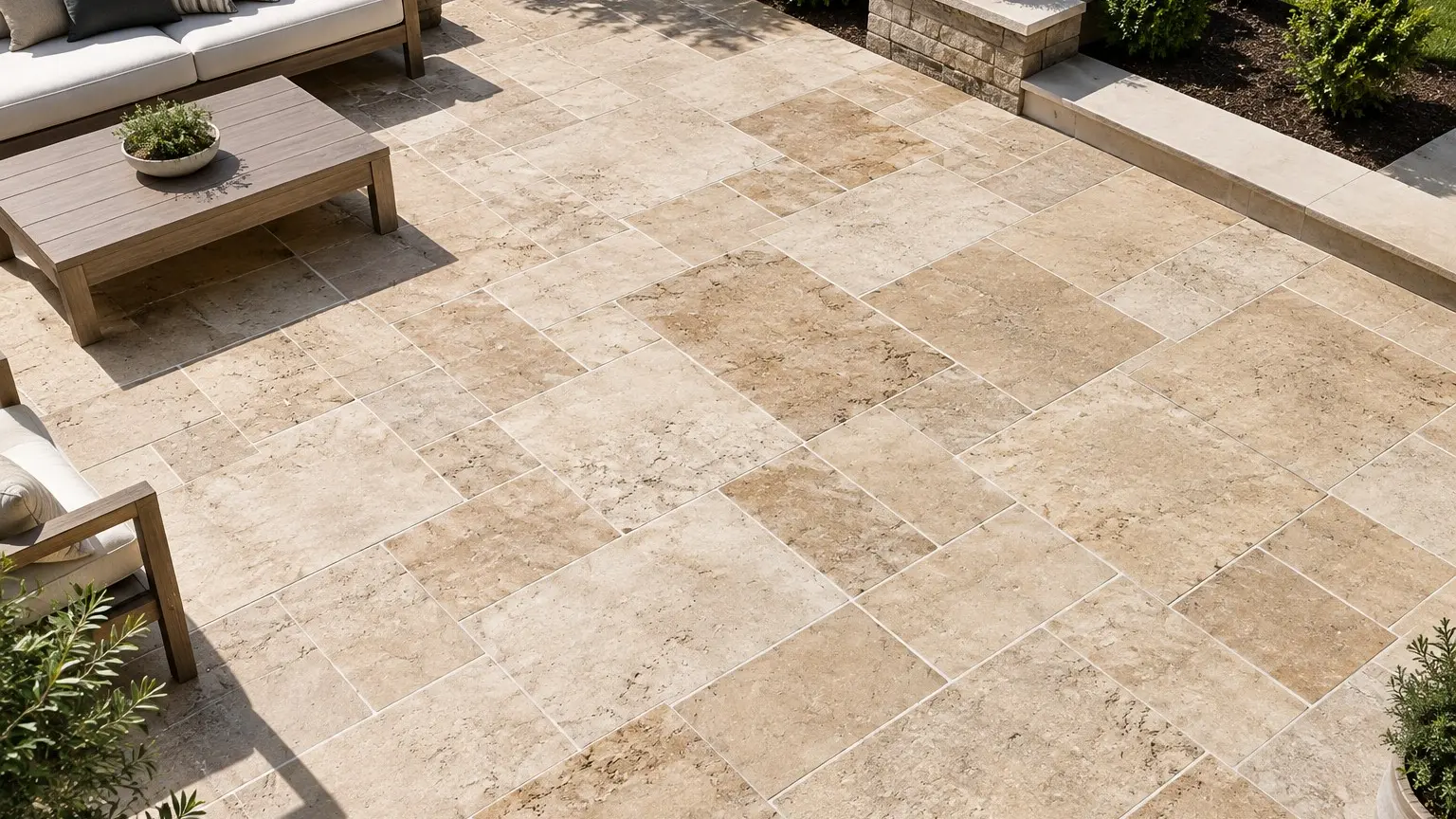
Large-format porcelain pavers suit stack bond or a one-third offset, travertine is often laid in a multi-size French or Versailles pattern, and smaller rectangular pavers are the classic choice for herringbone and basket weave. Matching the pattern to the material helps the finished patio look intentional, so it is worth choosing both together as you compare the pavers and exterior stone we carry at Nova Tile and Stone.
Porcelain pavers. Porcelain often comes in large, precise formats such as 24 by 24 inches or 12 by 24 inches, which look clean and modern in a stack bond. For an offset look, a one-third offset is usually preferred over a half offset. According to the ANSI A108.02 standard, offset patterns using tiles with an offset side longer than 15 inches should be limited to a 33 percent offset unless the manufacturer specifies otherwise, because slight warpage along the long edge can create uneven edges, as this explanation of tile offset limits describes. Always check the guidance for the specific porcelain paver you choose.
Travertine pavers. Travertine is closely linked with the French or Versailles pattern, which mixes four sizes of squares and rectangles in a repeating module. The varied sizes suit travertine's natural color movement and softened edges, giving the patio an old-world feel. Travertine also works in simpler layouts such as running bond or stack bond when you want a calmer look.
Quartzite, granite, and other cut stone. Cut natural stone pavers vary in color and veining from piece to piece. Simple patterns such as stack bond, running bond, or a multi-size layout often let the stone itself become the focal point, while a busy pattern can compete with the natural variation.
Smaller rectangular pavers. Brick-sized concrete and clay pavers are where herringbone and basket weave shine. Their small scale and consistent proportions make detailed patterns easier to lay out and read clearly across the patio.
What Is the Best Paver Pattern for Your Patio's Size and Shape?
Simple patterns such as running bond or stack bond suit small and rectangular patios, while curved or irregular patios are easier with running bond or 45-degree herringbone. Larger patios have room for more detailed layouts, and seeing pavers in person at our Reno, Minden, or Sacramento showroom can help you judge how a pattern will look at full scale.
Square and rectangular patios. Straight-edged spaces suit patterns that line up with the edges. With running bond, cuts are usually needed only at the start and end of each row, however long the patio runs. Stack bond and 90-degree herringbone also line up neatly with straight edges.
Curved and freeform patios. Running bond follows a gentle curve well, and 45-degree herringbone also adapts to curves because its diagonal lines do not run parallel to any one edge. Basket weave laid on the diagonal can work on curves too, though it adds cutting.
Long, narrow patios. Joint direction changes how a space feels. Rows running away from the house draw the eye outward, while rows running across the space feel calmer and more settled.
Small patios. A single paver color with a simple pattern keeps a small area from looking busy and can make it feel larger. Very small cut pieces at the edges can come loose more easily, so planning the layout around the real dimensions helps keep cut pieces a reasonable size.
Large patios. Bigger spaces give patterns room to show. This is where a 45-degree herringbone, a multi-size natural stone pattern, or a circle inset can become the main design feature. Contrasting colors can outline zones for dining or lounging without adding walls or steps.
What Is the Strongest Paver Pattern?
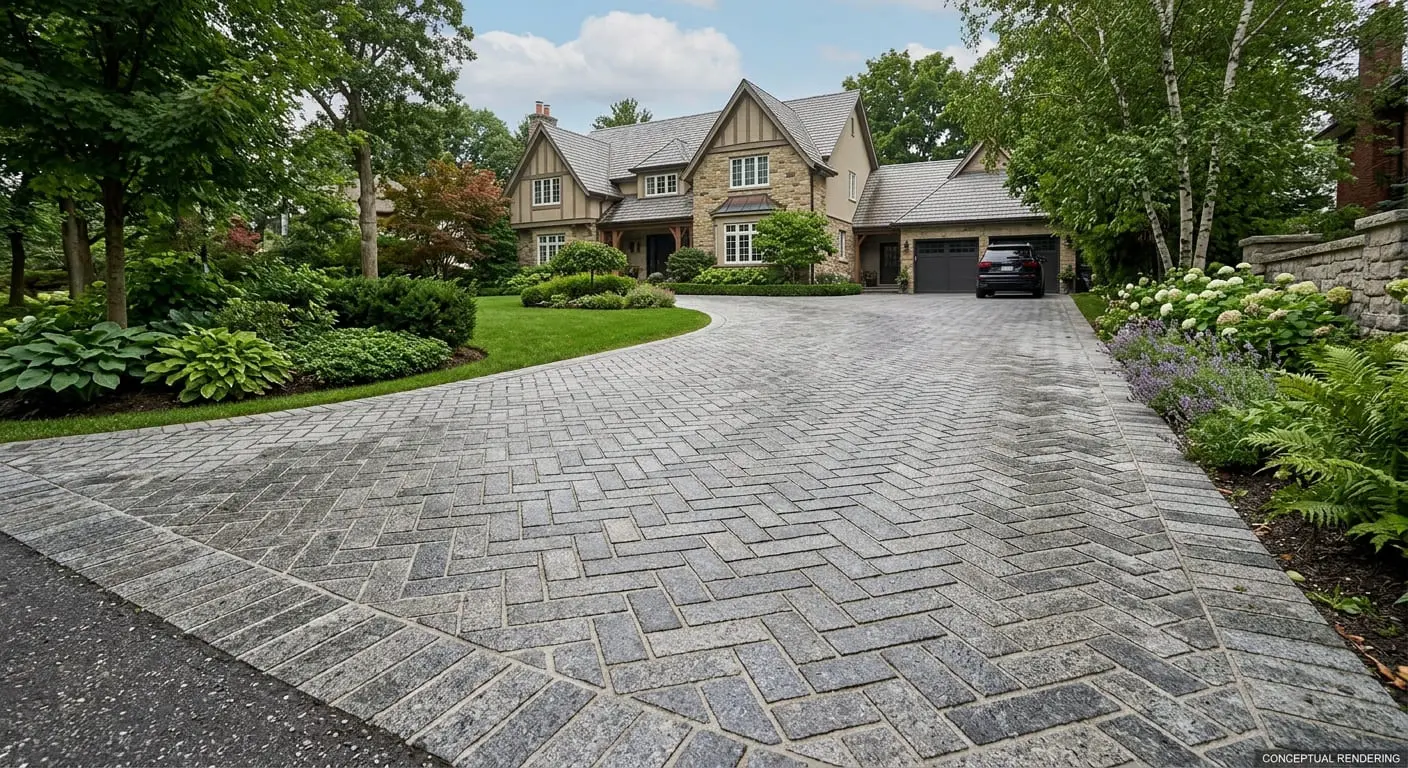
Herringbone is the strongest paver pattern, especially where cars, carts, or equipment will roll across the patio. For a patio that only carries people and furniture, running bond, basket weave, and stack bond can all perform well when the base and edges are built correctly.
The reason comes down to interlock, which is a paver's resistance to moving on its own. Laying patterns that break up long joint lines spread out the forces from turning, braking, and accelerating wheels. Testing has shown that herringbone patterns offer more structural capacity and resistance to sideways movement than other patterns, which is why this technical guidance on interlocking concrete pavement design recommends them anywhere vehicles drive. The same guidance calls for a 45-degree or 90-degree herringbone with sailor courses at the perimeter in vehicular areas.
That guidance also points to paver shape. According to the ASCE/T&DI 58-16 standard referenced there, pavers for vehicular use should have a length-to-thickness ratio of 3:1 or less and be at least 3 1/8 inches (80 mm) thick. A typical patio does not need to meet these numbers, but they are worth checking if your patio doubles as a parking pad or connects to a driveway.
Rolling comfort is another factor. If someone in the home uses a wheelchair, or you often move a grill, cart, or wheelbarrow across the patio, pavers with flat tops and small or no beveled edges give the smoothest ride. Laying the long side of each paver in the direction of travel also reduces the number of joints you roll across, and a 90-degree herringbone is generally smoother than a 45-degree herringbone.
Should a Paver Patio Have a Border?
A decorative border is optional, but every sand-set paver patio needs a firm edge restraint to hold the pavers in place. A border course adds a finished frame around the pattern and is often the detail that makes a simple layout look complete.
Soldier and sailor courses. A soldier course is a single row of pavers set side by side along the edge, with each paver's long side pointing into the patio. A sailor course turns the pavers so they run end to end, with their long sides along the edge. Either one gives the pattern a clean stopping point and hides some of the cut pieces along the perimeter.
Color and contrast. A border in a darker or contrasting color outlines the patio like a rug. A border that matches the field keeps the look quiet and lets the pattern carry the design. Some homeowners pick up a color from the roof, trim, or nearby stone so the patio ties back to the house.
Edge restraint. In sand-set installations, edge restraints hold the pavers tightly together and keep them from spreading under traffic. This technical overview of paver edge restraints also notes that thin landscape edging made for flower beds does not give pavers enough side support to stay locked together.
Inside borders and bands. Borders do not have to sit only at the outside edge. A band of contrasting pavers set inside the field can mark a seating area, frame a fire pit circle, or separate one pattern from another. Running bond, basket weave, and stack bond combine easily, while herringbone is harder to blend, so a single row of border pavers makes a clean transition between them.
How Many Extra Pavers Do You Need for Each Pattern?
Simple grid layouts need the fewest extra pavers, while diagonal and curved layouts need the most. Any cut paver is partly wasted, so patterns that create more cuts along the edges call for a larger overage.
Guides agree on the general trend, even though their exact numbers differ. One step-by-step method for estimating patio pavers suggests about 5 to 10 percent extra for a basic grid layout; about 10 percent for running bond, 90-degree herringbone, and basket weave; and at least 20 percent for diagonal or rounded designs. A second paver estimating guide gives similar figures: about 5 percent for manufactured pavers in a simple square pattern, 10 percent for natural stone pavers or circular patios, and 20 percent for intricate multi-size patterns or layouts with a lot of edging. Because the figures vary, treat them as starting points rather than exact numbers.
A few things push the number up or down:
Edge shape. Straight edges that line up with the pattern produce fewer cuts than curves, angles, or edges that run diagonally to the pattern.
Obstacles. Steps, posts, drains, and planters all add cuts.
Paver size. Larger units can leave bigger offcuts that are harder to reuse.
Future repairs. Keeping a few spare pavers makes it easier to replace a stained or damaged unit later.
It also helps to buy all of your pavers at once. Color and size can vary from one production run to the next, so pavers bought later may not match the first order exactly.
Conclusion
The right paver patio pattern balances appearance, strength, and practicality. Running bond is a simple, flexible choice that works on most patios, including curved ones. Herringbone offers the strongest interlock and is the pattern to consider if the patio may ever carry vehicles. Basket weave brings a classic garden look, stack bond suits clean modern spaces, and multi-size patterns or circle insets can turn a larger patio into a design feature.
Whichever pattern you choose, plan it around the patio's real dimensions, order enough extra pavers to cover the cuts, and finish the edges with a border that frames the design and helps hold the field in place.
At Nova Tile and Stone, we carry pavers and exterior stone in a range of sizes and finishes, so you can compare how different patterns might look with the material you have in mind. Our free design consultations are a good place to talk through your patio's measurements and narrow down the pavers that suit the layout you want.
Frequently Asked Questions
There is no single best pattern for every patio. Running bond is a reliable all-around choice, herringbone is the strongest option for areas that may see vehicles, and basket weave or stack bond work well where the patio mainly carries people and furniture.
Running bond is generally the easiest. Its offset rows need mostly straight cuts at the row ends, and the pattern is forgiving on both straight and gently curved patios.
A 90-degree herringbone runs square to the patio edges, has a stair-step look, and needs fewer cuts. A 45-degree herringbone looks more dynamic and adapts well to curves, but it needs angled cuts along every edge and more extra pavers.
Yes. Simple grid layouts need the fewest extra pavers, while diagonal and curved designs need the most because they create more cut pieces along the edges. Ordering the full amount at once also helps keep color and size consistent.
Yes. Many patios pair a main field in one pattern with a separate zone in another, such as a herringbone dining area beside a running bond walkway. A single row of pavers between the two keeps the transition clean.
Sources
- Concrete Masonry & Hardscapes Association (formerly ICPI), Tech Note PAV-TEC-004: Structural Design of Interlocking Concrete Pavement for Roads and Parking Lots (references the ASCE/T&DI 58-16 standard) | https://www.cmha.org/resource/pav-tec-004/
- Concrete Masonry & Hardscapes Association (formerly ICPI), Tech Note PAV-TEC-003: Edge Restraints for Interlocking Concrete Pavements | https://www.cmha.org/resource/pav-tec-003/
- Ceramic Tile Education Foundation, Offsets, Grout Joints and Customer Expectations (quotes ANSI A108.02, Section 4.3.8.2) | https://www.ceramictilefoundation.org/blog/offsets-grout-joints-customer-expectations
- Today's Homeowner, A Guide to Brick Patterns for Patios and Walkways | https://todayshomeowner.com/blog/guides/brick-patterns/
- HGTV, A Complete Guide to Brick Patterns for Walkways | https://www.hgtv.com/gardening/landscaping-and-hardscaping/brick-patterns-for-walkways
- This Old House, A Guide to Brick Patterns | https://www.thisoldhouse.com/pathways-sidewalks/guide-to-brick-patterns
- Hunker, How To Calculate Brick Pavers For A Patio | https://www.hunker.com/13424686/how-to-calculate-brick-pavers-for-a-patio/
- LoveToKnow, Patio Paver Calculator Guide | https://www.lovetoknow.com/home/garden/patio-paver-calculator
Note: Some images on this page may be conceptual renderings created to illustrate design possibilities and may not depict actual installations.