AT A GLANCE
• Porcelain pavers absorb 0.5% water or less under ANSI A137.1.
• Granite pavers are limited to 0.40% absorption under ASTM C615.
• Quartzite pavers are dense, quartz-rich stone that resists wear and acids.
• Porcelain pavers are typically 2 cm thick and generally need no sealer.
• Some travertine pavers are not suited to frequent freeze-thaw.
• Flamed and bush-hammered stone finishes tend to grip best when wet.
IN THIS POST
- What is the best material for outdoor pavers?
- What is the best natural stone for pavers?
- Are porcelain pavers good for outdoor use?
- How do concrete and brick pavers compare to stone?
- What are the best pavers for cold climates?
- Which pavers are least slippery when wet?
- How do you clean and maintain outdoor pavers?
- Conclusion
- Frequently Asked Questions
- Sources
The best material for outdoor pavers is a dense, low-absorption material such as porcelain, granite, or quartzite. According to the ANSI A137.1 standard, porcelain absorbs 0.5% water or less, and the ASTM C615 standard limits granite to 0.40%. Low absorption helps pavers resist frost damage, staining, and cracking.
Travertine, concrete, and clay brick pavers can also last outdoors when they are matched to the right climate, foot or vehicle traffic, and maintenance level. Because every paver material absorbs water, grips when wet, and handles freezing differently, the right choice depends on where and how the surface will be used.
What Is the Best Material for Outdoor Pavers?
No single paver material is best for every yard, so the most reliable way to compare options is by how much water each one absorbs. Density and absorption go hand in hand, and together they shape how a paver handles frost, stains, and daily wear.
Lab results for absorption are used to predict stain and freeze-thaw resistance, and paving is especially exposed because it can stay wet for long stretches after rain or snowmelt. The table below shows the absorption benchmark each material has to meet under its industry standard.
Paver material | Absorption benchmark | Freeze-thaw notes |
Porcelain | 0.5% or less (ANSI A137.1) | Low absorption; confirm frost resistance on the product’s specification sheet |
Granite | 0.40% max (ASTM C615) | Dense stone that generally handles cold climates well |
Quartzite | Low; varies by stone | Quartz-rich and dense; ask for test data on the specific stone |
Travertine | 2.5% max (ASTM C1527) | Some travertines are not suited to frequent freeze-thaw |
Concrete | 5% average max (ASTM C936) | Tested for freeze-thaw and deicing salt durability |
Clay brick | Set by weathering class (ASTM C902) | Class SX is meant for brick that may freeze while wet |
These figures are the limits a material must meet to comply with its standard, not typical test results. A specific stone or product may test well below its limit, so current test data for the exact paver you are considering is more useful than a category average.
What Is the Best Natural Stone for Pavers?
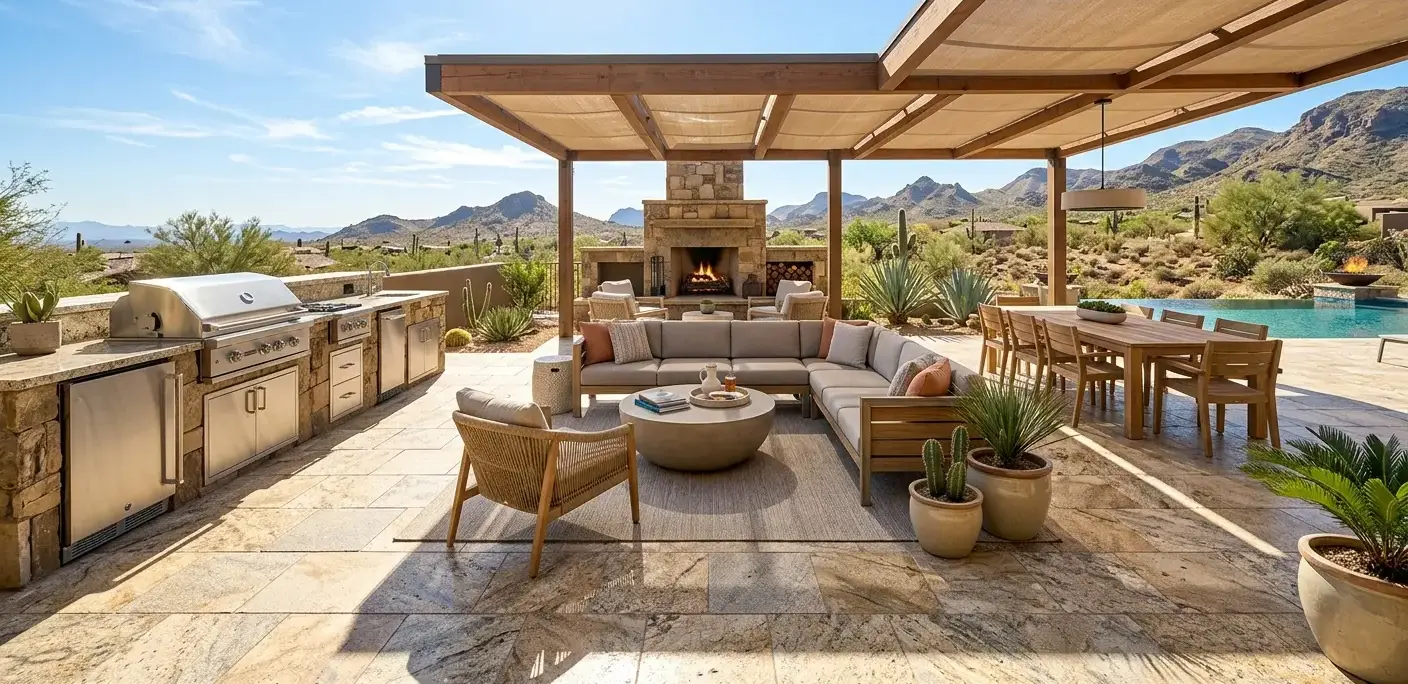
Granite and quartzite are generally the best natural stones for outdoor pavers because they are dense and absorb little water. Travertine is also widely used, but it is more porous and calls for closer attention to climate.
Granite pavers. Granite is hard and dense, and it resists scratches and acids, which suits patios, walkways, steps, and pool decks. It is also used where it has to stand up to salt used for snow melting. A few granites contain trace minerals that can discolor after long weather exposure, so ask how a specific stone has performed outdoors. Our granite comes in polished, leathered, and specialty finishes and is rated for indoor and outdoor floors, with UV resistance.
Quartzite pavers. Quartzite is a metamorphic stone formed from quartz-rich sandstone, so it shares much of granite’s resistance to wear and acids. Our quartzite is available in polished, honed, leathered, and specialty finishes and is rated for indoor and outdoor floors, with UV resistance.
Travertine pavers. Travertine is a form of limestone that develops near mineral springs, which gives it its pitted texture. It is calcareous, so acidic cleaners can etch it, and according to the ASTM C1527 standard for travertine, some travertines may not suit areas with frequent freeze-thaw cycles. Our travertine is available in polished, honed, leathered, and specialty finishes and is rated for indoor and outdoor floors.
What about marble? Marble is calcareous, so acid rain and acidic cleaners can dull or etch it over time. We recommend our marble for interior use rather than outdoor paving.
Other stones such as slate, sandstone, bluestone, and limestone are also used as pavers. Their properties vary widely from quarry to quarry, and stones are sometimes sold under the wrong classification, so ask for test data on any of them, the same way you would when comparing the granite and quartzite in our live slab inventory.
Are Porcelain Pavers Good for Outdoor Use?
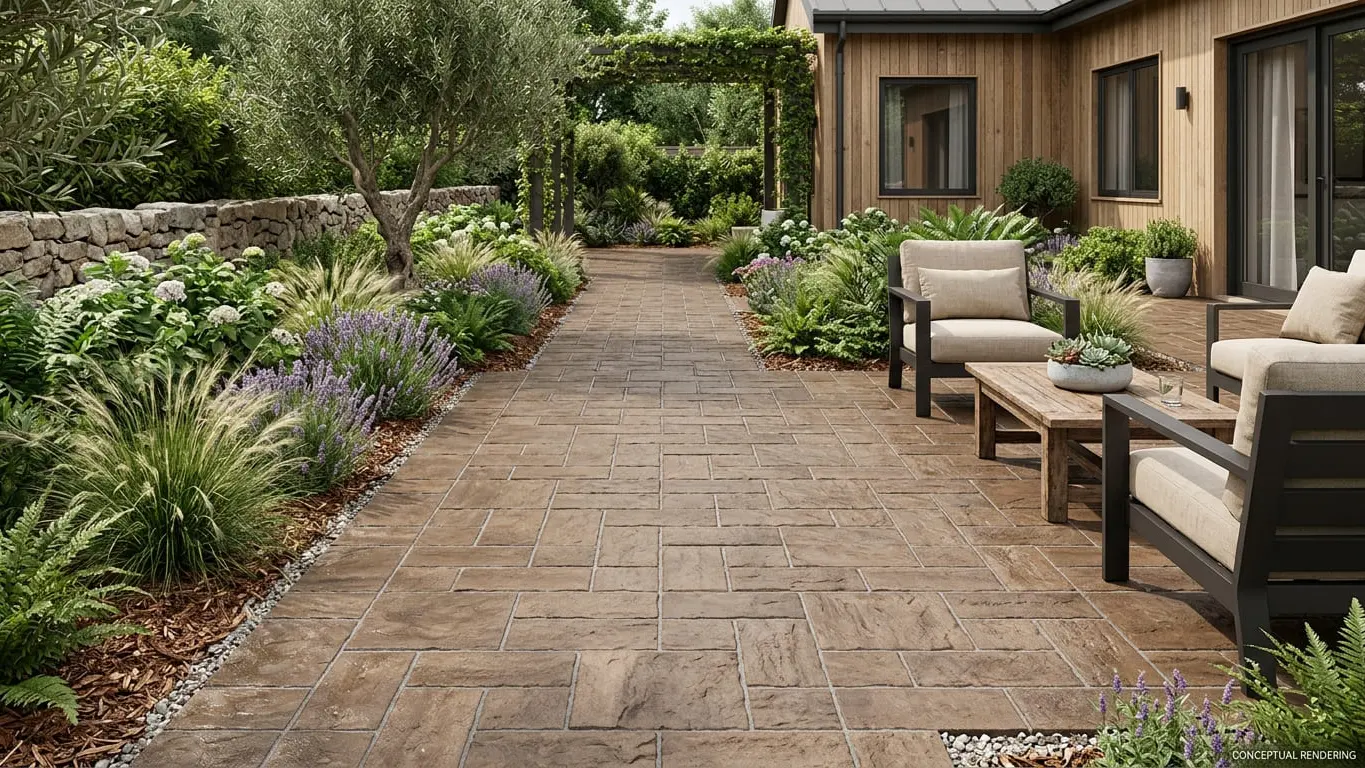
Yes. Porcelain pavers are a strong outdoor choice because they absorb almost no water, generally need no sealer, and typically resist freeze-thaw cycles, stains, and fading.
Porcelain pavers are thicker than standard porcelain tile, which is usually 8 to 10 mm. Gauged porcelain pavers are typically 2 cm thick or more, and that extra thickness lets them be laid over gravel, sand, or grass, set on pedestals, or bonded to a concrete slab. Bonded installation is generally recommended where pavers carry heavy loads, such as driveways.
Because porcelain’s color is fired into the material, it holds up well in full sun and around pool chemicals. It is also made in a wide range of looks, including stone, wood, and concrete, which makes it a practical option if you like the appearance of natural stone but want less upkeep. At Nova Tile and Stone, we carry porcelain tile rated for indoor and outdoor floors and walls, so one look can continue from an interior room out to the patio.
How Do Concrete and Brick Pavers Compare to Stone?
Concrete and brick pavers can both work well outdoors, but they are usually more porous than granite, quartzite, or porcelain, so climate and winter care play a bigger role in how long they last. Both are manufactured to industry standards.
Concrete pavers. According to the ASTM C936 standard, concrete pavers must have an average absorption of no more than 5% and an average compressive strength of at least 8,000 psi. The standard also sets freeze-thaw and deicing salt durability criteria, with an optional colder test for regions with severe winters. Deicer choice also matters, since some deicers can chemically degrade concrete.
Clay brick pavers. Clay pavers are fired brick. Pedestrian and light-traffic pavers are covered by ASTM C902, and heavy vehicular pavers by ASTM C1272. ASTM C902 also sorts brick into weathering classes, and Class SX is meant for water and freezing exposure, so it is the class to look for in cold climates.
What Are the Best Pavers for Cold Climates?
The best pavers for cold, freeze-thaw climates are generally low-absorption materials with proven frost performance, such as porcelain, granite, and quartzite.
Freeze-thaw damage happens when water soaks into a paver, freezes, and expands inside its pores. Pavers that stay wet for long periods, such as those in shaded areas or poorly drained spots, are the most exposed. Good drainage and a properly built base help every material, and deicers should be used only as needed.
For natural stone, there is not yet a formal ASTM freeze-thaw test written specifically for stone. The ASTM committee on dimension stone is developing freeze-thaw test methods for natural stone, and in the meantime, absorption data and a stone’s record in similar climates are the most practical guides.
If pavers will carry vehicles or be set on pedestals, involve a design professional. Pavers on pedestals are supported only at their corners, which makes each one a structural element, and stone pavers under vehicle traffic need to be designed for those loads.
Which Pavers Are Least Slippery When Wet?
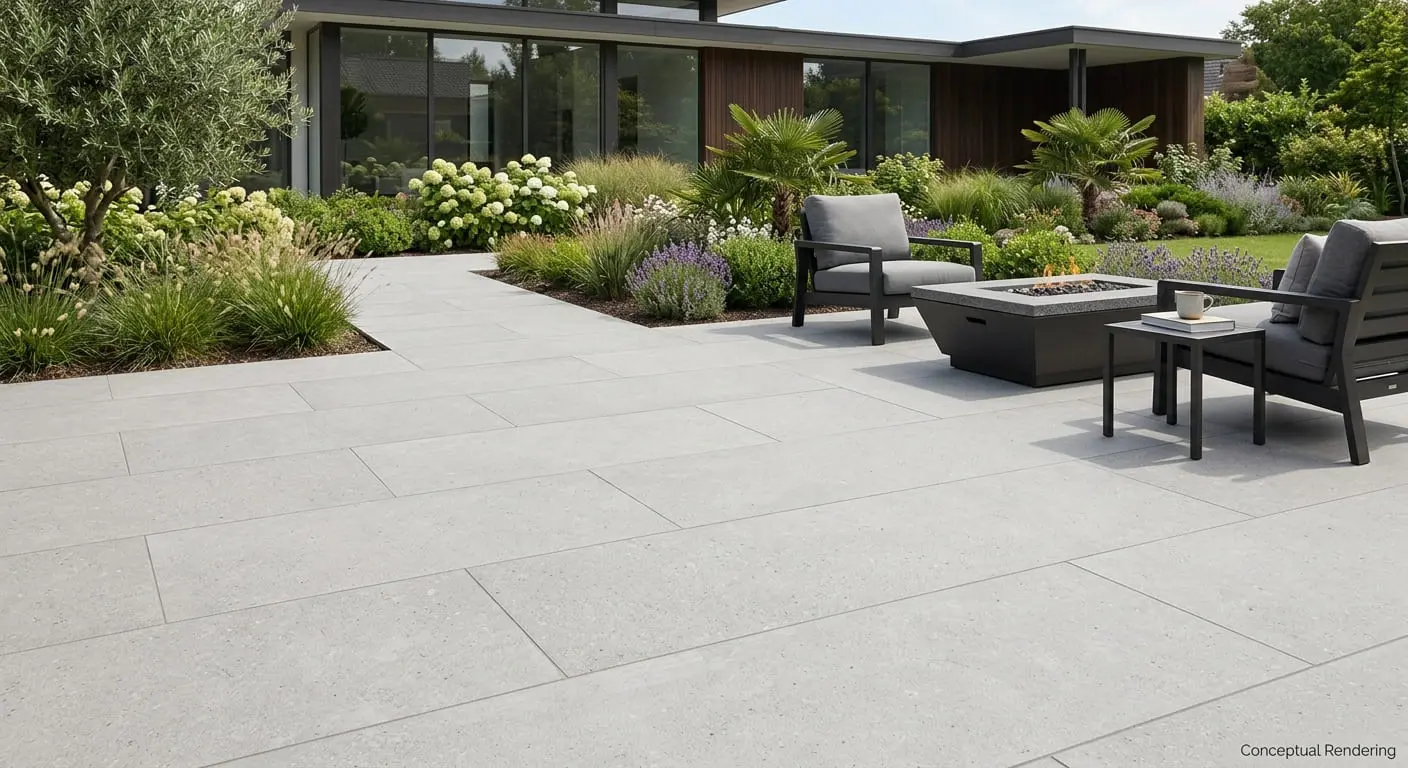
Pavers with a textured surface, such as flamed or bush-hammered stone and textured outdoor porcelain, are generally the least slippery when wet, while polished surfaces can become slick. For patios, steps, and pool decks, the finish often matters more for safety than the material itself.
- Flamed or thermal: Intense heat roughens the surface. It suits granite well, and because it affects roughly the top 1/8 inch of the face, that layer is usually left out of thickness calculations.
- Bush-hammered: A mechanical texture of small, even indentations that grips well in wet conditions.
- Leathered: A soft, textured feel with a low sheen.
- Honed: Smooth and matte, less reflective than polished but still fairly smooth underfoot.
- Polished: Glossy and smooth, better kept to walls and other vertical surfaces outdoors.
For any walking surface, ask for slip-resistance (DCOF) test results on the exact material and finish you are considering. Vertical surfaces are the exception, since slip testing is not needed for walls that never see foot traffic.
How Do You Clean and Maintain Outdoor Pavers?
Most outdoor pavers need only regular sweeping, rinsing with a neutral cleaner, and occasional treatment for algae or moss.
Routine cleaning. Sweep away grit, which acts as an abrasive underfoot. For natural stone, use a neutral cleaner, stone soap, or mild dish detergent and rinse well. Around pools, patios, and hot tubs, flush with clear water and use a mild bleach solution to remove algae or moss. Never mix bleach and ammonia, since the combination produces a toxic gas.
What to avoid on stone. Acidic cleaners can dull or etch calcareous stone such as travertine, marble, and limestone. Many household rust removers contain traces of hydrofluoric acid, which can attack every stone type, including granite and quartzite.
Sealing. Porcelain pavers generally do not need sealing. For natural stone, sealers are impregnators that act as repellents. They make stone more stain resistant, not stain proof, and many stones do not need sealing at all. If you seal, choose a product made for exterior use on your stone type and follow the manufacturer’s guidance on reapplication.
White powder on new pavers. A white powdery film called efflorescence comes from mineral salts carried up by water from below the surface. On a new installation, dry-brush it off as the pavers dry rather than washing it, and if it keeps returning, the moisture source needs attention.
Conclusion
Choosing outdoor pavers comes down to matching the material to its conditions. For cold winters and wet areas, low-absorption porcelain, granite, and quartzite leave the widest margin for error. For pool decks and steps, a textured finish should be near the top of your list. If you want the least upkeep, porcelain generally skips sealing, while natural stone rewards a little care with color and texture that vary from piece to piece.
If you would like to compare granite, quartzite, travertine, and porcelain pavers side by side, visit one of our showrooms or book a free design consultation with Nova Tile and Stone. Bring photos and details about your space, such as sun exposure, drainage, and winter conditions, and we can help you narrow the options.
Frequently Asked Questions
Neither is better in every case. Porcelain offers consistent color and generally needs no sealer, while natural stone gives each paver its own variation in color and texture, and dense stones like granite and quartzite also perform well outdoors.
Marble is generally better suited to interiors. It is a calcareous stone, so acid rain and acidic cleaners can dull or etch its surface over time.
Ask for current water absorption and freeze-thaw test data on the exact product. Low absorption helps, but it does not prove frost resistance on its own. Concrete pavers are tested for freeze-thaw durability, and clay brick pavers rated Class SX are intended for brick that may freeze while wet.
Rock salt is the least damaging deicer for concrete pavers. Magnesium chloride and calcium magnesium acetate are not recommended because they can chemically degrade concrete.
Porcelain pavers generally do not need sealing, and many natural stones do not require it either. When a stone is sealed, the sealer improves stain resistance but does not make the stone stain proof.
Sources
- ANSI A137.1, Porcelain Tile Definition (ANSI Blog) | https://blog.ansi.org/ansi/porcelain-ceramic-tile-ansi-a137-1-astm-definition/
- ASTM C615, Standard Specification for Granite Dimension Stone | https://store.astm.org/c0615_c0615m-23.html
- ASTM C1527, Standard Specification for Travertine Dimension Stone | https://store.astm.org/c1527_c1527m-23.html
- ASTM C936, Standard Specification for Solid Concrete Interlocking Paving Units | https://store.astm.org/c0936_c0936m-26.html
- ASTM C902, Standard Specification for Pedestrian and Light Traffic Paving Brick | https://store.astm.org/c0902-22.html
- ASTM C1528, Standard Guide for Selection of Dimension Stone | https://www.astm.org/c1528_c1528m-20.html
- Tile Council of North America (Why Tile), 2 cm Gauged Porcelain Pavers for Outdoor Spaces | https://whytile.com/2023/08/2-cm-gauged-porcelain-pavers-for-outdoor-spaces/
- Natural Stone Institute, ASTM International Standards | https://www.naturalstoneinstitute.org/stoneprofessionals/astm/
- Natural Stone Institute, Care and Cleaning of Natural Stone | https://www.naturalstoneinstitute.org/consumers/care/
- IIBEC, Dimension Stone Testing and Evaluation | https://iibec.org/publication-post/dimension-stone/
- ASTM International, Stone Cold: Dimension Stone Standards | https://www.astm.org/news/stone-cold-dimension-stone-standards-jf24
- Concrete Masonry and Hardscapes Association, The Effects of Deicing Chemicals on Interlocking Concrete Pavers | https://www.cmha.org/resource/pav-faq-001/
- Mason Contractors Association of America (Masonry Magazine), Brick Paver Installation Methods | https://masonrymagazine.com/Default?pageID=597
- Construction Canada, Selecting External Stone Cladding Material (page 1) | https://www.constructioncanada.net/selecting-external-stone-cladding-material/
- Construction Canada, Selecting External Stone Cladding Material (page 2) | https://www.constructioncanada.net/selecting-external-stone-cladding-material/2/
- Materiales de Construcción, The Effect of Surface Finishes on Outdoor Granite and Limestone Pavers | https://doaj.org/article/ccb9ea3af56740e8a2114e20b265a9a7
Note: Some images on this page may be conceptual renderings created to illustrate design possibilities and may not depict actual installations.