A Design-Ready Introduction to Outdoor Fireplace Surrounds
Ledger stone is a stacked natural stone veneer cut into flat, linear panels that mimic hand-set masonry without the bulk of full-bed stone. For outdoor fireplace surrounds, this stacked veneer delivers a textured, dimensional face that reads as rugged yet refined, pairing naturally with stucco, wood siding, or glass railings.
Homeowners sketching ledger stone outdoor fireplace ideas for modern homes often favor cool gray or warm taupe tones set in a straight stack pattern for a cleaner, architectural look. Because panels ship thin rather than full depth, the material suits vertical chimney chases, accent columns, and feature walls framing an outdoor hearth, without adding excess bulk to a facade.
Color and texture vary by quarry batch, which is part of the character of any natural stone veneer rather than a flaw to correct. For a broader primer on how veneer categories differ before narrowing a look, This Old House's stone veneer guide covers the basics of panel format, depth, and typical use cases. Outdoor fireplaces built from this material tend to anchor a backyard the way a fireplace anchors an indoor living room, giving the patio a clear focal point after dark.
Pairing the stacked texture with a simple steel mantel shelf or a built-in wood storage niche keeps the overall look current rather than rustic, which matters for homeowners comparing stacked stone options against more traditional stone-clad designs for a contemporary exterior.
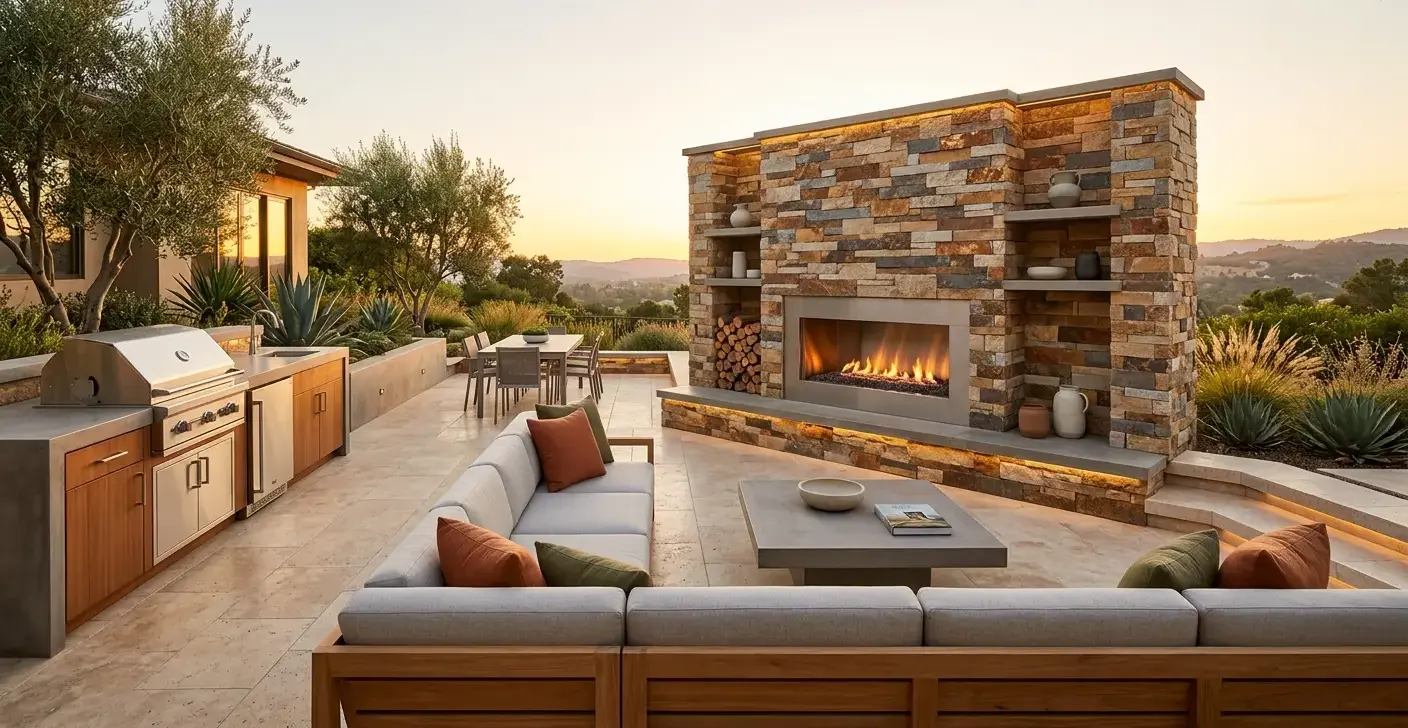 Conceptual rendering
Why Stacked Stone Veneer Elevates Fireplace Design
This stacked veneer's visual texture and thin panel format make it a popular pick for exterior stone features, though every project benefits from a few practical considerations before specifying panels for an outdoor hearth.
- Textured, dimensional face that reads differently at each viewing angle, adding depth to flat facades
- Thin panel profile that keeps buildup shallow around chimney chases and accent columns
- Wide tonal range, from cool charcoal to warm sandstone, for coordinating with existing patios
- Natural variation between panels, so no two fireplace surrounds look identical
- Compatible with mixed materials like wood mantels, metal fire bowls, or glass wind guards
- Works as a vertical accent even on a small footprint, such as a narrow chimney chase or column
Durable surfaces still need routine care, and exposure ratings vary by quarry lot.
Confirming a specific batch's freeze-thaw and sealing requirements with a design consultant is recommended before finalizing an outdoor specification, especially across colder service areas where winter cycling is more frequent.
Routine care is straightforward but not optional. Rinsing off dust, leaf litter, and ash buildup near the firebox keeps the surface looking fresh.
Resealing on a schedule suited to the finish helps the stone resist staining from smoke and weather exposure over time.
Ledger Stone Design Applications for Modern Outdoor Living
Outdoor fireplace surrounds built from stacked stone veneer appear across a range of layouts, from slim linear chimneys to broad fireplace walls anchoring an entire patio. The applications below show where this panel format and texture tend to perform best, along with planning notes worth discussing before finalizing a layout.
Straight Stack Chimney Surrounds
Straight stack panels, set in tight horizontal courses, suit contemporary outdoor rooms with clean roof lines and minimal ornamentation. The repeating linear pattern draws the eye upward along a chimney chase, which pairs well with flat-panel railings, concrete pavers, or linear fire features. Grout lines stay narrow and consistent, reinforcing the architectural look many current exterior designs pursue, particularly in newer subdivisions built around open-concept patios.
Multi-Tone Feature Walls
Blending two or three tones across a single feature wall creates depth without relying on pattern alone. This approach suits larger fireplace walls that extend past the firebox to include built-in seating or storage niches, giving the stone surface enough area to show its natural color shifts across a wider plane.
Color and Finish Selection
Finish and tone selection usually follows the surrounding hardscape rather than the house itself, since a fireplace wall sits closer to pavers and patio furniture than to siding. Cooler gray blends tend to read as more contemporary, while warmer taupe and tan blends lean toward a traditional or transitional look.
Lighting also changes how a finish reads outdoors. A matte, natural cleft face tends to soften under string lights or a built-in gas insert. A flatter sawn face shows more contrast under direct sun, which is worth viewing in person at a showroom before finalizing a tone family.
Coordinating Fireplace and Patio Flooring
When a fireplace surround sits beside a patio or pool deck, flooring safety becomes part of the design conversation. The ANSI and NFSI wet DCOF safety standard outlines benchmark friction values for walkways, and reviewing those figures alongside any paving material helps keep the area around a fire feature safer underfoot in wet conditions.
Planning a Stacked Stone Fireplace Surround: Five Steps
- Measure the chimney chase or fireplace wall, noting height, width, and any curves the panels must follow.
- Select a tone family and pattern, choosing between straight stack, random stack, or multi-tone blends.
- Request freeze-thaw and sealing documentation for the specific quarry lot being considered, especially for colder service areas.
- Compare panel pieces against existing patio, roofing, or siding materials for tonal consistency before committing to a final blend.
- Schedule time with a design consultant to review quantities, finishes, and crate availability before placing an order.
Natural stone veneer categories vary in how they are tested for exterior exposure.
The ASTM's freeze-thaw testing proposal outlines how standardized testing is evolving for natural stone, which is part of why confirming lot-specific documentation matters before finalizing a cold-climate project.
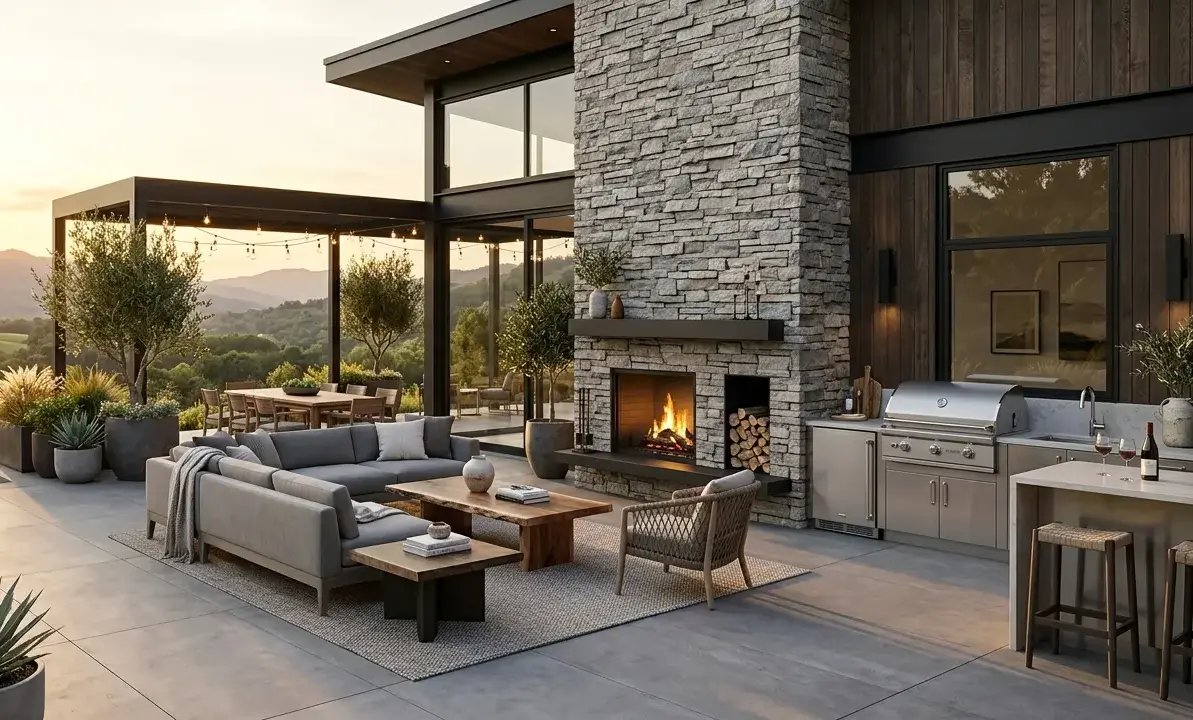 Conceptual rendering
Stacked Stone Veneer vs. Manufactured Stone Veneer
Feature | Natural Stacked Stone | Manufactured Stone Veneer |
Material source | Quarried natural stone | Cast concrete with pigment |
Texture | Natural panel variation | Molded, repeating texture |
Color range | Quarry-dependent, naturally varied | Factory-controlled, consistent |
Weight | Heavier, thin-panel format | Generally lighter overall |
Typical finish | Natural cleft or sawn face | Textured cast finish |
Advantages and Planning Considerations
Advantages
- Distinct natural texture unavailable in cast alternatives
- Thin panel profile reduces buildup around tight chimney details
- Wide tonal range supports custom blending across a feature wall
Planning Considerations
- Exposure ratings vary by quarry lot and should be confirmed before ordering
- Natural variation means panels should be viewed and blended in person
- Sealing schedules depend on climate and finish, not universal across projects
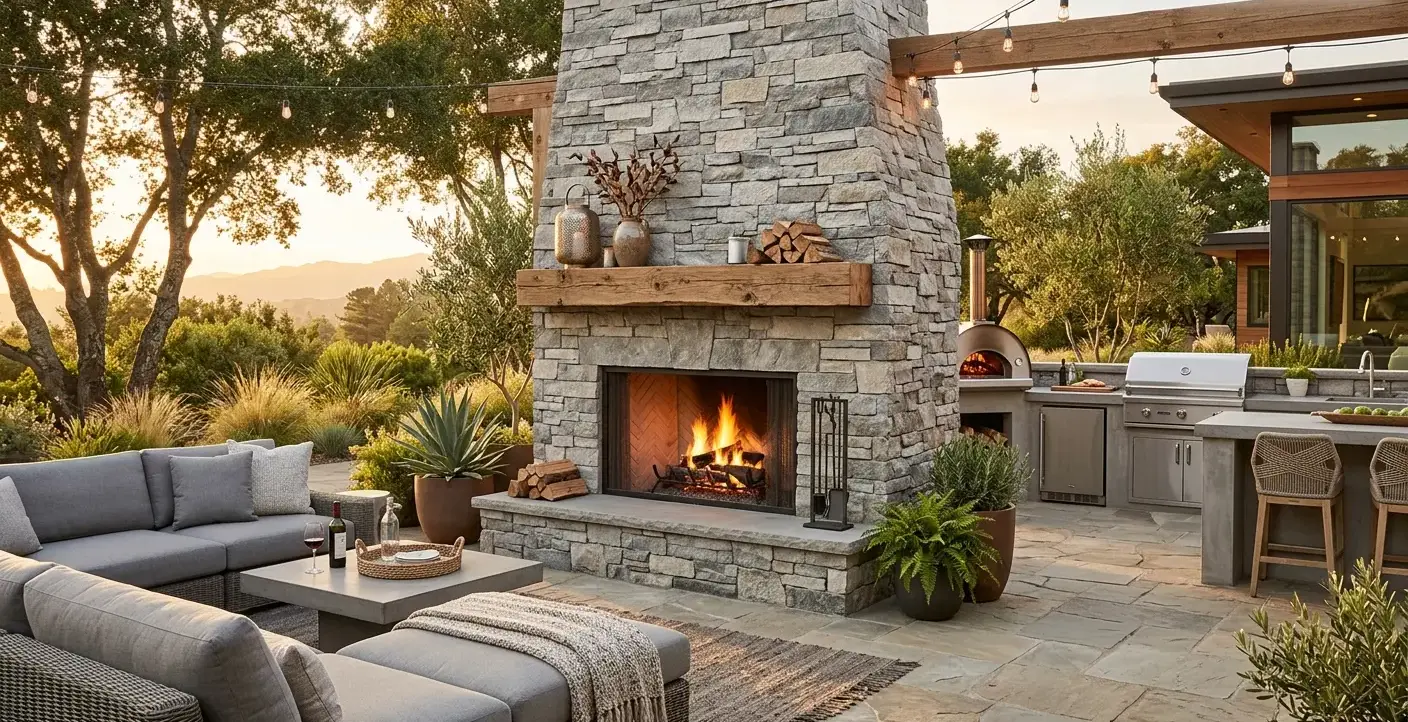 Conceptual rendering
Sourcing Stacked Stone Veneer Through Nova Tile and Stone
Design consultants help compare tone families, panel formats, and crate quantities for a specific chimney or fireplace wall, translating rough dimensions into an accurate material list before fabrication begins elsewhere. These consultations are commission-free, and arranged delivery assistance is available once an order is confirmed, so homeowners outside the immediate area are not limited to showroom pickup alone.
Panels can be viewed in person at the Fernley showroom, where a rotating display sits alongside outdoor fireplace mockups. The Reno showroom carries one of the wider tone selections for side-by-side comparison. The Minden showroom can arrange private viewings for larger wall quantities. The Sacramento location stocks additional multi-tone blends suited to feature walls. Anyone narrowing down a look from home can browse the exterior stone catalog before visiting a showroom in person.
Scheduling a short consultation ahead of time helps confirm exact quantities and tone selections before quarry lots change. A design consultant can book a consultation to start that conversation. Fernley, Reno, Sacramento, and Minden projects each face different seasonal conditions, from valley fog to mountain snow load. A consultant familiar with the local service area can flag which tone families and finishes tend to hold up best for a given backyard before an order is placed.
Conclusion
Ledger stone turns an outdoor fireplace or chimney surround into a textured, architectural focal point, provided exposure ratings and sealing needs are confirmed for the specific quarry lot selected. From straight stack chimneys to multi-tone feature walls, this stacked veneer adapts to a range of modern exterior styles, and browsing Nova's exterior stone selection is a reasonable starting point before narrowing down a design. Schedule a free consultation today to begin planning!
Visit Us In Person
Slabs and tile look different in person. Walk our floor, find some samples, take them home. Our showroom selections are carefully curated to bring everything you need under one roof.
Minden
2548 Business Pkwy, Minden, NV 89423
- Mon–Fri: 7:30am – 6:00pm
- Sat: 9:00am – 3:00pm
- Sun: Closed

BOOK NOW
Sacramento
6100 Warehouse Way, Sacramento, CA 95826
- Mon–Fri: 7:30am – 6:00pm
- Sat: Closed
- Sun: Closed

BOOK NOW

Reno
12835 Old Virginia Rd, Suite 24 Reno, NV 89521
- Mon–Fri: 7:30am – 6:00pm
- Sat: 9:00am – 3:00pm
- Sun: Closed

BOOK NOW
Frequently Asked Questions
It is most often used as a veneer surface on chimney chases, accent columns, and feature walls surrounding an outdoor firebox, prized for its stacked, dimensional texture that reads well from multiple viewing angles across a patio or backyard.
Suitability depends on the specific quarry lot's freeze-thaw and sealing documentation, so confirming that data with a design consultant before specifying a cold-climate project is recommended rather than assuming uniform performance across every batch.
Natural stacked stone is quarried with inherent color and texture variation from piece to piece, while manufactured veneer is cast from pigmented concrete and tends to repeat a more uniform, molded texture across panels.
Most natural stone veneers benefit from periodic sealing, though the exact schedule depends on climate, finish, and the specific stone, so confirming a maintenance routine for the chosen lot with a design consultant is worthwhile before finalizing a project.
Yes, it pairs well with wood mantels, metal fire bowls, glass wind guards, and concrete or paver flooring, which is part of why it shows up so often in layered, mixed-material exterior designs.