At a Glance
- Outdoor-rated stones: Granite, quartzite, and travertine are all rated for outdoor use. Marble and quartz are not.
- Best for full sun: Granite, the only natural stone in our outdoor group that we rate UV resistant.
- Best for covered or partly shaded spots: Quartzite and travertine, such as covered patios, shaded walkways, and loggias.
- Outdoor kitchens: Granite is the one outdoor stone we rate for food preparation and kitchen surfaces.
- Plan ahead: Choose stone for the shade the space will have once the project is finished, not the shade it has today.
- Shade upkeep: Shaded stone stays damp longer and can grow algae and moss, so plan for routine care.
In This Post
- Test One: Can the Stone Go Outside?
- Test Two: How Does It Handle All-Day Sun?
- Where Granite Earns Its Place
- Where Quartzite and Travertine Fit Best
- Plan for the Shade You Will Have, Not the Shade You Have Now
- Map Your Property Before You Shop
- Shade Brings Its Own Upkeep
- For Contractors and Designers
- Conclusion
- Frequently Asked Questions
- Sources
Natural stone is good for outdoor use when the stone is rated for exterior applications and matched to how much sun the surface gets. Of the natural stones Nova Tile and Stone carries, granite, quartzite, and travertine are rated for outdoor use, and granite is the only one we rate UV resistant.
That makes granite our pick for full-sun patios, entry steps, and facades, though results can differ by color and finish. Quartzite and travertine fit best in covered or partly shaded spots, and we do not recommend marble or quartz outdoors.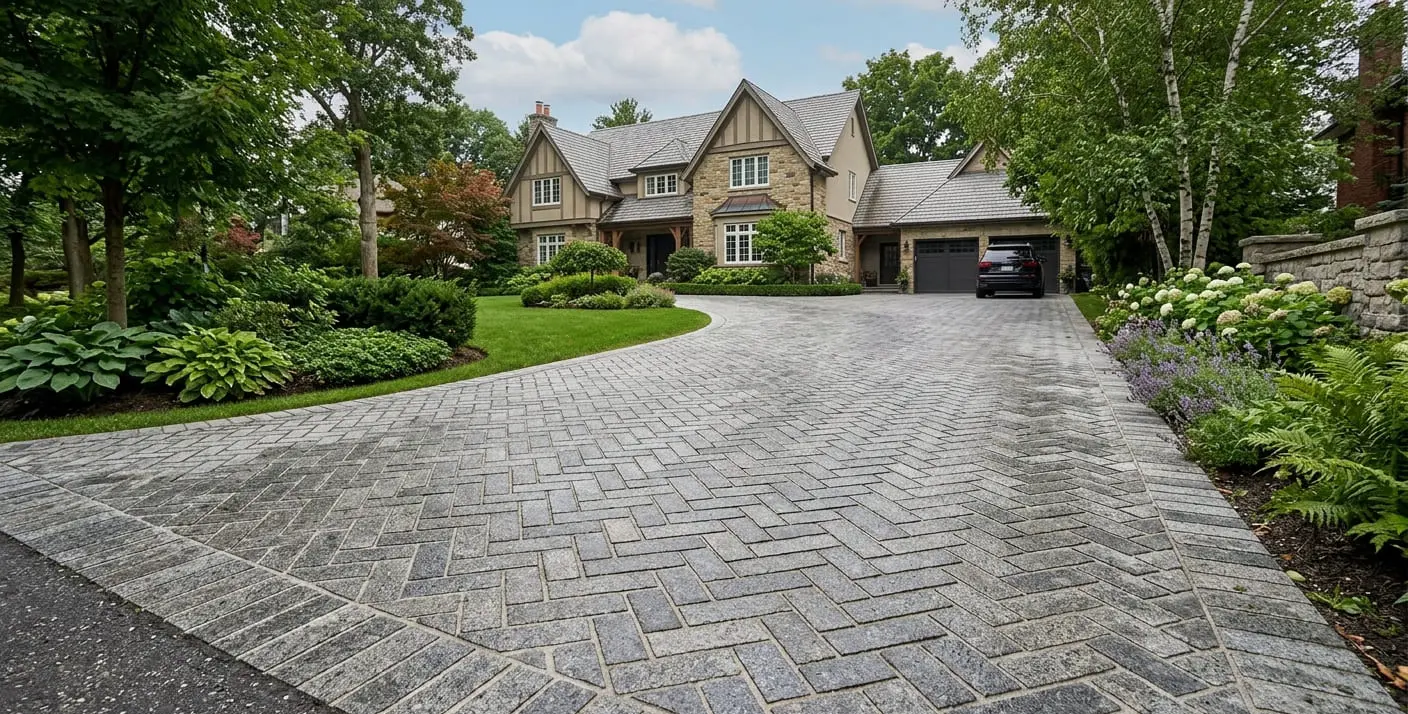
Test One: Can the Stone Go Outside?
Granite, quartzite, and travertine pass this first test. Marble and quartz do not, however good they look in the showroom.
That rules out an easy mistake: carrying marble out to a patio bar or a fire pit surround. Marble belongs inside, on floors, walls, and fireplaces, and one of the three outdoor stones should take its place anywhere outside.
Our exterior stone guide is a good place to see the range of outdoor placements, from front elevations to accent walls.
Passing this first test is a starting point, not a guarantee, since how a stone is set outside matters as much as which stone you pick.
Test Two: How Does It Handle All-Day Sun?
Here the field narrows to one. Granite is the only natural stone in our outdoor group that we rate UV resistant, which makes it our first pick for any surface that sits in direct sun from morning to evening.
We rate quartzite and travertine for outdoor use, but not as UV resistant. That does not make them poor outdoor choices. It means we do not make a sun resistance promise for them, and we would rather say so before you pick a slab than after.
Measuring sun exposure beats guessing at it. The EPA publishes a daily UV Index forecast by city and ZIP code, and checking it for your address during summer is a simple way to see how exposed an open patio really is.
Partial sun is where most of the judgment calls happen. A wall that catches only morning light, or a walkway shaded by the house after noon, sits closer to covered than to full sun, and we treat it that way when matching a stone.
Where Granite Earns Its Place
Granite is our recommendation for the most exposed spots on a property: an uncovered terrace, a south-facing patio, front entry steps, or a column wrap on a sunny facade.
Finish choice matters outdoors, and granite gives you the full range, from polished and honed to leathered and specialty finishes. For walking surfaces we lean toward honed or leathered over polished, since a textured surface gives better footing when wet, though caution is still worthwhile on any wet exterior surface.
Granite is also the one outdoor stone we rate as suitable for food preparation and kitchen surfaces, which makes it the clear pick for an outdoor kitchen counter in an open yard. Keep a cutting board handy rather than cutting straight on the stone.
The same reasoning carries over to a hearth or fire feature built out in the open. Granite is rated for fireplaces as well as outdoor use, so a single stone can run from the counter to the fire feature without giving up sun resistance.
To see which granite colors and finishes are on hand right now, browse our live slab inventory before planning the layout.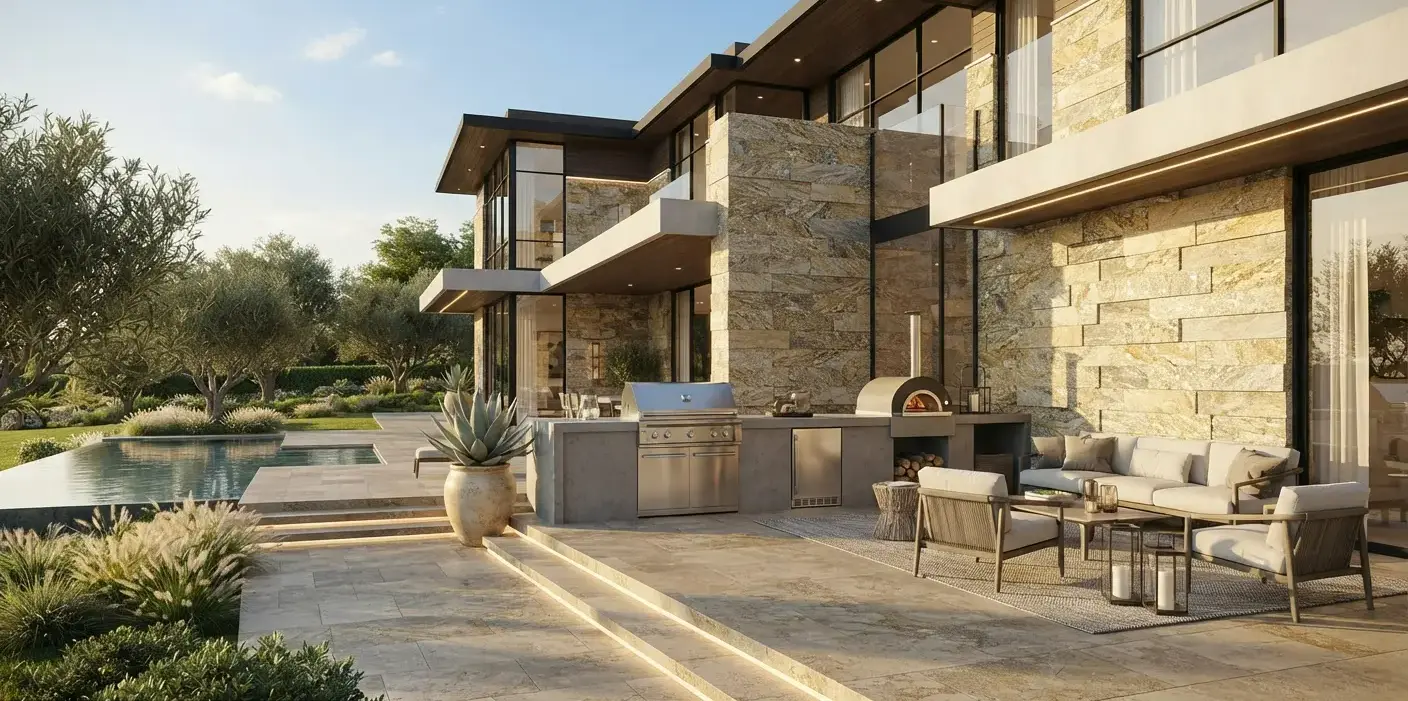
Where Quartzite and Travertine Fit Best
Quartzite and travertine are excellent outdoor stones in the right location. Our pick for both is a covered patio, a shaded walkway, a loggia, or a wall that only catches part of the day's sun.
Quartzite is a good fit for exterior wall cladding and covered patios, with polished, honed, leathered, and specialty finishes all suited to it. Routine care keeps its finish looking sharp.
It also makes a striking fireplace wall under a patio roof, a spot where the overhead cover takes direct sun out of the picture and lets the stone's finish do the talking.
Travertine brings warm, earthy color to patios and walkways, and we offer it in polished, honed, and leathered finishes. Its natural pores are part of its character, so treat sealing as part of owning it rather than an afterthought.
Our page on natural stone for exterior walls and facades goes deeper on how each of these three stones behaves outside.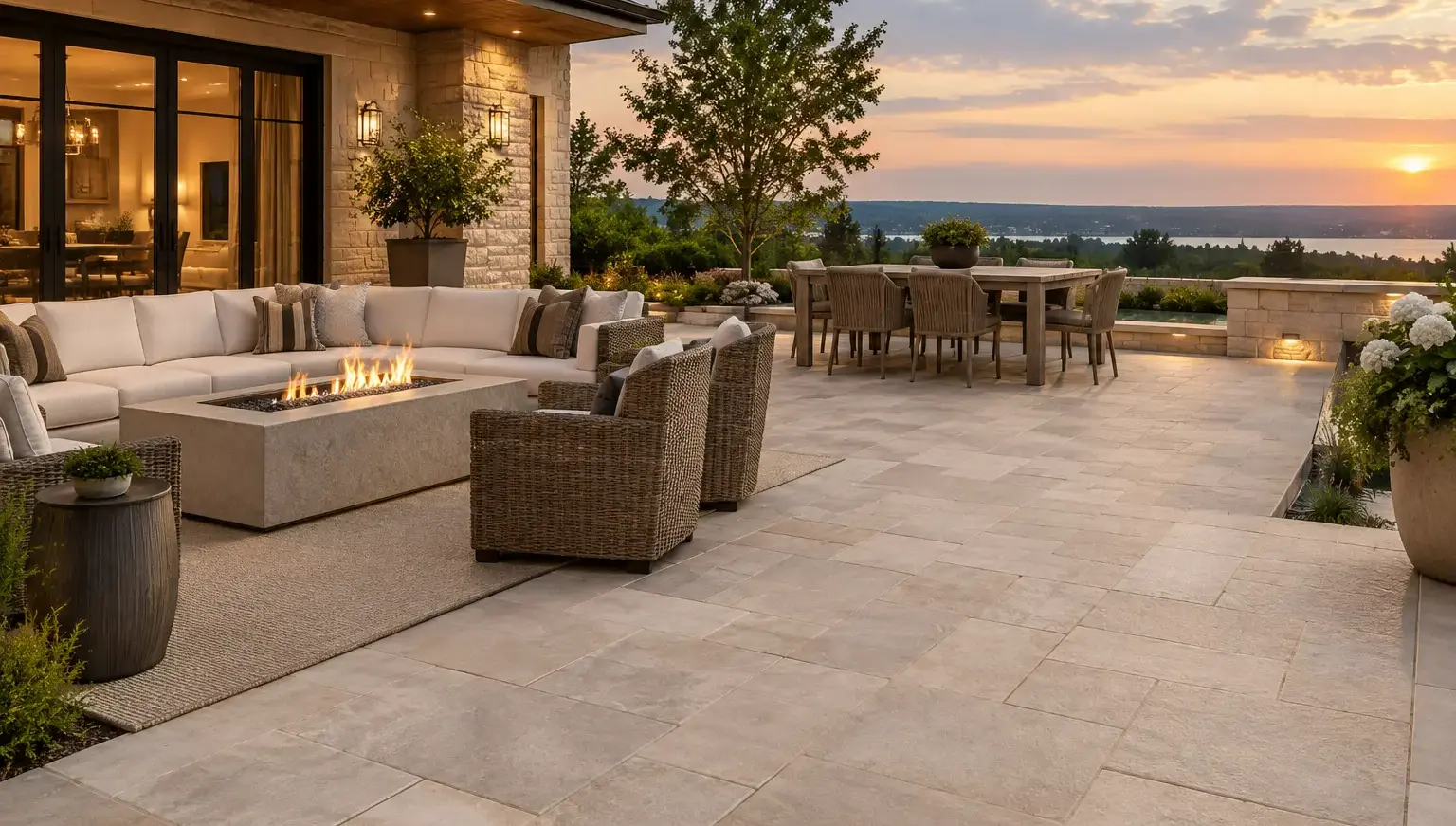
Plan for the Shade You Will Have, Not the Shade You Have Now
Sun exposure is not fixed. A pergola, a patio cover, or a row of young trees can turn a full-sun spot into a shaded one within a few seasons, and the opposite happens when an old tree comes down.
We recommend choosing stone for the space as it will look once the project is finished. If a patio cover is part of the plan, quartzite and travertine are realistic options underneath it, even if that patio sits in open sun today.
The reverse matters too. If a shade tree is aging or slated for removal, treat the area below it as full sun and lean toward granite, so the stone choice still holds up after the canopy is gone.
Map Your Property Before You Shop
Before visiting a showroom, walk the property around midday and sort every planned surface into three groups: full sun, partial sun, and covered. That five-minute exercise does more for the finished result than any color decision.
Full-sun surfaces go to granite. Partial-sun and covered surfaces open the door to quartzite and travertine as well, so the choice among the three can come down to look, finish, and how the stone pairs with the house.
A single project can use more than one stone. Granite steps at a sunny front entry and quartzite cladding on a shaded side wall, for example, put each material where it performs best.
Bring that sun map, plus photos of each area, to a free design consultation. Our design team uses it to narrow the selection to stones that suit both the space and the light.
Shade Brings Its Own Upkeep
Shaded and covered spots solve the sun question, but they stay damp longer, which is where algae and moss tend to get a foothold. That matters most for quartzite and travertine, since those are the stones we steer toward shade.
The Natural Stone Institute's stone care recommendations cover how to deal with algae and moss on outdoor stone. One safety point from that guidance is worth repeating: never mix bleach and ammonia when cleaning.
On the sunny side of the property, granite needs only a gentle cleaner and an occasional rinse to stay looking its best.
For Contractors and Designers
Trade pros specifying outdoor stone across several jobs can apply for a trade account for a dedicated rep and job-site delivery across Northern Nevada and Northern California.
When a client has settled on a granite terrace or a quartzite feature wall, our slab quote request form lets you list the slabs you are interested in, along with any bundle numbers you have already picked out.
For designers presenting options, the two tests make a simple client conversation: show granite for the exposed areas and offer quartzite or travertine wherever cover allows, so every choice on the board already fits its location.
Projects with green building goals often need more than a sun rating. The Natural Stone Institute's consumer site, Use Natural Stone, has an article explaining environmental and health product labels for natural stone, which is useful background before a client meeting.
Conclusion
Once every surface has a sun label, the stone list mostly writes itself, and the remaining choices come down to color, finish, and how each stone sits next to the house. Those are easier to judge in person than on a screen.
Bring your sun map to one of our showrooms in Reno, Minden and Sacramento, and compare granite, quartzite, and travertine side by side before you commit to a slab.
Frequently Asked Questions
Of the natural stones we carry for outdoor use, granite is the only one we rate UV resistant, though performance may vary by color and finish. Quartzite and travertine are rated for outdoor use but not for UV resistance.
We do not recommend it. Marble is not rated for outdoor use, so we suggest keeping it to indoor floors, walls, and fireplaces and choosing granite, quartzite, or travertine for exterior spaces.
Travertine is rated for outdoor use, but we do not rate it as UV resistant. We suggest it for covered or partly shaded spots and steer surfaces that get sun all day toward granite.
Quartzite is rated for outdoor use, but we do not rate it as UV resistant. For walls or patios that sit in full sun all day, granite is the safer choice.
Granite is the only stone in our outdoor lineup that we rate for food preparation and kitchen surfaces, with a cutting board recommended for any chopping.
Sources
- U.S. Environmental Protection Agency, The UV Index | https://www.epa.gov/sunsafety/uv-index-1
- Natural Stone Institute, Care & Cleaning of Natural Stone | https://www.naturalstoneinstitute.org/consumers/care/
- Natural Stone Institute (Use Natural Stone), Understanding Environmental and Health Product Labels for Natural Stone | https://usenaturalstone.org/understanding-environmental-and-health-product-labels-for-natural-stone/
Note: Some images on this page may be conceptual renderings created to illustrate design possibilities and may not depict actual installations.