Hardscape is the layout a patio, walkway, or pool deck's stone surface is arranged in, not just the material chosen for it, and the four layouts used most often are French pattern, ashlar, running bond, and herringbone. French pattern locks four different stone sizes into a repeating sequence, while running bond staggers matching pieces in simple rows, and that difference changes joint spacing, cutting waste, and how the finished surface actually reads.
Travertine outdoor paving is one piece of our full product lineup, and it is available in all four of those layouts, across polished, honed, and leathered finishes. Each layout is a distinct planning decision, not a default a contractor reaches for once the base is poured.
Most homeowners planning a patio or pool deck settle on a stone color first and leave the layout question for later. That order skips a decision that affects water movement across the surface, how borders and curves get cut, and how the finished space actually reads at full scale.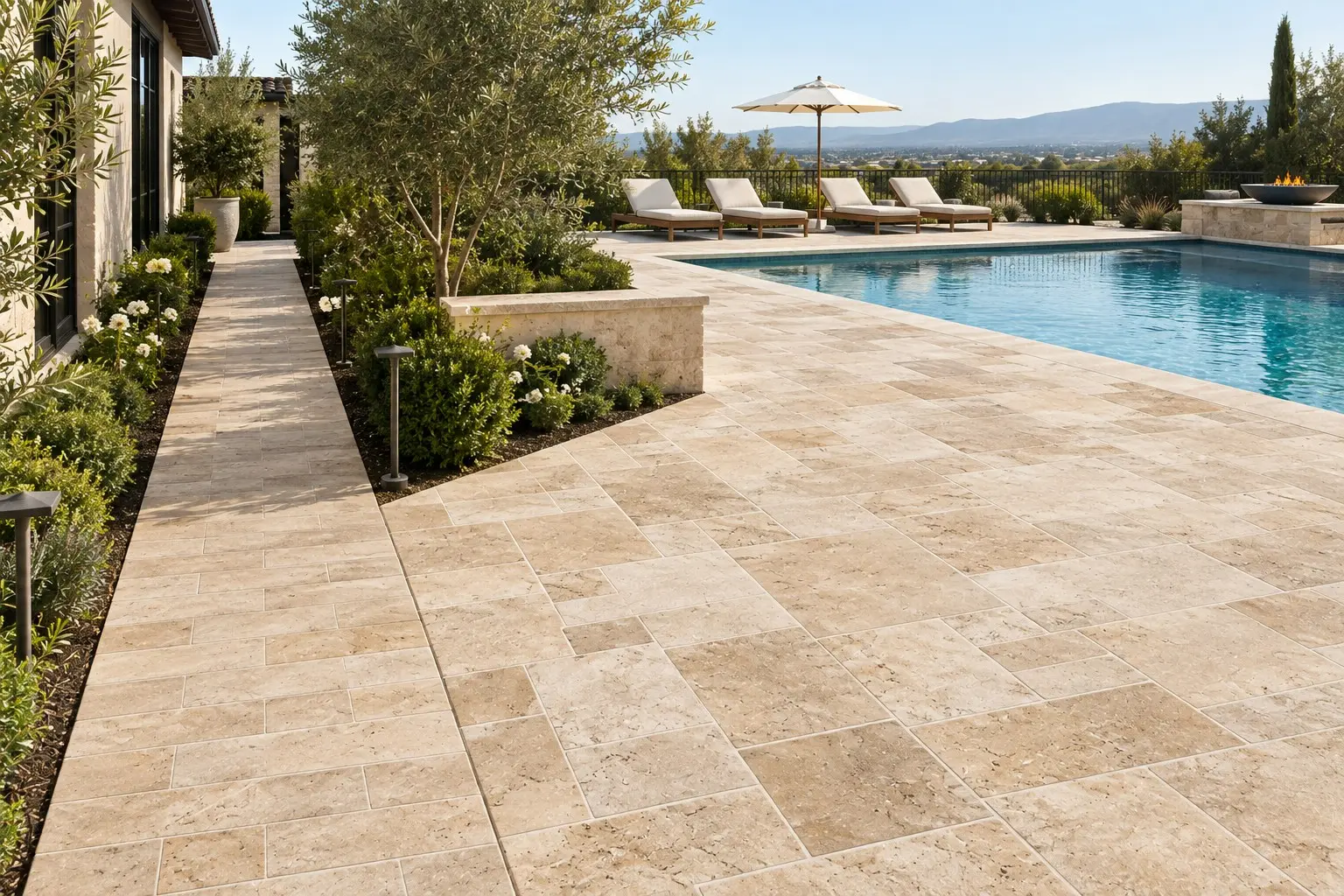
Reading the Space Before Choosing a Layout
A walkway two feet wide reads differently than a pool deck forty feet across, and the layout has to match the space, not just the stone. A narrow garden path suits a tighter, more uniform pattern, while a wide patio has room for the size variation French pattern is built around.
Pool coping and step edges also shape the layout choice, since a pattern with more joint lines needs more attention paid to where those joints fall relative to a pool edge or a step nosing. A curved pool edge, a fixed planter, or a built-in fire feature all interrupt a layout at a specific point, and that interruption reads differently depending on whether the surrounding pattern has consistent piece sizes or a varied mix.
This is a planning decision that belongs at the start of a project, alongside material selection, not as a detail settled later. Sketching the actual footprint, including any curves, steps, or fixed obstacles, before choosing a layout saves homeowners from discovering a mismatch once the stone has already been ordered.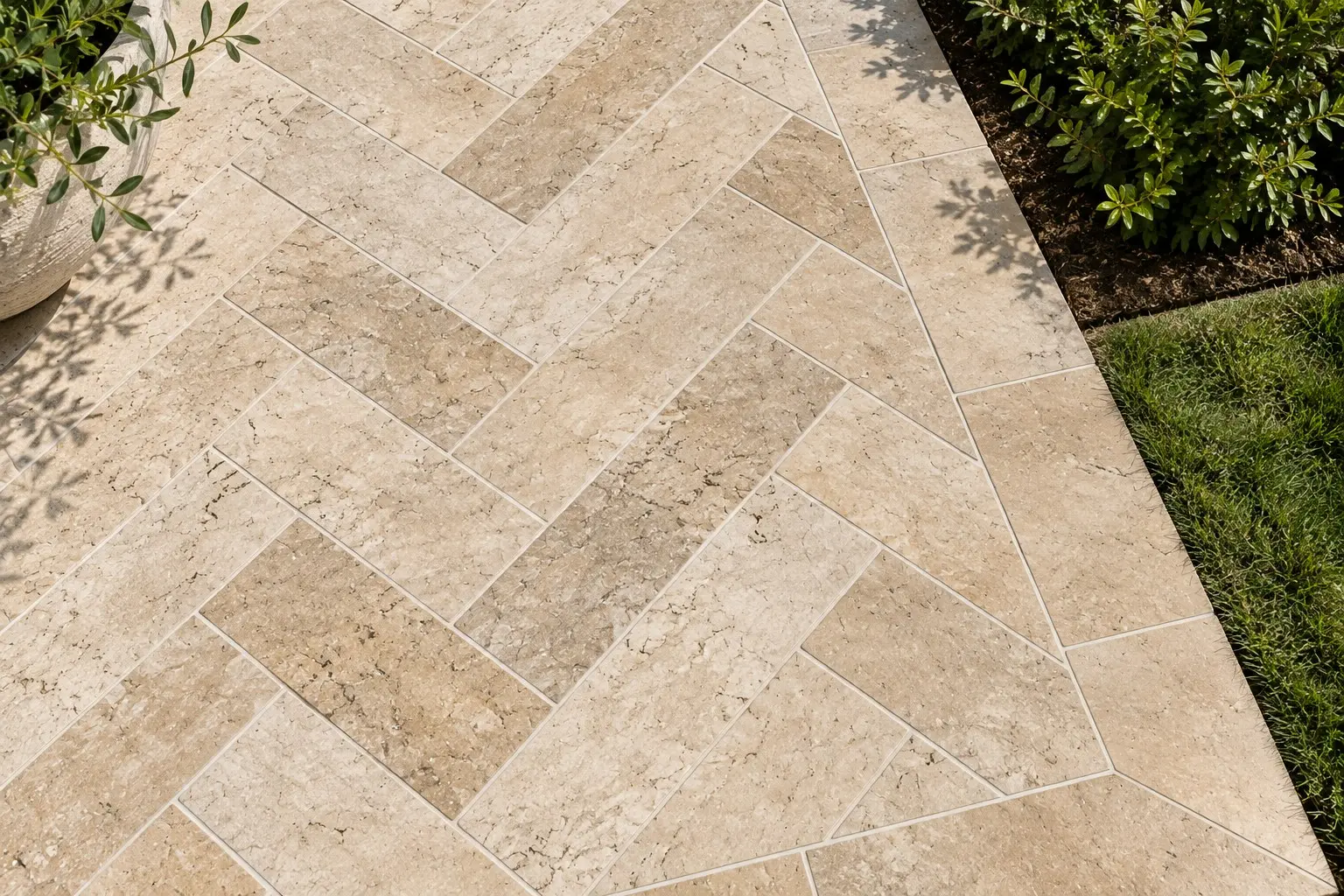
French Pattern, Ashlar, Running Bond, and Herringbone
French pattern combines four interlocking stone sizes set in a repeating sequence, a layout built for irregular, old-world rhythm rather than a uniform grid. It is the layout most associated with long-established courtyards and formal patios.
Ashlar arranges rectangular blocks of varying sizes in a coursed, staggered layout, giving a structured look while still avoiding a repetitive grid. Running bond offsets rows of matching pieces in a simple, repeating stagger, and it is the most straightforward layout to plan around a rectangular patio or walkway.
Herringbone sets each piece at an angle so it locks against the next, producing a woven look that pulls more cut pieces along the edges of a space. Our travertine slabs are cut in standard 2 centimeter and 3 centimeter thicknesses, with full-format pieces reaching roughly 126 by 63 inches, and that format factors directly into how a French pattern's four sizes get cut from a single slab run. You can browse our current slab inventory to see how a given travertine batch reads across these layouts before settling on one.
Cutting Waste and Borders Along a Patio Edge
Irregular layouts like French pattern and herringbone create additional cut pieces where the pattern meets a straight border or a curved planting bed, since matching varied joint lines against a fixed edge takes extra individual cuts. Running bond lines up naturally against a rectangular perimeter, since its repeating, uniform sizing was built to meet a straight edge cleanly.
This matters most on smaller patios and narrow side-yard walkways, where border cuts make up a larger share of the total surface than they would on a large pool deck. Homeowners planning a compact space should factor this into the layout conversation early, since it affects how much of the finished surface is full-size stone versus fitted edge pieces.
Carrying One Stone Layout from Patio to Indoor Rooms
Granite, quartzite, and travertine are each rated for indoor floors, walls, and fireplace surrounds in addition to outdoor use, which means a hardscape layout built around one of those materials does not have to stop at the threshold. A patio in French pattern travertine can continue into an entryway floor or a fireplace surround in the same stone, rather than switching materials where the outdoor space meets the house.
That continuity is a planning decision worth making early, since it means choosing a layout for the patio and a complementary layout for the adjoining indoor floor at the same time, rather than treating them as two separate projects with two separate material choices. Homeowners working toward that kind of indoor-outdoor match often find it easier to settle on a single slab run for both spaces rather than sourcing indoor and outdoor stone separately later.
Layout and Climate in a Freeze-Thaw Region
Our showrooms sit in Reno, Minden, Sacramento, and Fernley, a footprint where stone patios and pool decks go through real seasonal temperature swings. Outdoor stone in that kind of climate needs a layout and installation plan that accounts for expansion and contraction across the surface, not just a color that matches the house.
Granite and quartzite are both suited to outdoor use, and travertine's naturally porous structure lets water move through the surface rather than sit on top of it. The slab or surface is suitable for outdoor use, but installation must match the application, which is part of why a layout decision benefits from an in-person conversation rather than a photo alone. Homeowners in the region can check showroom locations across the region and stop by our Reno showroom, or our Sacramento showroom, to see granite, quartzite, and travertine slabs side by side before finalizing a layout.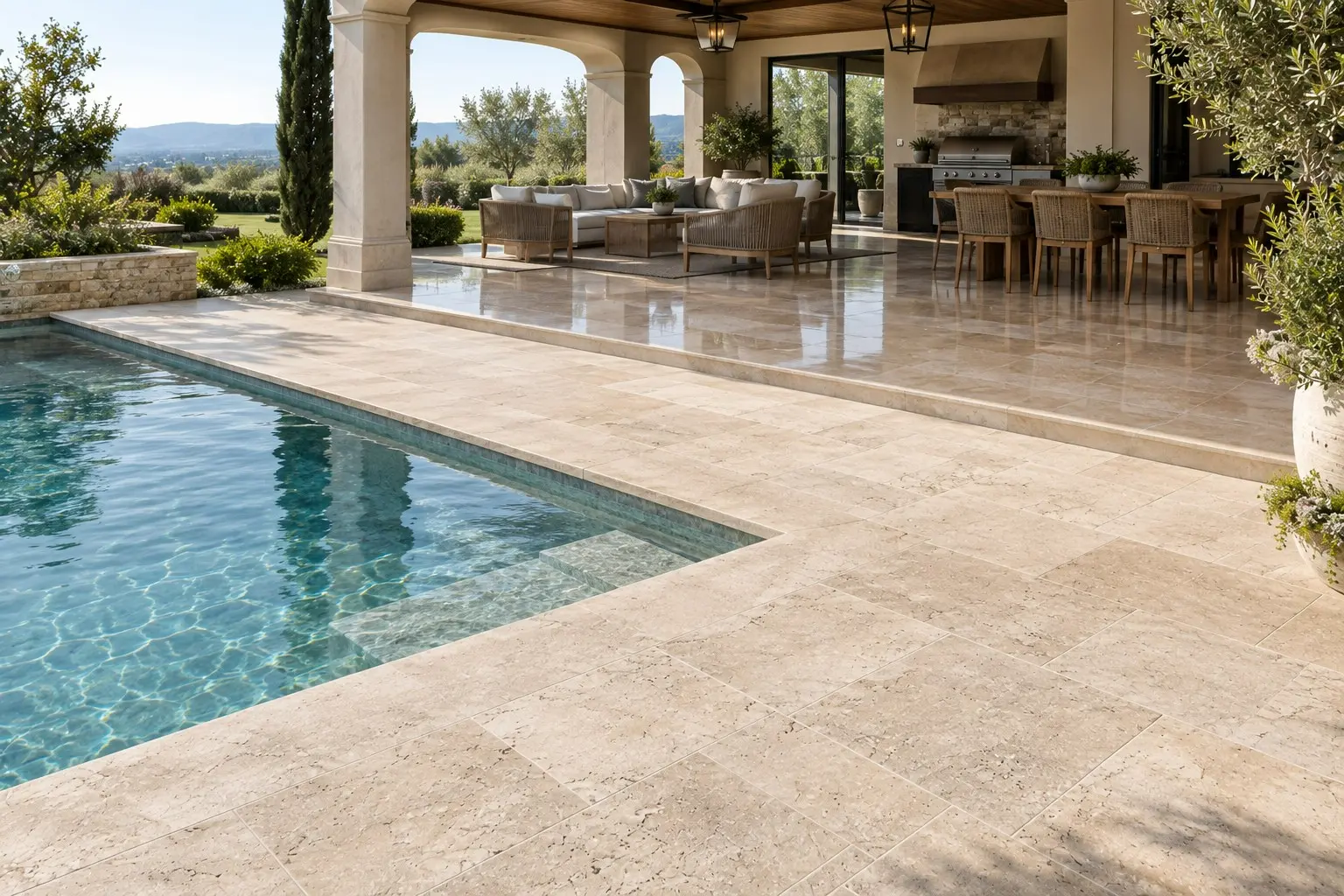
Finish and Pattern Together on Pool Decks
Travertine outdoor paving is offered in polished, honed, and leathered finishes, and pool decks and other wet-traffic areas commonly use honed and tumbled finishes for their slip resistance. Polished surfaces are better suited to covered spaces such as a loggia, where standing water and direct pool splash are less of a factor.
Slip resistance on any hard surface, patterned or not, is measured industry-wide through dynamic coefficient of friction testing, the same method referenced across pool deck and patio specifications nationally. Matching a finish to a layout is as much a planning question as picking the stone color itself, since a covered patio and an open pool deck call for different finish priorities within the same material.
Material Options for Exterior Layouts
Granite, quartzite, travertine, and porcelain are each suited to exterior stone applications, whether that is a patio, a walkway, or a pool surround. Porcelain is part of that same pavers and exterior stone offering, and our porcelain options include travertine-look and granite-look finishes for homeowners who want those looks in an engineered surface.
Granite also carries a fireplace-rated designation, which matters for homeowners pairing an outdoor fireplace or fire feature with the same hardscape layout used on an adjoining patio. The material is built for lasting use, but each application should be evaluated individually before a final layout and material combination is locked in. You can request a slab quote once a layout and material combination is narrowed down.
Caring for a Patterned Outdoor Surface
A pattern with more joint lines, such as French pattern or herringbone, has more seams where dirt, leaves, and moisture can collect compared to a simple running bond, which affects how often a surface needs attention. Stains on outdoor stone generally fall into a few categories, oil-based, organic, and mineral or rust-based, and identifying which type is present shapes what cleaning approach actually works.
Our natural stone care guidelines cover cleaning products, sealing intervals, and stain identification that apply regardless of the layout chosen. Granite and quartzite surfaces are stain resistant, but spills should still be cleaned promptly to keep a pattern looking consistent across every joint line, and porcelain pavers are non-porous, but regular cleaning is still recommended, particularly in a pattern with tighter joint spacing where debris has more edges to settle into.
Conclusion
A hardscape layout is easiest to finalize with the actual stone in hand rather than from a rendering, which is one reason a showroom visit matters more for this decision than it does for a simple tile swap. Homeowners can schedule a free design consultation to walk through French pattern, ashlar, running bond, and herringbone options against the specific dimensions of a patio or pool deck.
Visiting our Minden showroom or our Fernley showroom in person makes it easier to see how a finish and pattern combination will actually look at full scale before ordering. After that, the next step is narrowing down a material and requesting a quote on the specific layout chosen.
Note: Some images on this page may be conceptual renderings created to illustrate design possibilities and may not depict actual installations.
Frequently Asked Questions
French pattern combines four interlocking stone sizes in a repeating sequence for an irregular, old-world look, while ashlar arranges rectangular blocks of varying sizes in a more structured, coursed layout.
Layout affects joint spacing and how a surface accommodates seasonal expansion and contraction, which matters in a freeze-thaw climate like the Reno, Minden, Sacramento, and Fernley region.
Granite, quartzite, travertine, and porcelain are each suited to exterior stone applications such as patios, walkways, and pool surrounds.
Honed and tumbled finishes are commonly chosen for pool decks and other wet-traffic areas because of their texture, and slip resistance is measured industry-wide through dynamic coefficient of friction testing.
General natural stone care guidelines cover cleaning products and sealing intervals, and stain-resistant surfaces like granite and quartzite still benefit from prompt spill cleanup to keep every joint line looking consistent.
Curious About Something Else?