At a Glance
- Best for: patios, walkways, pool decks, and outdoor kitchens
- Outdoor-suitable stones: granite, quartzite, travertine, and porcelain
- Key decisions: purpose, drainage, finish, color, and quantity
- Care: sealing needs vary by stone, and porcelain generally needs less
- Next step: a free consultation with Nova design consultants
In This Guide
- Benefits of settling details early
- Core planning decisions for outdoor stone
- Materials, finishes, and care comparison
- A four-step ready-to-order plan
- How Nova supports your stone selection
- Key takeaways and common questions
What to Settle Before You Order Stone
Hardscape planning is the process of deciding how each outdoor area will be used, drained, and finished before stone is ordered. A clear plan helps match hardscape materials to sun, frost, and foot traffic, which can reduce mismatched orders.
In Northern Nevada and Northern California, outdoor surfaces face strong sun, winter freezes, and wide temperature swings, so what to consider before buying stone begins with how each space will actually be used.
Patios, walkways, pool decks, and outdoor kitchens place different demands on a surface, and those demands narrow the choices for stone type, finish, and color.
Thinking through layout, flow, and focal points first also gives each material a clear role in the overall design.
This checklist covers purpose, site conditions, material fit, finish, care, and quantities in a practical order. Readers can also browse stone slabs online to compare colors while reading.
Each step is best revisited with a design consultant, since site details and product specifications can change which stone fits best.
Why Does Hardscape Planning Matter Before You Order?
Stone is ordered in set formats and quantities, so early decisions help keep color, finish, and thickness consistent across a patio, walkway, and steps.
A written plan also gives designers, contractors, and suppliers one shared reference, which can make conversations about hardscape materials faster and clearer.
Early planning also leaves room to review stone in person, compare colors in natural light, and confirm availability before a project schedule is set.
- Better material fit: matching stone to sun, moisture, and traffic can reduce surface problems over time.
- A cohesive look: choosing finish and color together helps separate areas read as one design.
- Clearer quantities: measured layouts help prevent shortages, though a small overage for cuts is still wise.
- Smoother scheduling: knowing access routes and timing makes delivery coordination easier.
- Realistic care expectations: understanding sealing needs before purchase can prevent surprises later.
What Hardscape Planning Decisions Shape Your Design?
Work through these decisions in order, because each answer narrows the next. Together they form the core of what to consider before buying stone for any outdoor area.
Define Purpose and Foot Traffic
Start by listing every use: dining, lounging, grilling, walking, or poolside seating. Each use affects how much wear, moisture, and heat a surface may see.
Polished stone can become slippery when wet, so textured, flamed, or bush-hammered finishes are the more cautious pick for pool decks, steps, and other wet zones.
Think about transitions as well. Steps, borders, and changes in level often call for different formats or finishes than open patio areas.
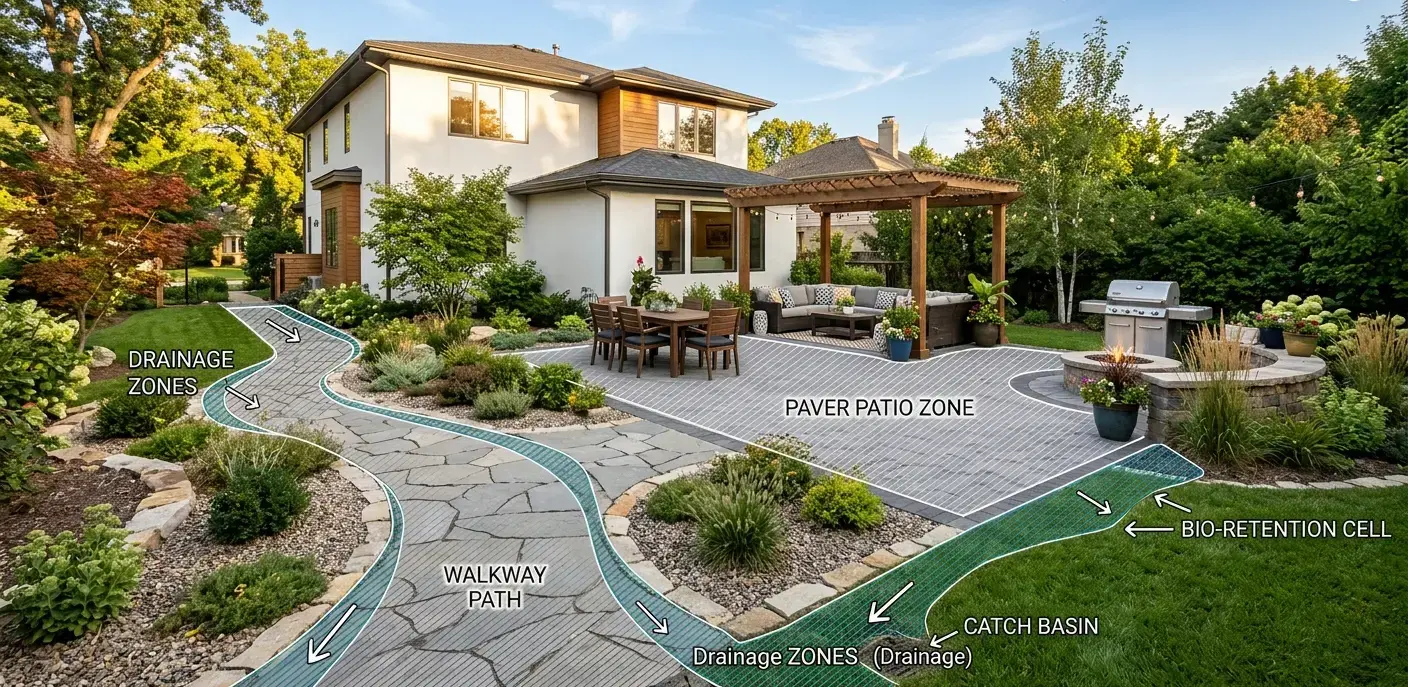 Conceptual rendering
Check Sun, Frost, and Drainage
Granite, quartzite, and porcelain fall in Nova's UV-resistant category. UV performance is still product-dependent, so verify the exact product's UV rating before choosing stone for full-sun areas.
Travertine is generally approved for outdoor use but sits outside that UV-resistant category. Confirm manufacturer sun exposure approval and freeze-thaw suitability for local winters.
Drainage matters too. The EPA permeable pavement overview explains how some surfaces reduce runoff, which helps when mapping slopes and water paths.
Before any ground is disturbed, buried utility lines should be located. Property owners and contractors can request 811 utility marking in Northern Nevada and Northern California.
 Conceptual rendering
Match Stone Type, Finish, and Color
Four materials suit outdoor use in Nova's range. Marble and dolomite are better reserved for indoor spaces, so they are left out of this comparison.
Finish changes both appearance and traction. Polished surfaces reflect light, honed surfaces look softer, and leathered or specialty finishes add texture, depending on the stone. Polished surfaces reflect light, while leathered and specialty finishes add texture, depending on the stone.
Natural stone varies from slab to slab, so review colors and veining in person when possible before finalizing a selection.
Material | Outdoor Use | UV-Resistant Category | Sealing | Finishes Offered |
Granite | Yes | Yes | Needed | Polished, leathered, specialty |
Quartzite | Yes | Yes | Needed | Polished, specialty |
Travertine | Generally yes | No, confirm product rating | Needed | Polished, leathered, specialty |
Porcelain | Yes | Yes | Generally not needed | Polished, specialty |
Confirm each product's specification before ordering, since ratings and finishes can vary by product.
Plan Care, Sealing, and Daily Use
Granite, quartzite, and travertine need sealing, while porcelain generally does not, though product guidance should be confirmed.
Design professionals can review sealer and cleaner basics in the stone care course from the Natural Stone Institute.
For outdoor kitchens, heat-resistant surfaces still need trivets, since heat-resistant does not mean thermal-shock proof. Cutting boards protect finishes, and spills should be cleaned promptly with non-abrasive cleaners.
Food contact depends on material, finish, and sealing, so outdoor kitchen counters should be matched to product guidance. Granite, quartzite, and porcelain are the countertop options in this group.
Advantages and Disadvantages of Natural Stone Outdoors
Advantages
- Natural color and veining give each area a distinct look.
- Granite, quartzite, and travertine are outdoor-suitable, with product-specific checks.
- Several finishes are offered, so wet and dry zones can be treated differently.
Disadvantages
- Granite, quartzite, and travertine need periodic sealing.
- Natural variation means pieces can differ, so review stone before ordering.
- Polished finishes can be slippery when wet.
- Scratch resistance and heat tolerance vary by stone.
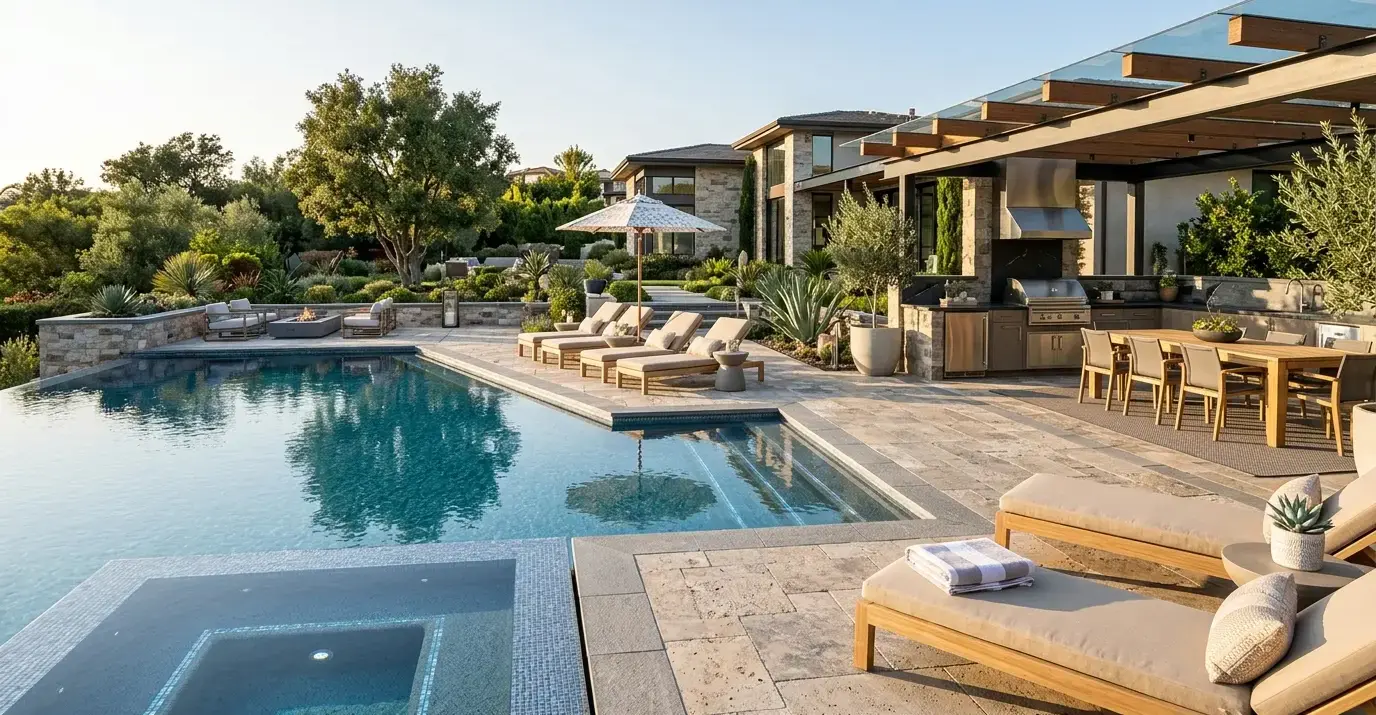 Conceptual rendering
A Four-Step Plan Before You Order
- Measure each zone. Record length, width, and any steps or curves for patios, paths, and decks.
- Note site conditions. Mark sun exposure, slopes, drainage paths, and wet areas.
- Shortlist stone and finish. Choose two or three options that fit the use, climate, and care routine.
- Review with a consultant. Confirm specifications, quantities, and delivery timing before ordering.
How Nova Tile and Stone Supports Your Stone Selection
Nova Tile and Stone supplies premium natural stone and porcelain materials, backed by commission-free design consultants who compare products according to project requirements, surface finishes, and visual appeal. The company also provides delivery coordination support to help streamline material scheduling and arrival.
Consultants can review hardscape materials against a layout, sun exposure, and wet areas, then narrow the choices to a short list worth viewing in person.
Planning can go more smoothly with real stone in view. Showrooms serve customers in Fernley, Reno, Minden, and Sacramento, and each location can talk through what to consider before buying stone.
- Visit the Fernley showroom to review stone options in person.
- Visit the Reno showroom to compare finishes and colors side by side.
- Visit the Minden showroom to talk through outdoor material choices.
- Visit the Sacramento showroom to review stone for Northern California projects.
Ready to narrow your list? Readers can book a free consultation to review plans, photos, and measurements with a design consultant.
Key Takeaways
- Hardscape planning works best when purpose, site conditions, and materials are decided before stone is ordered.
- Granite, quartzite, travertine, and porcelain suit outdoor use, while marble and dolomite fit indoor spaces better.
- Match hardscape materials to site conditions, and verify UV, frost, and slip details for the exact product.
- Sealing needs vary: granite, quartzite, and travertine need it, and porcelain generally needs less.
- Review natural stone in person, since color and veining vary from piece to piece.
- Bring measurements, photos, and site notes to a consultation.
Book a Design Consultation
A short conversation with a design consultant can turn this checklist into a ready-to-order plan. Bring measurements, site photos, and ideas for color and finish to receive guidance on which stone fits each outdoor area.
SACRAMENTO SHOWROOM
6100 Warehouse Way, Sacramento, CA 95826
 Google Maps
Store hours this week:
- Mon. - Fri.: 7:30 am - 5:00 pm
- Sat. - Sun.: Closed
MINDEN SHOWROOM
2548 Business Pkwy, Minden, NV 89423
Store hours this week:
- Mon. - Fri.: 7:30 am - 6:00 pm
- Sat.: 9:00 am - 3:00 pm
- Sun.: Closed
RENO SHOWROOM
12835 Old Virginia Rd Suite 24, Reno, NV 89521
Store hours this week:
- Mon. - Fri.: 7:30 am - 6:00 pm
- Sat.: 9:00 am - 3:00 pm
- Sun.: Closed
FERNLEY SHOWROOM
1855 US Highway 95A North, Fernley, NV 89408
Store hours this week:
- Mon. - Fri.: 7:30 am - 4:00 pm
- Sat. - Sun.: Closed
Consultants are commission-free, so the focus stays on matching materials to the project. Even early sketches are enough to start the conversation. Book your free consultation today!
Frequently Asked Questions
Consider how the space will be used, how much sun and frost it receives, how water drains, and which finish suits wet or dry zones. Also review sealing needs, measured quantities, and delivery timing with a design consultant before placing an order.
Granite, quartzite, travertine, and porcelain are generally suited to outdoor use, while marble and dolomite are better reserved for indoor spaces. Because sun, frost, and slip ratings vary by product, verify the exact product's specifications before ordering for exposed areas such as patios, walkways, and pool decks.
Granite, quartzite, and travertine need sealing, and how often depends on the product and exposure. Porcelain generally does not need sealing, though that should be confirmed with product guidance. Prompt spill cleanup and non-abrasive cleaners also help preserve the surface appearance over time.
Polished finishes can be slippery when wet, so textured, flamed, or bush-hammered finishes are the more cautious choice around pools, steps, and other wet zones. Ask a design consultant to confirm the slip characteristics of the exact product before ordering, especially for areas with regular foot traffic.
Bring measurements, site photos, notes on sun exposure and drainage, and any color or finish ideas. A design consultant can then compare suitable stone options, review quantities, and discuss delivery timing for projects in Fernley, Reno, Minden, or Sacramento, which makes the first conversation more productive.
Sources
Natural Stone Institute. (n.d.). Stone care: What you should know [Continuing education course]. https://www.naturalstoneinstitute.org/education/ceu-page/classes-available/stone-care-what-you-should-know/
USA North 811. (n.d.). USA North 811. https://usanorth811.org/
U.S. Environmental Protection Agency. (2026, October 13). Soak up the rain: Permeable pavement. https://www.epa.gov/soakuptherain/soak-rain-permeable-pavement