The three most common hardscape paver patterns are herringbone, running bond, and basketweave. Herringbone is the strongest choice for driveways because its interlocking V shapes resist shifting under vehicle traffic, and the Interlocking Concrete Pavement Institute (ICPI) recommends it for all vehicular paving. Running bond, also called stretcher bond, lays pavers in offset rows and is the most widely used pattern for patios, walkways, and pool decks. Basketweave alternates pairs of pavers to create a woven look that suits traditional patios and garden paths with foot traffic only.
The right paver pattern depends on four factors: the traffic the surface will carry, the size and shape of the space, the paver dimensions, and the style of the home. Each pattern also affects how many cuts are needed and how much extra material to plan for.
In this guide, we explain how each pattern works, where it performs best, and how to choose between them.
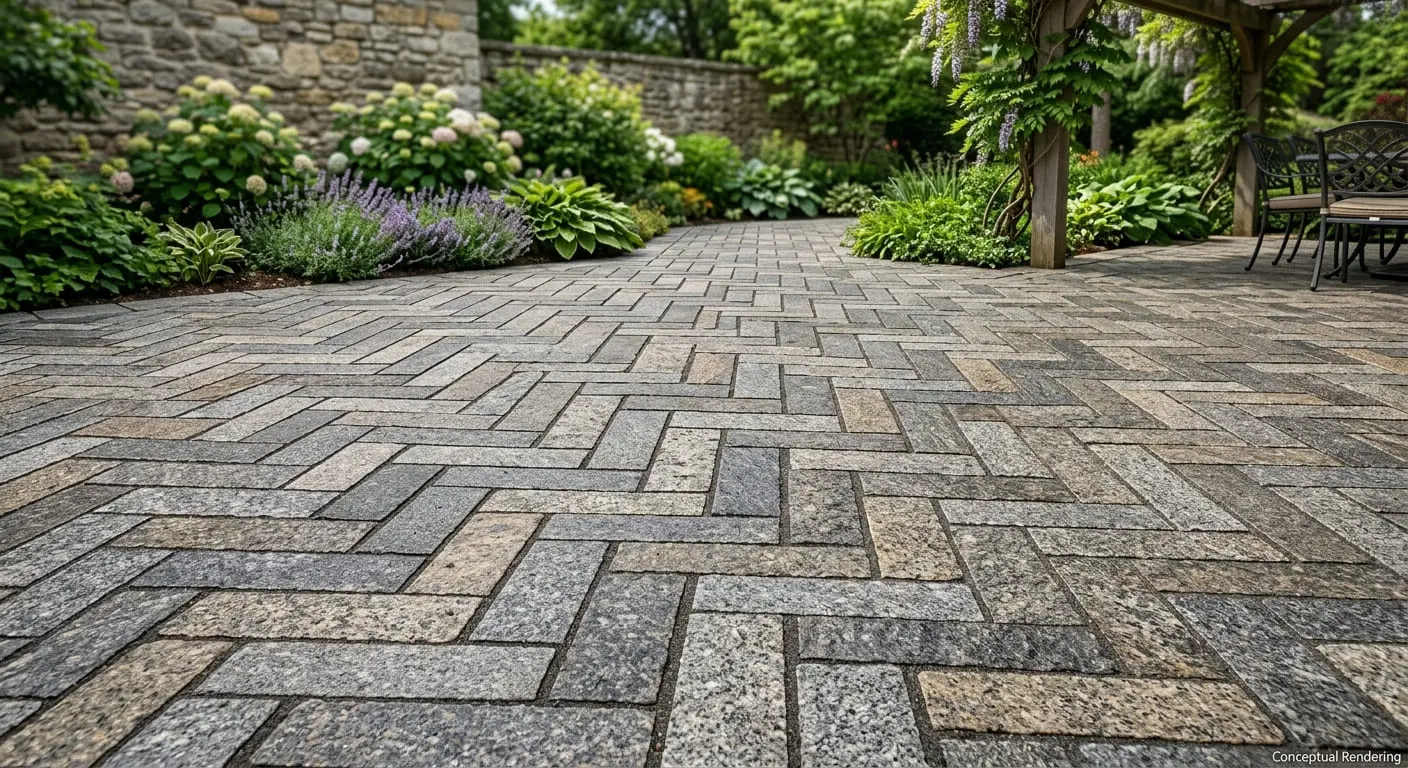
What Is a Herringbone Paver Pattern?
A herringbone paver pattern arranges rectangular pavers in a zigzag of interlocking V shapes, with pavers set at right angles to one another. The name comes from its resemblance to the skeleton of a fish. Because pavers running in two directions lock each other in, herringbone resists shifting better than any other common pattern.
45-Degree vs. 90-Degree Herringbone
Herringbone can be laid at two angles relative to the edge of the paved area. In a 90-degree herringbone, each paver sits square to the border, so the zigzag steps diagonally across the surface and the cuts along straight edges are simple square cuts. In a 45-degree herringbone, the pavers sit at an angle to the border, so the V shapes line up in rows along the edge for the familiar fishbone look. This version needs an angled cut on nearly every edge paver.
Where Herringbone Works Best
Herringbone is the pattern most often recommended for driveways, parking pads, and any surface that will carry vehicles. When a car turns or brakes, it pushes pavers sideways. In a herringbone layout, that force is spread across many interlocked units instead of sliding along a continuous joint line. ICPI recommends herringbone for all vehicular applications, partly because no joint line in the pattern runs longer than about one and a half pavers. Laboratory testing of interlocking concrete block pavement has found that herringbone deflects less under load than running bond or basketweave.
The pattern also suits:
- Entry walkways that call for a formal, structured look
- Courtyards and patios with a European or traditional design direction
- Pool surrounds and outdoor living areas that get heavy foot traffic
What to Keep in Mind
Herringbone is laid with rectangular pavers, most often ones with a length exactly twice the width (such as 4 by 8 or 6 by 12 inches), which keeps the pattern square and the joints short. It also produces more cut pieces than running bond, especially at 45 degrees, so plan for extra material when estimating quantities, and check our overstock sale for discounted options. A border, such as a soldier course, is commonly used to frame herringbone and hide cut edges.
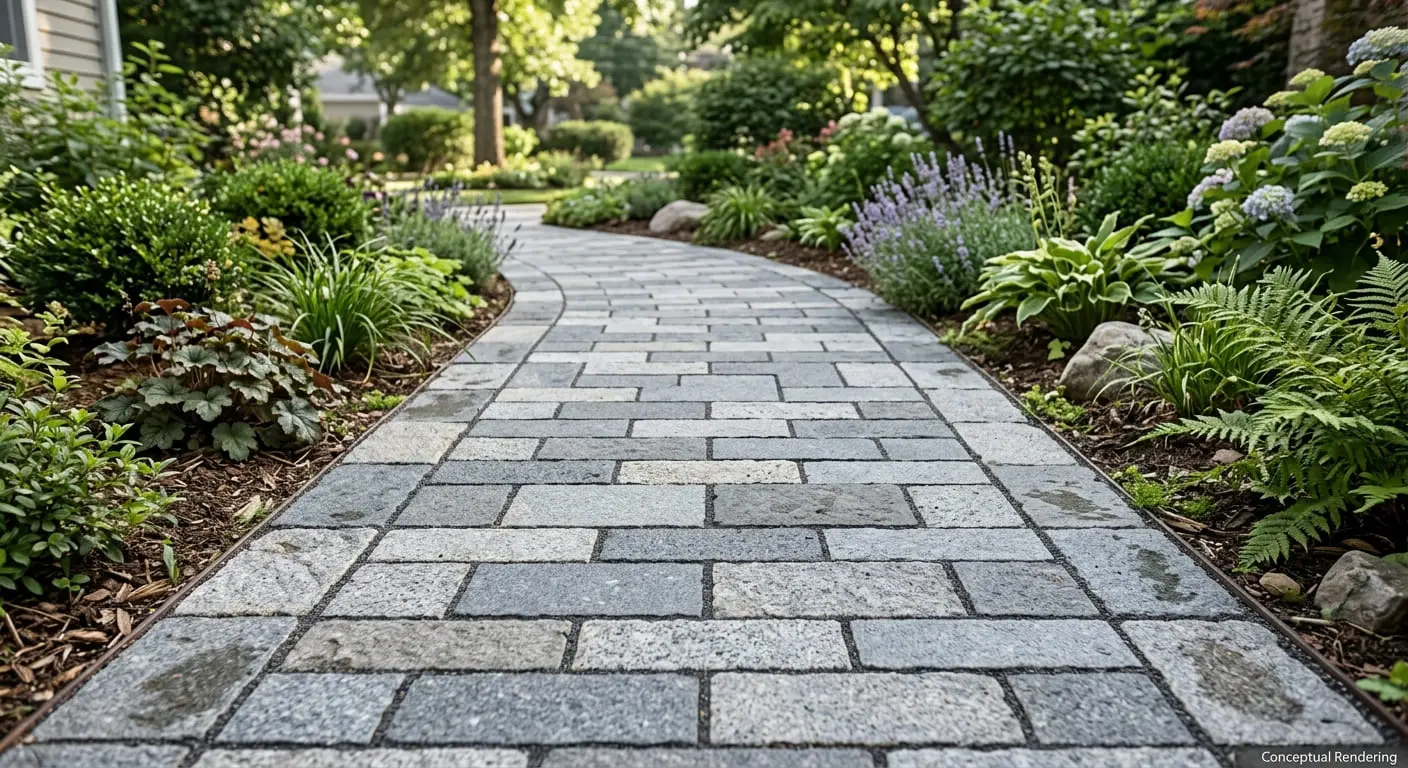
What Is a Running Bond Paver Pattern?
A running bond paver pattern lays rectangular pavers end to end in straight rows, with each row offset from the one beside it, usually by half a paver. It is the same arrangement you see in most brick walls, and it is also called a stretcher bond. Running bond is the most widely used paver pattern because it is simple to lay out, works with many paver sizes, and produces a clean, orderly surface.
How Direction Changes the Look
The direction of the rows has a strong effect on how a space feels. Rows that run the length of a walkway draw the eye forward and make the path appear longer. Rows that run across a patio or side yard make the area appear wider. On a patio that connects to the house, running the rows parallel or perpendicular to the house wall keeps the pattern aligned with the architecture.
The offset can be adjusted as well. A half offset is the classic look. With long or large-format porcelain pavers, manufacturers often recommend an offset of one-third or less, which helps limit uneven edges caused by slight bowing in long units.
Where Running Bond Works Best
Running bond fits almost any foot-traffic area:
- Patios and outdoor dining spaces
- Garden paths and side yard walkways
- Pool decks, where the long lines suit a modern or coastal design
- Steps and landings, where straight rows line up neatly with tread edges
Running bond can also be used on residential driveways, but its interlock is moderate rather than strong. If you use it where cars will drive, industry guidance calls for the rows to run perpendicular to the direction of travel so that tires cross the joints instead of rolling along them. For heavy or frequent vehicle traffic, herringbone is still the safer choice.
What to Keep in Mind
Running bond generates fewer cuts and less waste than herringbone, which helps keep material quantities predictable. Because the rows are long and straight, any wandering in the layout is easy to spot, so a carefully set reference line matters. The pattern pairs well with modern, large-format pavers and with natural stone pavers that come in consistent rectangular sizes, both available in our paver and exterior stone collections.
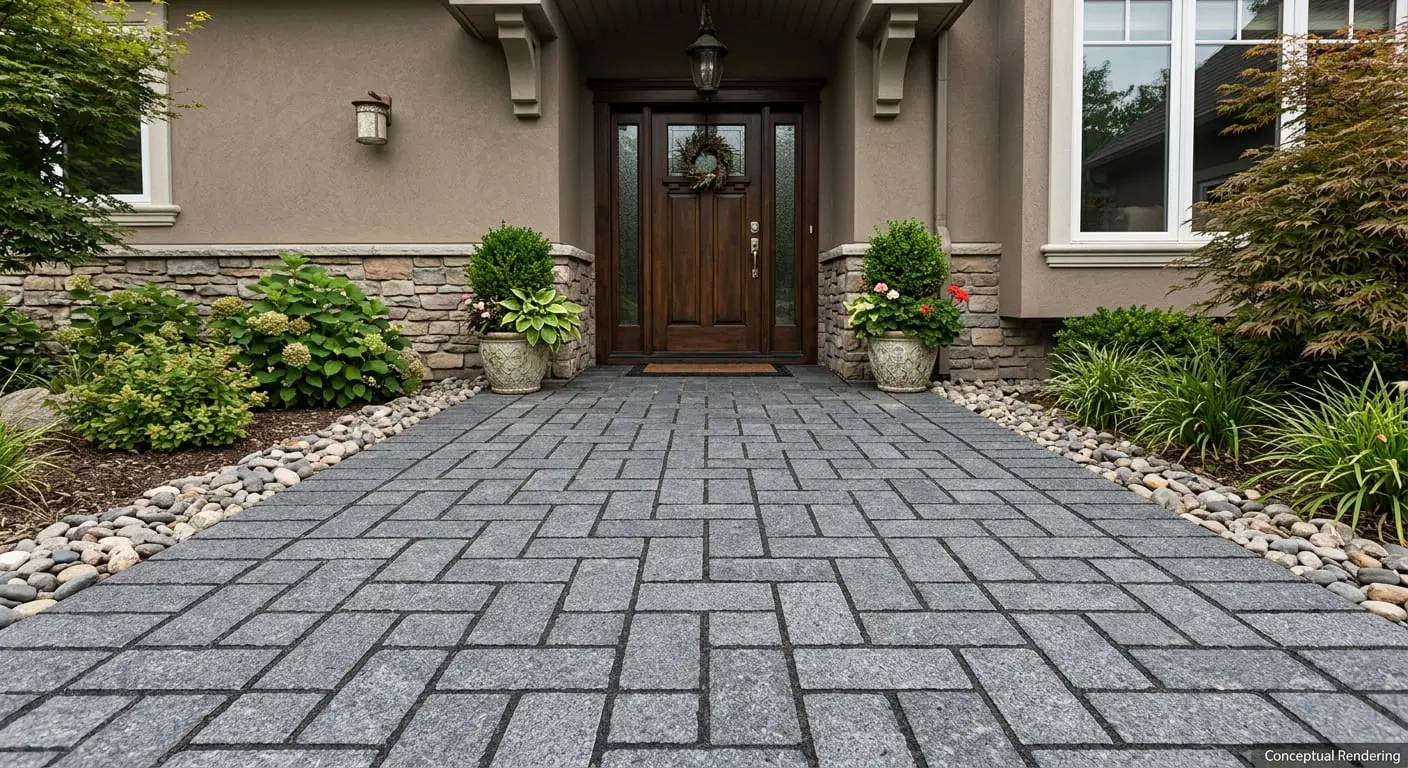
What Is a Basketweave Paver Pattern?
A basketweave paver pattern places pavers in small groups that form squares, then alternates the direction of each group so the surface looks like woven fabric. In the most common version, two rectangular pavers sit side by side to form a square, and the next square turns 90 degrees. The result is a checkerboard rhythm with a traditional look.
Common Basketweave Variations
The standard basketweave uses pairs of pavers with a 2-to-1 length-to-width ratio, such as 4 by 8 inches. A three-paver version uses longer, narrower pavers with a 3-to-1 ratio, where three units form each square. This creates a finer, more detailed texture. Basketweave can also be laid at a 45-degree angle for a diamond effect, though this adds cuts at every edge.
Where Basketweave Works Best
Basketweave is best suited to areas used by people rather than vehicles:
- Patios and seating areas behind traditional, colonial, or cottage-style homes
- Garden paths and courtyards where you want texture and pattern detail
- Inset panels or “rugs” within a larger running bond field, such as under a dining table or fire feature
Because the joints in a basketweave line up in continuous straight runs in both directions, the pattern has less interlock than herringbone or running bond. Under repeated vehicle loads, pavers can creep along those joint lines. For that reason, basketweave is generally not recommended for driveways.
What to Keep in Mind
Basketweave depends on accurate paver dimensions. If the pavers in each group do not form a true square, small errors add up across the surface and the pattern drifts. Tumbled or irregular-edged pavers can soften the woven look, while crisp-edged pavers make it read more clearly. The pattern works especially well with clay-look and brick-style pavers, which suit its traditional roots.
Herringbone vs. Running Bond vs. Basketweave
Herringbone offers the most strength, running bond offers the most flexibility, and basketweave offers the most decorative texture.
| Feature | Herringbone | Running Bond | Basketweave |
| Interlock strength | Highest | Moderate | Lowest |
| Vehicle traffic | Recommended | Light residential use only | Not recommended |
| Number of cuts | High (highest at 45 degrees) | Low | Low to moderate (higher on a diagonal) |
| Paver shape needed | Rectangle, most often 2:1 | Most rectangles | Rectangles that form a true square |
| Visual effect | Movement and structure | Direction and length | Woven texture |
| Design style | Classic, European, transitional | Modern, clean, versatile | Traditional, cottage, colonial |
How to Choose the Right Paver Pattern for Your Hardscape
Choosing a paver pattern works best when you start with function and then narrow the choice by appearance.
Start With Traffic
If vehicles will drive or park on the surface, herringbone is the standard recommendation. For patios, walkways, and pool decks that only see foot traffic, all three patterns perform well, so the decision becomes mostly visual. If a single hardscape includes both a driveway and a front walkway, you can use herringbone on the driveway and switch to running bond or basketweave on the walk.
Consider the Shape of the Space
Long, narrow areas such as side yards and garden paths often look best in running bond laid lengthwise, which emphasizes the path. Square patios and courtyards give herringbone and basketweave room to show their full pattern. Curved edges and irregular shapes add cuts with any pattern, but the effect is most noticeable with 45-degree herringbone and basketweave.
Match the Pattern to the Paver
Not every paver works with every pattern. Standard basketweave needs rectangular pavers with a 2-to-1 ratio, and herringbone is most often laid with the same proportions. Running bond is more forgiving and works with a wide range of rectangular sizes, including large-format porcelain pavers and sawn natural stone. Square pavers cannot form herringbone or basketweave on their own and are usually laid in stack bond, running bond, or on a diagonal. Before settling on a pattern, confirm that the paver size and shape you like supports it, ideally after seeing the pavers at one of our showrooms.
Plan for Cuts and Extra Material
Patterns with more cuts require more material to cover the same area. Running bond usually produces the least waste, along with basketweave laid square to straight edges. Herringbone, especially at 45 degrees, produces the most because nearly every edge paver is trimmed. Ask your contractor to calculate quantities based on the specific pattern you choose rather than square footage alone, and order enough to keep a few spare pavers from the same production run for future repairs. Contractors with a trade account also get commercial estimating with full material takeoffs.
Use Borders and Mixed Patterns
A border frames the field pattern, hides cut edges, and adds a finished look. A soldier course, a single row of pavers set side by side with their long sides perpendicular to the edge, is one of the most common borders. Many hardscapes also combine patterns: a running bond field with a herringbone border, or a basketweave inset defining a seating area. Using a contrasting color or finish for the border helps separate zones without adding another material.
Look at Your Home’s Architecture
Pattern style should feel consistent with the house, and a free design consultation can confirm the fit. Basketweave and herringbone in brick-style or clay-look pavers suit traditional, colonial, and craftsman homes. Running bond in large-format, clean-edged pavers fits modern and contemporary homes. Transitional homes can go either way, and herringbone in a neutral, contemporary paver can work as a middle ground.
Conclusion
Herringbone, running bond, and basketweave each bring something different to a hardscape. Herringbone is the strongest option and the standard recommendation for driveways and other surfaces that carry vehicles. Running bond is the most adaptable, with fewer cuts and a clean look that suits patios, walkways, and modern homes. Basketweave adds woven texture and traditional character to patios, courtyards, and garden paths that see foot traffic only.
The best results come from choosing the pattern and the paver together. Paver size, shape, color, and finish all influence how a pattern reads once it is laid across an entire space, and seeing materials in person makes that decision much easier. Our team can review paver options with you, discuss how different patterns would suit your layout, and help you put together a material selection to share with your contractor. You can visit us at our showrooms in Sacramento, Reno, Minden, and Fernley to compare paver and exterior stone options and start planning your next hardscape project.
Note: Some images on this page may be conceptual renderings created to illustrate design possibilities and may not depict actual installations.
Frequently Asked Questions
Herringbone is the strongest paver pattern for a driveway. Each paver is locked in by neighbors running at right angles to it, so the force from turning and braking tires is spread across many pavers instead of pushing rows along a straight joint. Both 45-degree and 90-degree herringbone are suitable for vehicle traffic.
Running bond rows that span the width of a narrow patio make the space appear wider, while running bond laid lengthwise makes a path appear longer. A 45-degree herringbone can also make a compact area feel larger because the diagonal lines draw the eye outward. Busy patterns with many small units can make a small space feel crowded, so larger pavers often help.
Herringbone usually requires more material than running bond to cover the same area. The pattern produces more cut pieces along edges, especially when laid at 45 degrees, and trimmed offcuts often cannot be reused. Running bond generally produces less waste than herringbone. Your contractor can calculate exact quantities based on the pattern and the shape of your space.
A standard basketweave needs rectangular pavers with a 2-to-1 length-to-width ratio, such as 4 by 8 inches or 6 by 12 inches, so two pavers form a true square. A three-paver basketweave uses pavers with a 3-to-1 ratio. Pavers with consistent dimensions keep the woven pattern aligned across the whole surface.
Yes, combining paver patterns is common in hardscape design. A herringbone driveway can transition to a running bond walkway, and a basketweave inset can define a seating or dining area within a larger running bond patio. A border, such as a soldier course, helps separate the patterns and gives each area a finished edge.