Understanding Hardscape Budgeting Before You Build
Hardscape budgeting is the process of accounting for every material variable, from slab type to finish, before ordering stone for a patio, walkway, or outdoor living space.
Material type, slab format, finish selection, and quantity planning are the factors that shape a hardscape cost planning exercise most. Learning how to budget for a hardscape project starts with understanding how these variables interact.
Northern Nevada and Northern California homeowners planning outdoor stonework face a wide range of material choices, each with its own performance profile. Granite, quartzite, travertine, and porcelain all handle outdoor exposure differently.
Each material carries its own sealing, finish, and format considerations. A patio built with large-format polished granite behaves differently, over time and in planning, than one built from textured porcelain pavers.
Seasonal temperature swings across the region also make material performance, not just appearance, a meaningful part of any hardscape cost planning conversation. A hardscape design guide explains how hard landscaping materials form the structural backbone of outdoor spaces, a concept that applies to both home patios and public plazas.
What Shapes Hardscape Cost Planning
Several material-level variables influence hardscape cost planning long before any other expense is considered. Slab type, finish, format size, and long-term maintenance needs each affect how much material a project ultimately requires. These same factors scale up or down depending on project size, from a single entry walkway to a full backyard renovation.
- Material category: natural stone such as granite, quartzite, and travertine, or engineered stone such as porcelain
- Finish selection: polished, textured, flamed, or bush-hammered finishes affect slip resistance and maintenance needs
- Slab format: large-format slabs versus smaller modular pieces changes total quantity required
- Application: patios, pool decks, and fire features each call for different suitability ratings
- Sealing needs: natural stone typically requires periodic sealing, while some engineered materials need very little
- Waste factor: cutting around curves, steps, and irregular layouts increases the material quantity needed
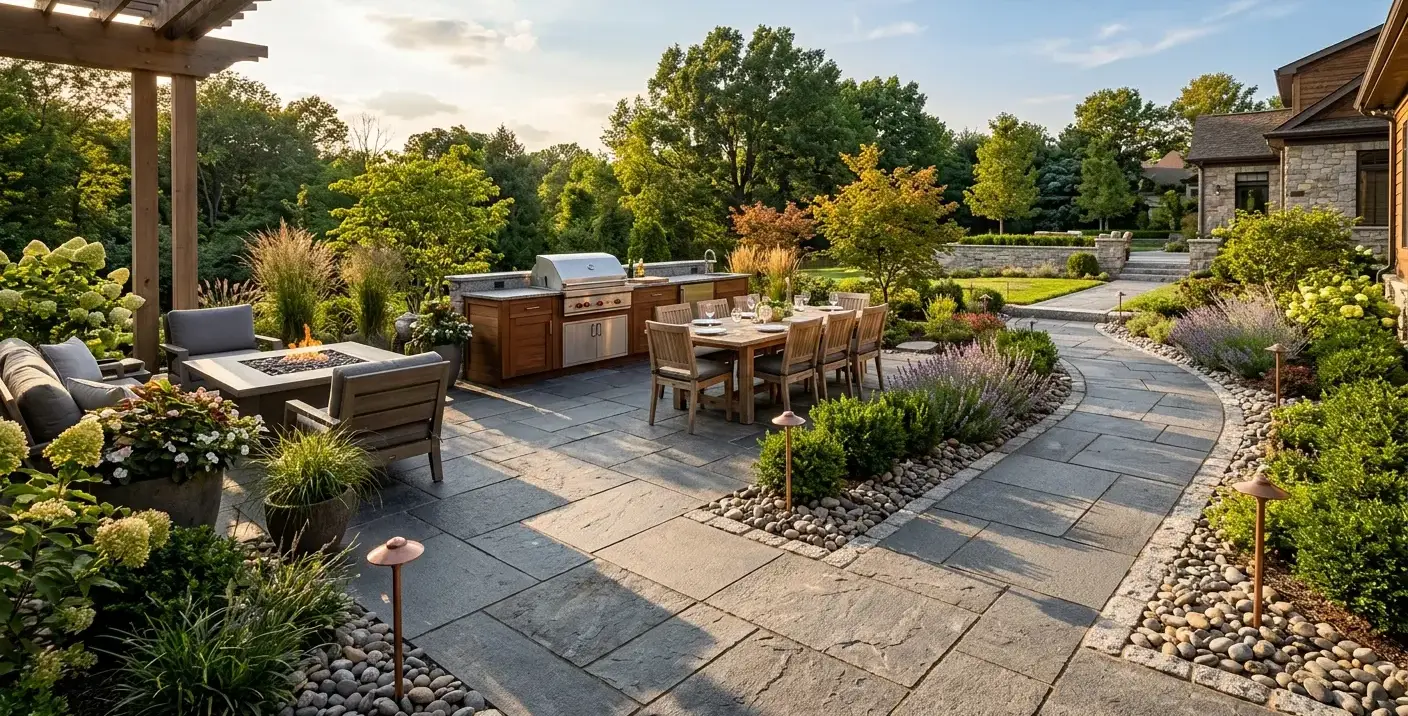 Conceptual rendering
Outdoor-rated slabs are not interchangeable in a hardscape cost planning exercise. Granite, quartzite, travertine, and porcelain are each approved for exterior use, but their sealing requirements, UV exposure tolerance, and finish options vary from one material to the next.
Marble and dolomite are generally reserved for indoor applications and are not part of a typical outdoor hardscape plan. The table below outlines how these four outdoor-suitable materials compare across the factors that most often affect material quantity and long-term maintenance planning.
Material | Slab Type | Outdoor Suitable | Sealing Needed | UV Resistance |
Granite | Natural Stone | Yes | Yes, periodic | Generally UV-stable; confirm per product |
Quartzite | Natural Stone | Yes | Yes, periodic | Generally UV-stable; confirm per product |
Travertine | Natural Stone | Yes | Yes, periodic | Verify product UV rating |
Porcelain | Engineered | Yes | Typically minimal | Generally UV-stable; confirm per product |
Where Hardscape Materials Show Up Around the Property
Outdoor slab applications range from simple walkways to elaborate pool decks, and each use case brings its own material and finish considerations. Matching the right slab to the right application is one of the clearest ways to keep a hardscape cost planning process on track.
Keeping the same material family across multiple features, such as a patio and an adjacent fire feature, can also simplify long-term maintenance planning.
Patios and Walkways
Patios and walkways are among the most common hardscape applications for granite, quartzite, and travertine slabs. A textured finish, such as flamed or bush-hammered, is generally preferred in these high-traffic, wet-prone areas, since smooth polished and honed surfaces can become slippery when wet.
Some aging technique ideas use stone pathways to add a weathered, established look to a landscape, a style some homeowners factor into material selection early in planning.
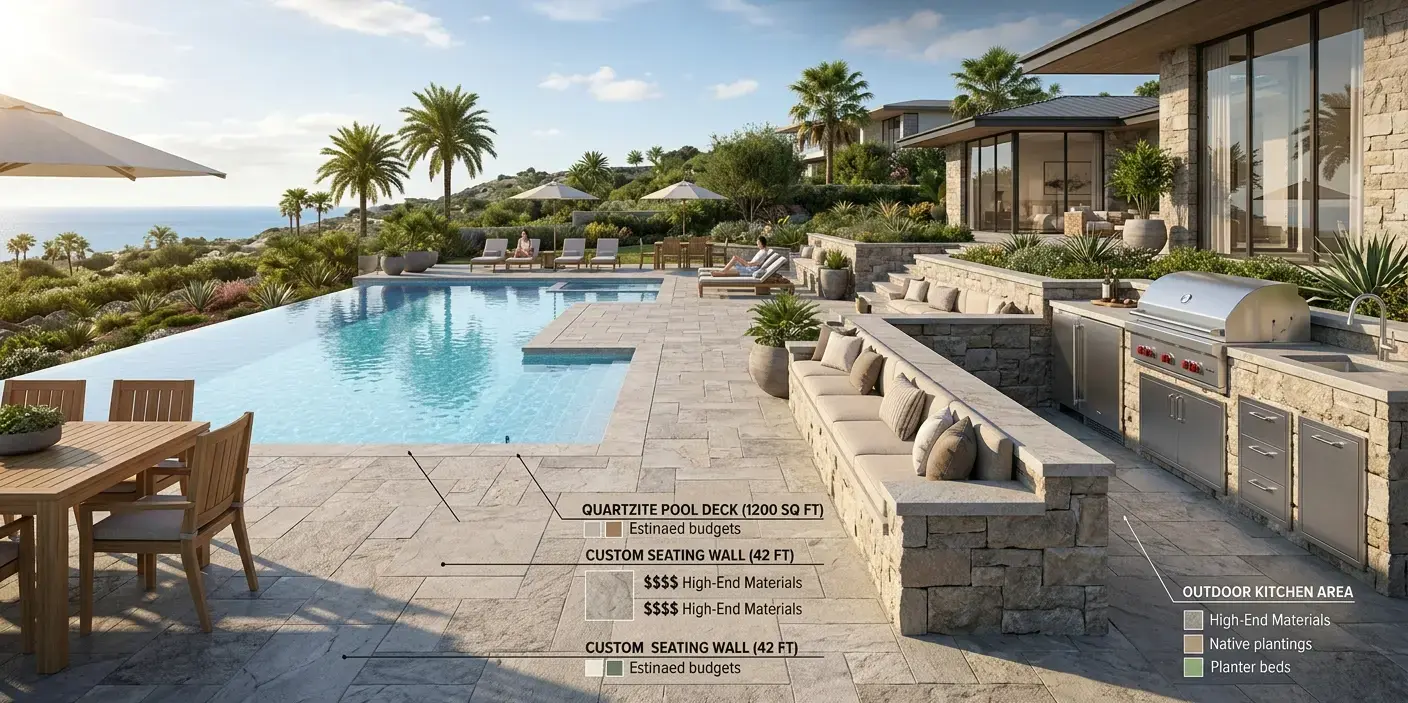 Conceptual rendering
Pool Decks and Water Features
Pool decks call for slip-resistant textures and strong outdoor performance, making quartzite and porcelain common choices for this application. Both materials tolerate direct sun exposure well, though travertine remains a viable option once its specific product UV rating has been confirmed against the space's expected sun exposure.
Fire Features and Seating Walls
Fire features and low seating walls benefit from granite or porcelain slabs rated for fireplace-adjacent use. These accent elements typically use smaller material quantities than a full patio or deck, but finish consistency across pieces still matters for a cohesive hardscape cost planning outcome.
Large-Format vs. Modular Slabs for Hardscape Planning
Slab format itself is a quantity-planning decision with its own trade-offs, and the right choice depends heavily on layout complexity. A long, uninterrupted patio run favors a different format than a walkway with tight curves or step transitions.
Reviewing both options against a project's specific footprint, rather than defaulting to one format, often reveals the more efficient quantity to order.
Large-Format Slabs
Advantages:
- Continuous veining and color consistency across wide spans
- Fewer total pieces required to cover large areas
- Fewer visible seams across a finished surface
Disadvantages:
- Higher offcut volume on irregular or curved layouts
- Fewer finish options available in extra-large formats
- Greater quantity typically needed to account for pattern matching
Modular or Smaller-Format Slabs
Advantages:
- Easier to fit irregular layouts with less offcut material
- Broader finish and thickness selection across smaller formats
- Simpler to source matching replacement pieces later on
Disadvantages:
- More total pieces required for the same square footage
- More visible seams across larger surface areas
- Natural variation between individual pieces in some finishes
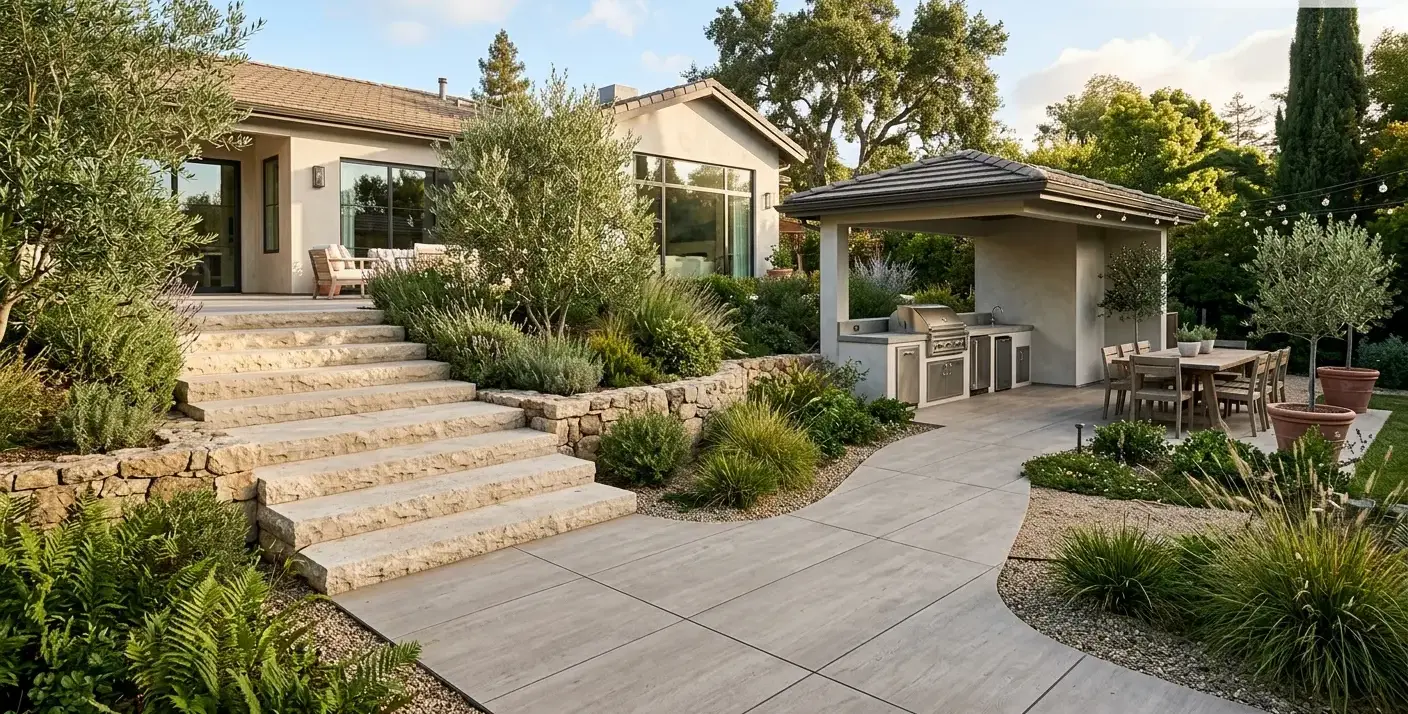 Conceptual rendering
Nova Tile and Stone Supports Hardscape Cost Planning
Expert guidance narrows down material choices quickly once project goals are clear. Nova Tile and Stone's design consultants work without commission, helping match slab type, finish, and format to a project's outdoor performance needs.
Showrooms across Fernley, Reno, Minden, and Sacramento carry granite, quartzite, travertine, and porcelain slabs suited to exterior applications, with service extending to each of those areas. Nova's background as a direct-import supplier is detailed on the company's site for anyone comparing sourcing options.
A short planning sequence keeps a hardscape budget realistic from the first measurement to the final order. The steps below outline how to budget for a hardscape project from start to finish.
- Measure the Full Area: Calculate the exact square footage of every surface involved, including patios, walkways, and decking, before selecting any material or finish.
- Choose a Material Category: Compare natural stone and engineered options against outdoor suitability, sealing needs, and finish availability for the intended application and climate.
- Account for Waste Factor: Add extra material to the base measurement to cover cutting, pattern matching, and irregular layout edges around steps or curves.
- Confirm Finish and Performance Needs: Decide between polished and textured finishes, such as flamed or bush-hammered, based on wet-area slip concerns and the space’s expected sun exposure.
- Request a Formal Quote: Submit project details through a request a quote form to document exact quantities before finalizing material selection.
Contractors managing several hardscape projects at once can apply for trade account access for streamlined ordering across jobs.
For crews looking to sharpen technique alongside material planning, resources like a hardscape training platform cover design and build fundamentals from an independent industry source. Material sourced through Nova includes arranged delivery assistance to the Reno, Sacramento, Fernley, and Minden service areas.
Anyone ready to move from planning to ordering can schedule a consultation with a design consultant. Visiting the Fernley showroom is another option for seeing outdoor-rated slabs firsthand before committing to a final material list.
Conclusion
Hardscape budgeting comes down to understanding how material type, finish, format, and quantity interact before a single slab is ordered. Granite, quartzite, travertine, and porcelain each bring different sealing, UV, and finish considerations to an outdoor project.
Matching the right material to the right application keeps a hardscape cost planning process realistic from the start. Reviewing sealing needs, finish options, and expected sun exposure together gives a clearer picture of total material requirements.
Anyone browsing stone slab options for an upcoming patio, walkway, or pool deck can review available materials before finalizing a plan.
Note: Some images on this page may be conceptual renderings created to illustrate design possibilities and may not depict actual installations.
Frequently Asked Questions
Material type, slab format, finish selection, and total quantity needed are the variables that affect hardscape cost planning the most. Sealing requirements and the waste factor added for cutting also play a meaningful role in overall material planning for any outdoor project.
A waste factor beyond the base square footage is typically added to account for cutting, pattern matching, and irregular layout edges around steps or curves. The exact amount depends on slab format and the overall complexity of the layout being planned.
Yes. Polished and honed finishes are slipperier when wet, so textured finishes such as flamed or bush-hammered are often preferred for patios, walkways, and pool decks. Finish availability also varies by material type and by slab format, which affects total material planning.
Granite, quartzite, and travertine typically require periodic sealing to maintain appearance and performance outdoors. Porcelain generally needs very little sealing, though care still depends on the specific product and its manufacturer guidance.
Budgeting for a hardscape project starts with measuring the full area, selecting a suitable material category, accounting for waste factor, confirming finish needs, and requesting a formal quote before finalizing material selection for the space.
Book your free consultation today!
Slabs and tile look different in person. Walk our floor, find some samples, take them home. Our showroom selections are carefully curated to bring everything you need under one roof.
Minden
2548 Business Pkwy, Minden, NV 89423
- Mon–Fri: 7:30am – 6:00pm
- Sat: 9:00am – 3:00pm
- Sun: Closed

VISIT PAGE BOOK NOW
Sacramento
6100 Warehouse Way, Sacramento, CA 95826
- Mon–Fri: 7:30am – 6:00pm
- Sat: Closed
- Sun: Closed

VISIT PAGE BOOK NOW
Fernley
1855 Hwy 95A, Fernley, NV 89408
- Mon–Fri: 7:30am – 4:00pm
- Sat: Closed
- Sun: Closed

VISIT PAGE BOOK NOW
Reno
12835 Old Virginia Rd, Suite 24 Reno, NV 89521
- Mon–Fri: 7:30am – 6:00pm
- Sat: 9:00am – 3:00pm
- Sun: Closed

VISIT PAGE BOOK NOW