A stone facade for a house exterior can be full, covering the whole front of the home, or partial, covering areas such as the lower third of the wall, the entry, or a chimney. Full coverage suits homes with simple rooflines and a traditional stone look, like Mediterranean and Tuscan designs. Partial coverage suits sided or stucco homes and fronts with several rooflines.
Granite and quartzite are both good fits for either approach. Instead of choosing full or partial for the whole house at once, look at each wall separately and decide whether stone suits it.
A stone wainscot on the lower third of the house is one of the most requested exterior stone applications at Nova Tile and Stone. Our showrooms in Reno, Sacramento, Minden, and Fernley carry natural stone suited to exterior use.
Why Coverage Is a Wall-by-Wall Decision
Picture a two-story Craftsman with a covered porch, a front-facing gable, and a garage bump-out. Stone on the porch base and the garage wall grounds the house, while the same stone carried up into the gable makes the top half feel heavier than the bottom.
That is the problem with treating coverage as a single yes-or-no choice. Stone looks best on the parts of a house meant to look solid: the base of the walls, chimneys, entry walls, and porch foundations.
Our exterior stone guide groups these placements into facades and walls, entrances, and smaller accents. That grouping makes a handy checklist when marking up a photo of your own home.
In practice, a request for "stone on the front" usually narrows to two or three specific walls once the photo is marked up. That marked-up photo is exactly what to bring to our Fernley showroom, so the visit starts with specific walls instead of a general look.
A single-story ranch shows the opposite case from the Craftsman. Its long, low front usually looks best with stone on the entry and a lower-third band, since full coverage across that much length can make the whole house read as one horizontal wall.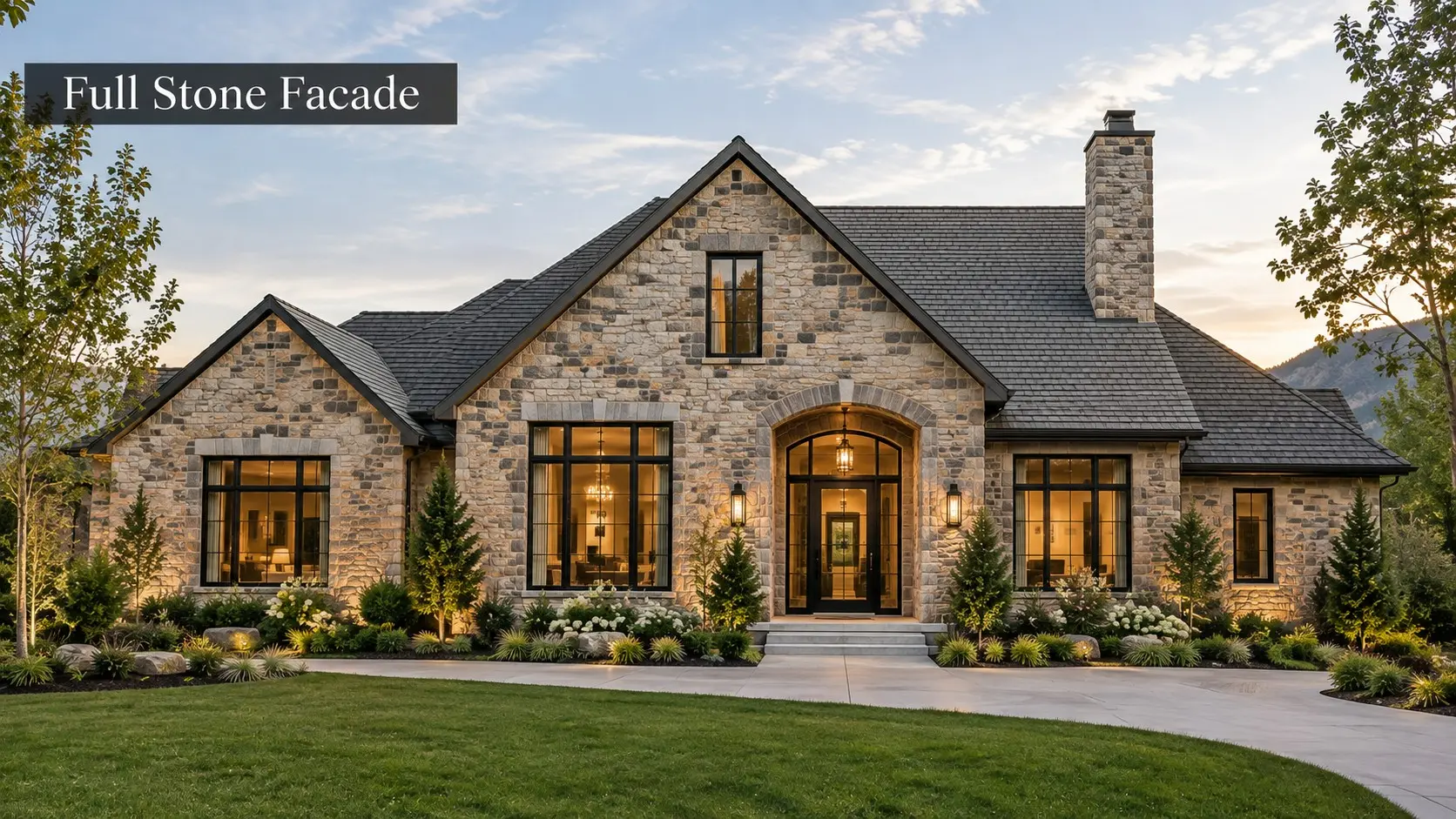
House Styles That Carry a Full Stone Facade
Full coverage suits homes whose architecture already reads as stone: Mediterranean and Tuscan designs, European cottage styles, and rustic mountain homes with deep eaves. On these houses, stone on every wall looks original to the design rather than added later.
Before committing a full front to one color, compare it in person at our Sacramento showroom rather than choosing from a photo alone.
Full coverage struggles on homes with busy rooflines and several bump-outs. Every extra wall adds corners and edges, and a fully covered complex front starts to look heavier than the house itself.
Even on the right style, something has to break up the stone. Generous windows, a wood entry door, or timber brackets give the eye a rest, and without that contrast a fully covered two-story front can look more like a retaining wall than a home.
Full coverage also makes the most of stone's environmental edge. Industry environmental product declarations for natural stone show natural stone cladding with roughly one-third of the production carbon footprint of precast concrete cladding, and on a full facade that difference carries across the entire front of the house.
Thin stone veneer is part of why full coverage is realistic on an existing home. It is much lighter than full-depth stone, which is why our exterior stone guide describes it as a common choice for renovations and additions.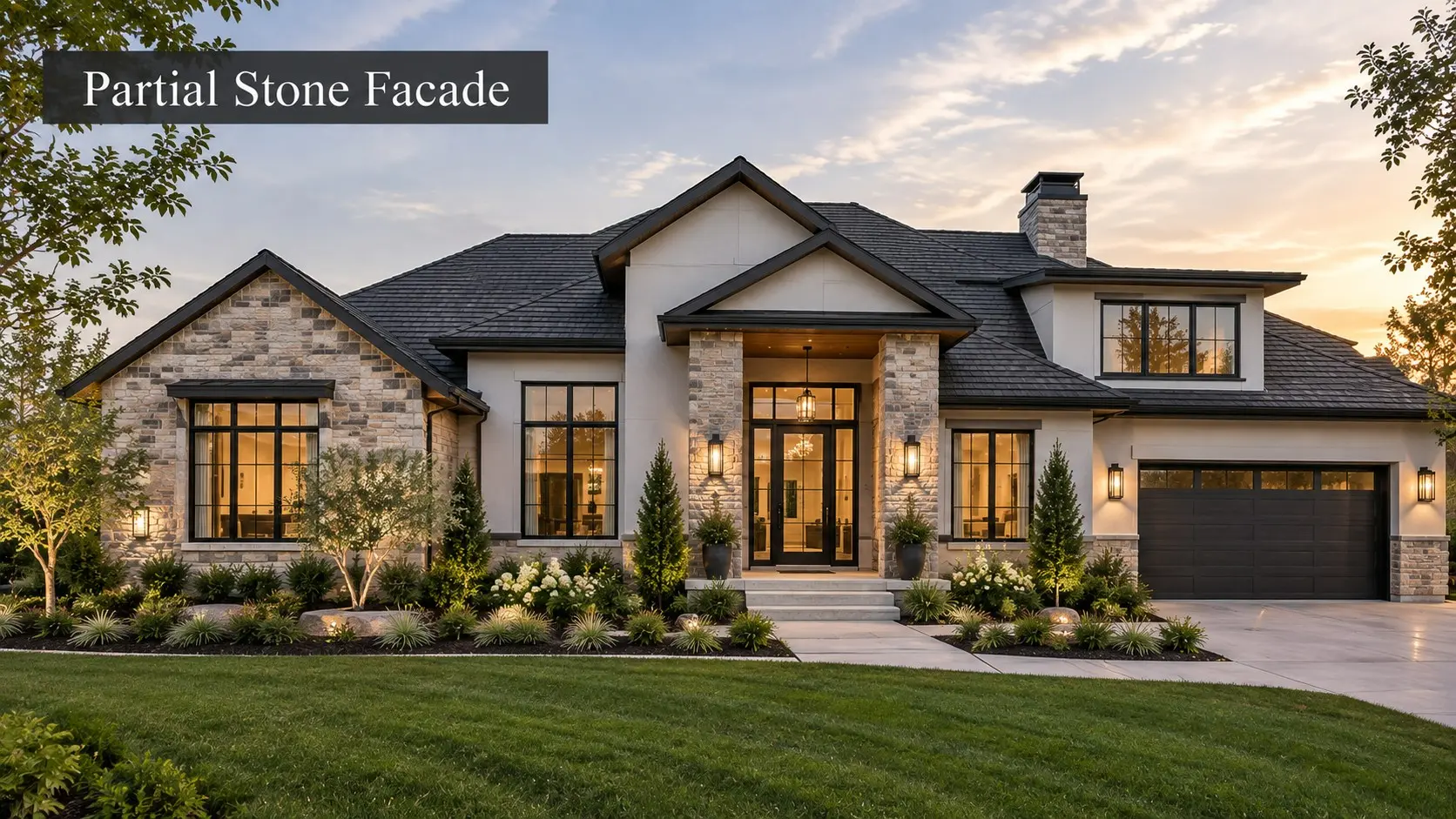
Where a Partial Facade Looks Intentional
The lower-third wainscot, topped by siding or stucco, earns its popularity. Visually, it anchors the house to the ground while leaving the upper walls light.
Height is where partial coverage succeeds or fails. A wainscot that stops at the windowsill line looks planned, while one that ends a foot below the sills looks like the stone simply ran out.
Where Partial Stone Should Stop
One misstep to avoid with partial coverage is ending the stone at an outside corner. Seen from the side, that exposes a thin edge, and the whole facade reads as a stick-on skin instead of solid stone.
Wrapping the stone around the corner and ending it at an inside corner or where the wall changes direction keeps the solid look intact.
Chimneys are the exception to most partial-coverage rules. A chimney is meant to look like stone, so carrying it from the ground to the top looks honest even on a mostly sided house, while stopping halfway looks like a budget decision.
Entry-only treatments follow the same logic. A stone surround framing the front door of a modern farmhouse, with board-and-batten siding on either side, gives the entry weight without competing with the rest of the house.
Before committing, sketch two or three coverage options on a photo of the house, then book a free design consultation to walk through coverage and stone choices for each option. Homeowners in Carson Valley can bring the same sketches to our Minden showroom and see exterior stone in person.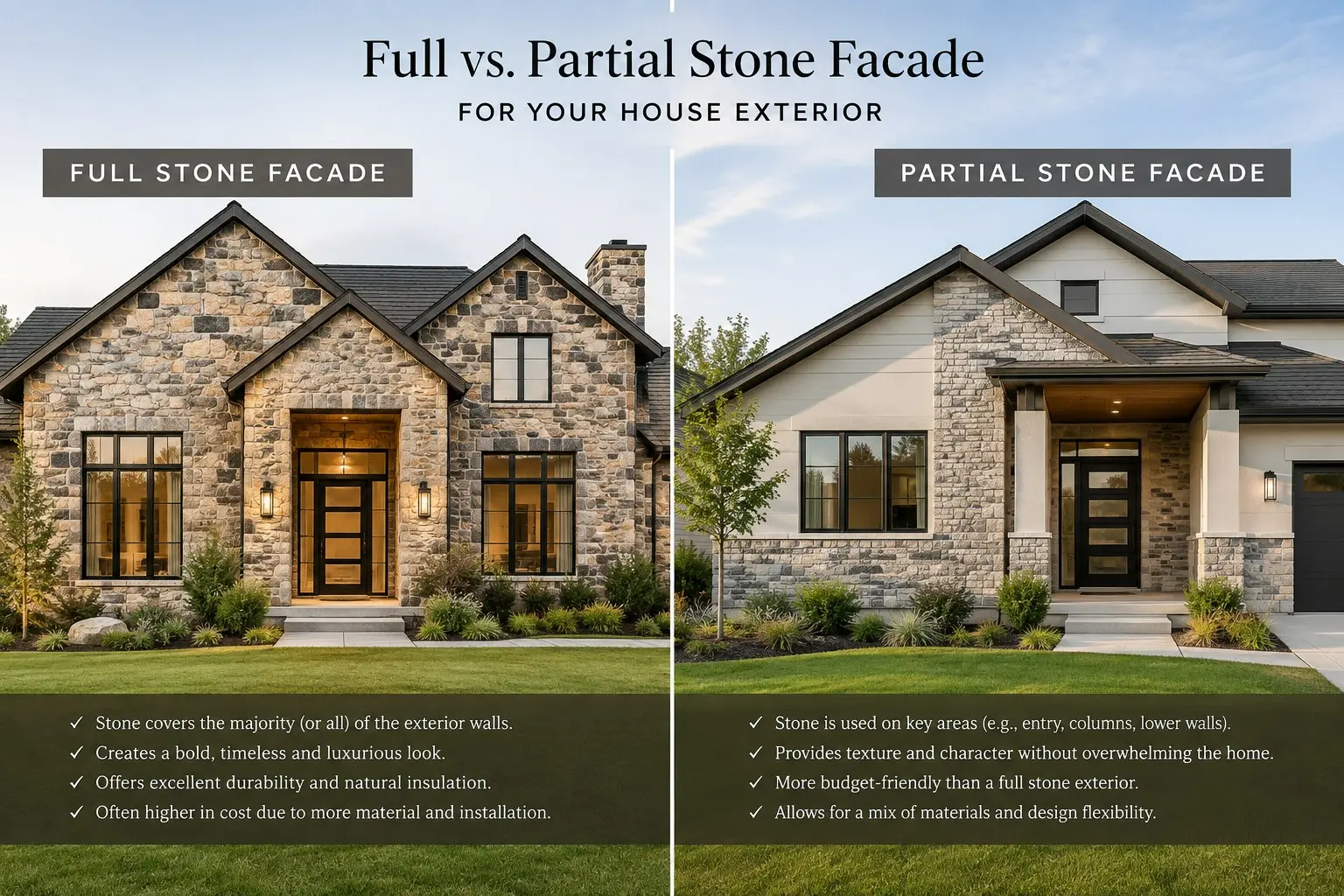
Choosing the Stone for Your Facade
Granite and quartzite are both good fits for exterior stone applications, and both are part of our natural stone selection. Our exterior stone guide pairs quartzite with bright, contemporary facades and granite with full facades and walls that take the most weather, so the architecture usually points to one before color does.
Stone for Northern Nevada Winters and Sun
Reno, Minden, and Fernley see freezing winter nights and strong high-desert sun, and both matter more on a full facade than on a small accent. Water that soaks into porous stone can freeze and expand, which is why we recommend dense, low-absorption stone like granite or quartzite for homes in hard-freeze areas.
Both are UV resistant, but performance may vary by color and finish. One reason is resin: some natural stone slabs are resin-treated during processing to fill small fissures, and resin can discolor under long sun exposure, especially on lighter colors.
Before choosing a stone for a sunny wall, ask whether it has been resin-treated. Sacramento winters are milder, so for homes in that area, sun exposure and color tend to drive the decision more than freezing does.
Stacked Stone, Veneer, and Pavers
Stacked stone, part of our Pavers and Exterior Stone selection, is a strong option for a partial facade. Its layered, textured face adds depth to a wainscot or entry wall without covering the whole house.
Our stone veneer options also include natural stone, manufactured, ledgestone, and fieldstone styles. That range gives a partial facade room to match either a rustic or a clean, modern front.
Finish choice shifts with coverage too. On a full facade, a honed or leathered finish gives a large wall a softer, less reflective look, while polished stone tends to read best as a small accent near the entry.
The same Pavers and Exterior Stone selection includes small to large format pavers. Choosing the front walkway alongside the facade keeps the path and the stone entry in related colors instead of two separate decisions.
Cleaning and Sealing
Everyday care stays simple. The Natural Stone Institute's consumer care guide recommends a neutral cleaner or mild soap with warm water for natural stone, and flushing outdoor stone areas with clear water.
Sealing depends on the stone. Granite and quartzite need very little upkeep beyond an occasional rinse, but harsh cleaners should be avoided, while more porous stone calls for periodic sealing, and our care supplies include protective sealants.
To see what is currently in stock, browse our full material selection and shortlist two or three colors per wall.
What Builders and Designers Should Confirm Before Ordering
For trade pros, measure each wall separately rather than the whole front as one block. That way every corner and transition shows up in the material list.
Color consistency is the other detail to settle early. Natural stone varies in tone, veining, and movement from piece to piece, so ordering the whole facade at once, from the same lot or batch, helps keep color consistent from wall to wall.
Transitions deserve their own line on the plan. The point where a stone wainscot meets siding is visible from the street, so getting homeowner sign-off on where the stone ends avoids a finish detail nobody expected.
When a project pairs a stone exterior with a granite outdoor kitchen counter or a quartzite fireplace, our live slab inventory shows the slabs currently in stock. From there, you can request a slab quote by listing the slab names and any bundle numbers you have in mind.
Contractors and designers with a trade account also get job-site delivery and a dedicated rep, which helps when a facade order spans several walls and several deliveries.
Conclusion
The quickest way to settle full versus partial is to bring photos of every side of the house, including views that show each corner. Side views matter because the outside-corner rule above is impossible to judge from a straight-on photo.
You can visit one of our showrooms with those photos in hand, including our Reno location. The design team at Nova Tile and Stone offers commission-free design help and can compare stone options wall by wall, so each part of the house gets the coverage that suits it.
Note: Some images on this page may be conceptual renderings created to illustrate design possibilities and may not depict actual installations.
Frequently Asked Questions
A full stone facade covers the entire front of a house, while a partial facade places stone on selected areas such as the lower third of the wall, the entry, or a chimney. Partial coverage pairs stone with siding or stucco and uses less material.
Stopping the stone at a natural line, such as the windowsill height or roughly the lower third of the wall, tends to look planned. Ending the stone just short of the sills tends to look unfinished.
Mediterranean, Tuscan, European cottage, and rustic mountain homes carry full coverage well because their architecture already reads as stone. Homes with complex rooflines and many bump-outs usually look better with partial coverage.
In many cases, yes. Thin stone veneer is much lighter than full-depth stone, which makes it a common choice for renovations and additions, and our stone veneer options include natural stone, manufactured, ledgestone, and fieldstone styles.
Dense, low-absorption stone such as granite or quartzite suits the freezing winters and strong sun in Reno, Minden, and Fernley. Both are UV resistant, but performance may vary by color and finish, and stacked stone is another option for a partial facade or entry wall.