Exterior stone finishes control three things outdoors: slip resistance, surface heat, and maintenance. Tumbled, flamed, honed, and split face finishes are among the most common choices for patios, pool decks, walkways, and walls.
Tumbled stone is turned in a rotating drum with water and grit until the edges round off and the face wears, and it is most common on travertine, marble, and limestone pavers. Flamed stone is heated with an intense flame until surface crystals fracture into a rough texture, and it is most common on granite. Honed stone is ground with progressively finer abrasives to a smooth, matte face with little reflection. Split face stone is broken with a hydraulic splitter or guillotine instead of sawn, which exposes a rough, natural face used on walls and cladding.
Slip resistance separates these finishes on wet walking surfaces. ANSI A326.3 notes a generally accepted minimum wet DCOF of 0.55 for exterior wet areas such as pool decks, patios, and walkways, compared to 0.42 for level interior floors. Flamed, tumbled, and natural cleft finishes generally offer more wet grip than honed stone.
What a Surface Finish Does to Exterior Stone
A finish is the treatment applied to the face of the stone after it is cut. It does not change what the stone is made of, but it changes the surface texture, how light reflects off it, and how deeply the color reads. A granite paver with a polished face and the same granite with a flamed face can look like two different materials.
Outdoors, the finish carries more weight than it does indoors. Exterior stone deals with standing water, grit tracked in on shoes, temperature swings, UV exposure, and in colder areas, freeze-thaw cycles.
Polished finishes are rarely used on exterior walking surfaces because a mirror-smooth face turns slick with rain, frost, or pool splash. The four finishes in this guide are widely used on those same surfaces, and they show up across our pavers and exterior stone selection, from pool coping to stacked stone.
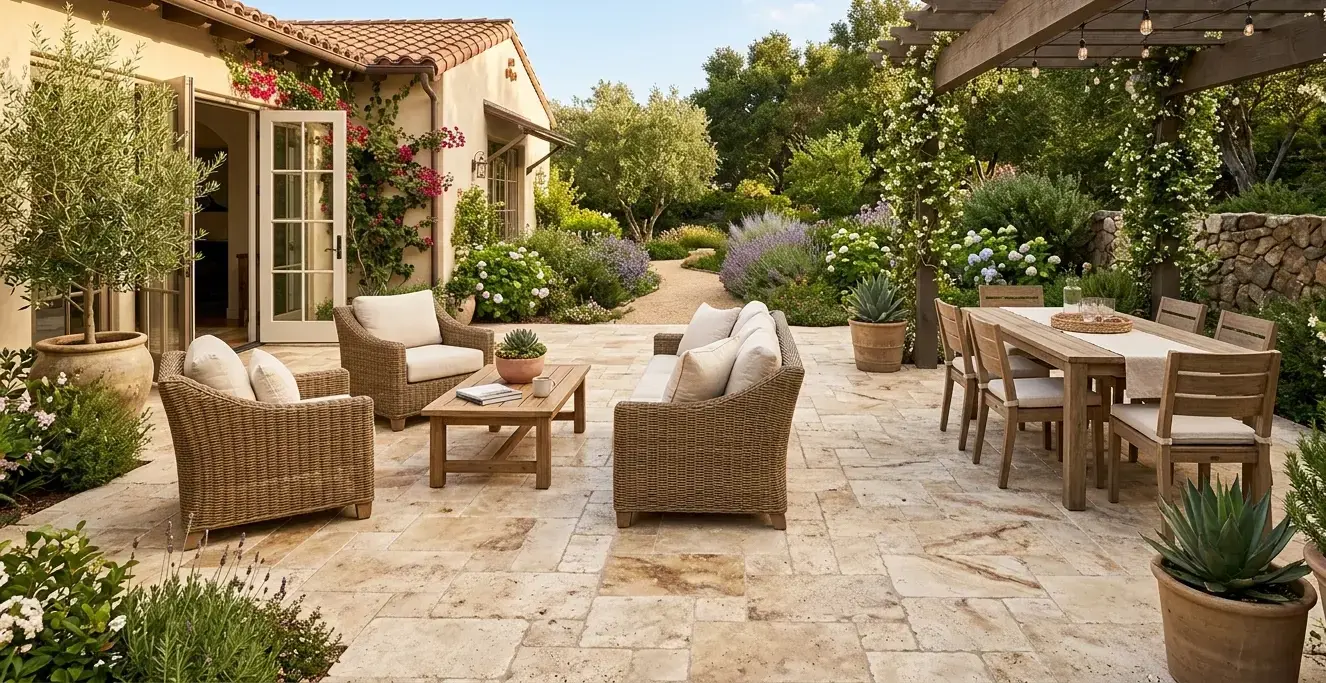
Tumbled Finish: Rounded Edges and a Weathered Face
Inside the tumbling drum, sand, grit, or small stones grind against each piece with water, rounding the edges and softening the face until it looks worn.
Tumbling suits softer, calcium-based stones such as travertine, marble, and limestone. Tumbled travertine pavers are widely used outdoors, and they often appear around pools, on patios, and along garden paths.
Tumbled travertine comes filled or unfilled. In filled travertine, the natural holes are packed with a cementitious or resin filler at the factory. In unfilled travertine, the holes stay open, which adds texture and can collect leaves and debris.
What to know about tumbled stone:
- The pitted, worn face adds grip compared to smooth finishes.
- Color variation tends to look softer and less contrasting after tumbling.
- Smaller pieces are easier to tumble, so this finish shows up most often on pavers, coping, and mosaics rather than large slabs.
- Because these stones are calcium-based, acidic cleaners can etch the surface, and some deicing salts can damage it.
Flamed Finish: Heat-Textured Granite and Hard Stone
A flamed finish, also called a thermal finish, is created by passing an intense flame across the face of the stone, often followed by a water quench. The sudden heat causes crystals near the surface to expand and fracture, leaving a rough, slightly uneven texture.
Flaming works on hard, crystalline stones made of minerals that expand at different rates when heated. Granite is the most common, along with basalt and some quartzites. Most marble, limestone, and travertine are not flamed. Their calcium carbonate content responds to heat more uniformly, so the surface tends to scorch or crack instead of flaking into an even texture. A few dense limestones are exceptions.
After flaming, many producers run abrasive brushes over the surface to knock down sharp points. This variation is usually sold as flamed and brushed.
What to know about flamed stone:
- Flaming often lightens and mutes color, so a flamed sample can look quite different from a polished piece of the same stone.
- The texture offers more wet grip than smooth finishes, which is why flamed granite shows up on steps, pool decks, and public plazas.
- The stone needs enough thickness to handle the thermal shock, so very thin pieces are rarely flamed.
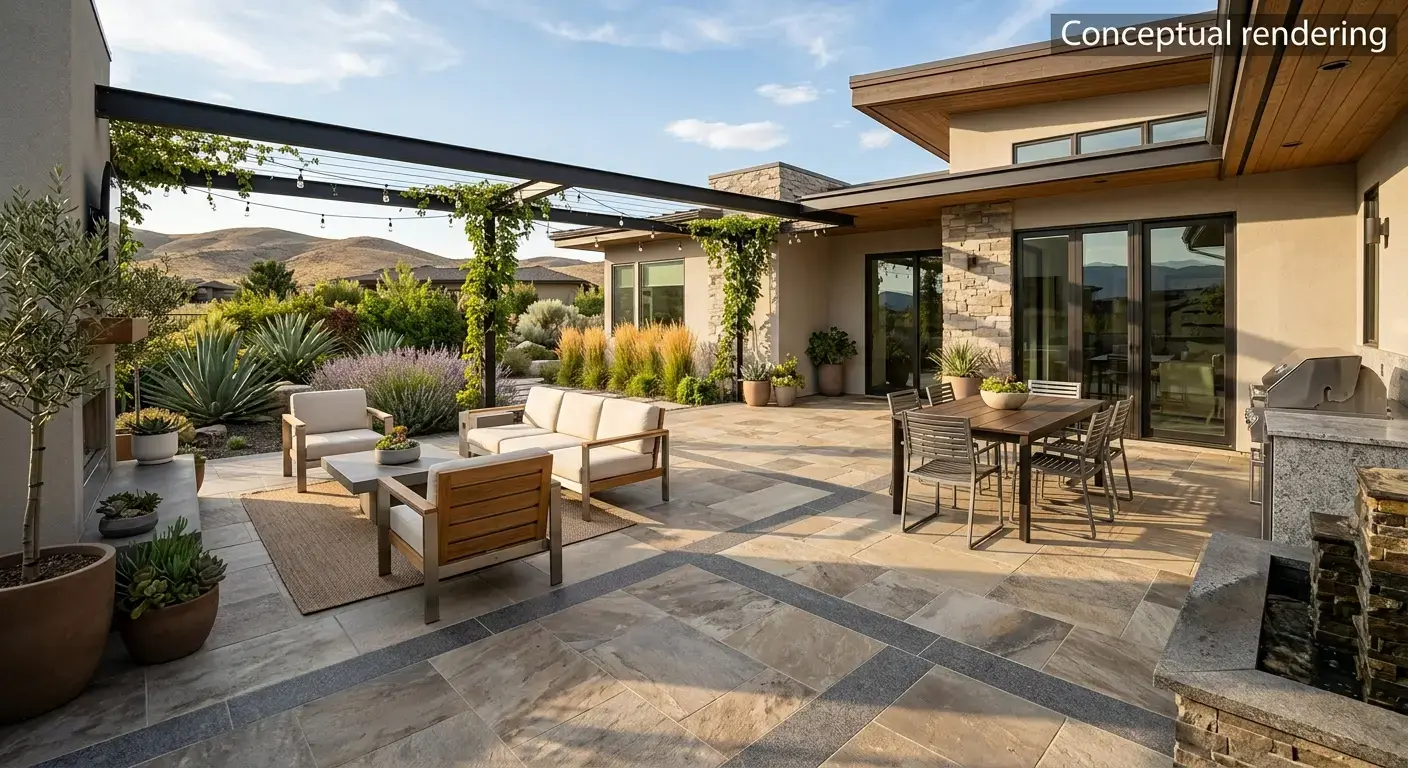
Honed Finish: Smooth and Matte
Honing works through a sequence of finer abrasives and stops before the surface reaches a polish, leaving the face flat and smooth. The result is a matte or satin look with little reflection.
Almost any natural stone can be honed, including marble, limestone, travertine, granite, quartzite, and bluestone. Compared to polishing, honing gives a softer, slightly lighter read of the stone's color and pattern without glare, and it often appears in contemporary designs.
Outdoors, honed stone takes more planning than textured options. A honed face is smoother than tumbled or flamed stone, and it can become slippery when wet, especially on slopes, steps, and pool surrounds. Designers often place honed stone on vertical surfaces, covered patios, covered outdoor kitchens, wall caps, and areas that stay dry most of the time. If you are deciding where a honed surface fits in your layout, our free design consultations can help you map finishes to each area of the project.
What to know about honed stone:
- For any walking surface, ask the supplier whether wet slip-resistance data is available for that stone and finish.
- Honed surfaces show scratches and wear less than polished ones, but more than heavily textured ones.

Split Face Finish: Deep Texture for Vertical Surfaces
Split face stone is made by breaking a block with a hydraulic splitter or guillotine instead of sawing it, which exposes a fractured, natural face. The exposed face is rough and irregular, with ridges and shadows that shift as the sun moves across it.
This finish belongs on vertical applications rather than walking surfaces. Common uses include exterior wall cladding, stacked stone veneer, retaining walls, column wraps, fireplace and fire pit surrounds, planters, and the front faces of steps and seat walls.
Sandstone, limestone, slate, quartzite, granite, and travertine all appear in split face products, and each splits differently. Slate and quartzite tend to break into thin, layered faces, while limestone and sandstone produce chunkier, blocky textures. Contractors and landscape designers specifying split face and other exterior stone across several jobs can apply for a trade account for trade pricing and job-site delivery.
What to know about split face stone:
- Deep texture casts shadow lines, so the same stone can look darker on a wall than in a flat sample.
- Split face is often paired with a smoother cap, such as honed or flamed stone, on top of walls and steps so there is a flat surface to sit on.
Other Exterior Finishes on the Showroom Floor
A few other finishes appear alongside the main four in exterior displays:
- Natural cleft: The face left when slate, sandstone, and some quartzites separate along their layers. It is flatter than split face and is common on flagstone and paving.
- Sandblasted: Abrasive is blasted at the surface under pressure, producing a fine, even texture and a muted color.
- Bush-hammered: A hammer with a head of pyramid-shaped points strikes the surface repeatedly, creating a pitted texture on granite, limestone, and sandstone.
- Brushed or antiqued: Abrasive brushes wear down softer areas of the stone and leave a gently undulating surface, often on travertine and limestone.
Finish names vary between suppliers, so handling a sample in person at one of our local showrooms helps confirm what a label actually means.
How Each Finish Handles Water, Heat, and Freezing
Texture drives wet grip, so honed stone needs more care on walking surfaces than flamed, bush-hammered, tumbled, or natural cleft stone. Under ANSI A326.3, pool decks, patios, and walkways fall into the Exterior Wet category, which is manufacturer-declared and carries a generally accepted minimum wet DCOF of 0.55. Many natural stone products do not carry a published DCOF value, so ask the supplier for test data and wet a sample to feel it underfoot. Ramps and slopes call for extra caution.
Surface temperature depends mostly on color, though finish plays a part. Lighter stones reflect more sunlight, and a matte or textured face cuts glare compared to a reflective one. Light travertine and limestone are frequent picks around pools for this reason, while dark flamed granite can get hot in direct afternoon sun.
In freezing climates, water absorption matters as much as finish. Water that soaks into stone expands when it freezes, and repeated cycles can cause spalling or cracking. Dense, low-absorption stones tend to handle freeze-thaw cycles better than porous ones. ASTM C615, for example, sets a maximum absorption of 0.40% by weight for granite dimension stone. Unfilled holes and open pores can hold moisture, so good drainage and sealing matter for any finish.
Deicing salts are another factor. Travertine, marble, and limestone can scale or deteriorate with some deicers, and salt residue can build up in textured surfaces. Sand for traction, or a deicer approved by the stone or sealer manufacturer, is a gentler option.
Choosing a Finish by Location Around Your Home
Most outdoor projects use more than one finish. A patio might combine tumbled pavers underfoot, a split face wall along one edge, and a honed cap on top of that wall. Mixing finishes can also help manage cost, and our overstock materials can be an option for smaller accent areas. The table below matches common locations with finishes that tend to suit them.
| Location | Finishes to consider | Notes |
| Patios and walkways | Tumbled, flamed, natural cleft, bush-hammered | Texture adds grip after rain and irrigation |
| Pool decks and coping | Tumbled travertine, flamed and brushed granite, sandblasted | Lighter colors stay cooler; ask about wet slip data |
| Exterior steps | Flamed, bush-hammered, natural cleft | Treads need texture; risers can take any finish |
| Covered patios and outdoor kitchens | Honed, brushed, tumbled | Less exposure to standing water |
| Walls, cladding, and columns | Split face, natural cleft, honed | Walking grip is not a factor on vertical faces |
| Wall caps and seat walls | Honed, flamed and brushed | A flatter top for sitting or setting things down |
| Fire pit and fireplace surrounds | Split face, flamed, honed | Ask whether the stone suits direct heat exposure |
Architectural style plays a role too. Tumbled and brushed finishes are common on Mediterranean, Spanish, and farmhouse homes. Flamed and honed finishes lean modern. Split face fits mountain, rustic, and craftsman architecture.
Sealing and Care for Each Finish
When exterior stone is sealed, a penetrating, or impregnating, sealer is the usual choice. It soaks into the stone and repels water and stains without forming a film on top. Topical film-forming sealers can make exterior surfaces slick and trap moisture, so they are generally avoided on walking surfaces. Resealing frequency depends on the stone, the sealer, and the exposure. A simple water-drop test shows when water starts soaking in instead of beading.
Day-to-day care differs by finish:
- Tumbled: Sweep often so grit does not settle into pits and holes. Unfilled travertine may need occasional debris clean-out.
- Flamed: Scrub with a stiff nylon brush and a pH-neutral stone cleaner to lift dirt from the textured face.
- Honed: Clear spills, leaves, and bird droppings promptly, since stains stand out on a flat matte surface.
- Split face: Brush and rinse at low pressure. High-pressure washing can loosen mortar joints or chip thin edges.
For every finish, avoid acidic cleaners on calcium-based stones and test any new product on a hidden area first.
Conclusion
Tumbled, flamed, honed, and split face finishes each change how a stone looks, feels, and performs outdoors. Tumbled and flamed finishes add texture for walking surfaces, honed stone gives a smooth matte face for dry or covered areas, and split face brings depth to walls and other vertical features.
Photos rarely capture texture well, and the same stone can look different from one finish to the next. We carry exterior stone for patios, walkways, and outdoor living areas, and seeing finishes side by side makes the differences easier to judge. Stop by one of our showrooms in Sacramento, Reno, Minden, or Fernley to see and feel these finishes for yourself.
Note: Some images on this page may be conceptual renderings created to illustrate design possibilities and may not depict actual installations.
Frequently Asked Questions
Textured finishes are the usual choice for pool decks because they offer more grip when wet. Tumbled travertine, flamed and brushed granite, and sandblasted stone are common options. ANSI A326.3 notes a generally accepted minimum wet DCOF of 0.55 for exterior wet areas like pool decks. Lighter colors also tend to stay cooler underfoot in direct sun.
Yes, honed stone can be used outdoors, but it is smoother than textured finishes and can become slippery when wet. It is often placed on covered patios, wall caps, vertical surfaces, and areas that stay mostly dry. For walking surfaces, ask the supplier whether wet slip-resistance data is available.
Flamed granite is textured with intense heat, which fractures surface crystals and leaves a rough face, often with a lighter, muted color. Honed granite is ground smooth to a matte finish that shows its pattern without glare. Flamed granite offers more wet grip, while honed granite has a flatter, smoother feel.
Split face stone is not used for patio floors because its rough, irregular face is hard to walk on and difficult to keep level. It is used on walls, cladding, columns, planters, and fire pit surrounds. Patios usually use tumbled, flamed, or natural cleft stone underfoot.
Many exterior natural stones benefit from a penetrating sealer, whatever the finish, though needs vary by stone. Dense granite typically needs it less often than porous travertine or limestone. Textured surfaces can hold dirt and moisture in their pits and crevices, and sealing helps limit staining and water absorption. A water-drop test shows when it is time to reseal.