The best exterior stone options are dense, low-absorption materials like granite, quartzite, and slate, which resist freeze-thaw damage, UV fading, and moisture penetration better than porous stones like limestone, sandstone, and travertine. The right choice depends on where the stone will be used (a full façade, a patio, or a decorative accent) and the specific weather conditions it will face over time.
Two stones that look nearly identical in a showroom can perform very differently once installed outdoors, depending on how much water each one absorbs and how it responds to repeated freezing, direct sun, or salt air. Understanding both factors, along with how each stone type is typically applied, makes it possible to choose a material that holds up for decades rather than one that looks right in a display but fails outdoors within a few years.
This guide covers what makes a stone suited for exterior use, how the most common types compare on durability, water absorption, and application, and how to maintain exterior stone so it keeps its appearance long term.
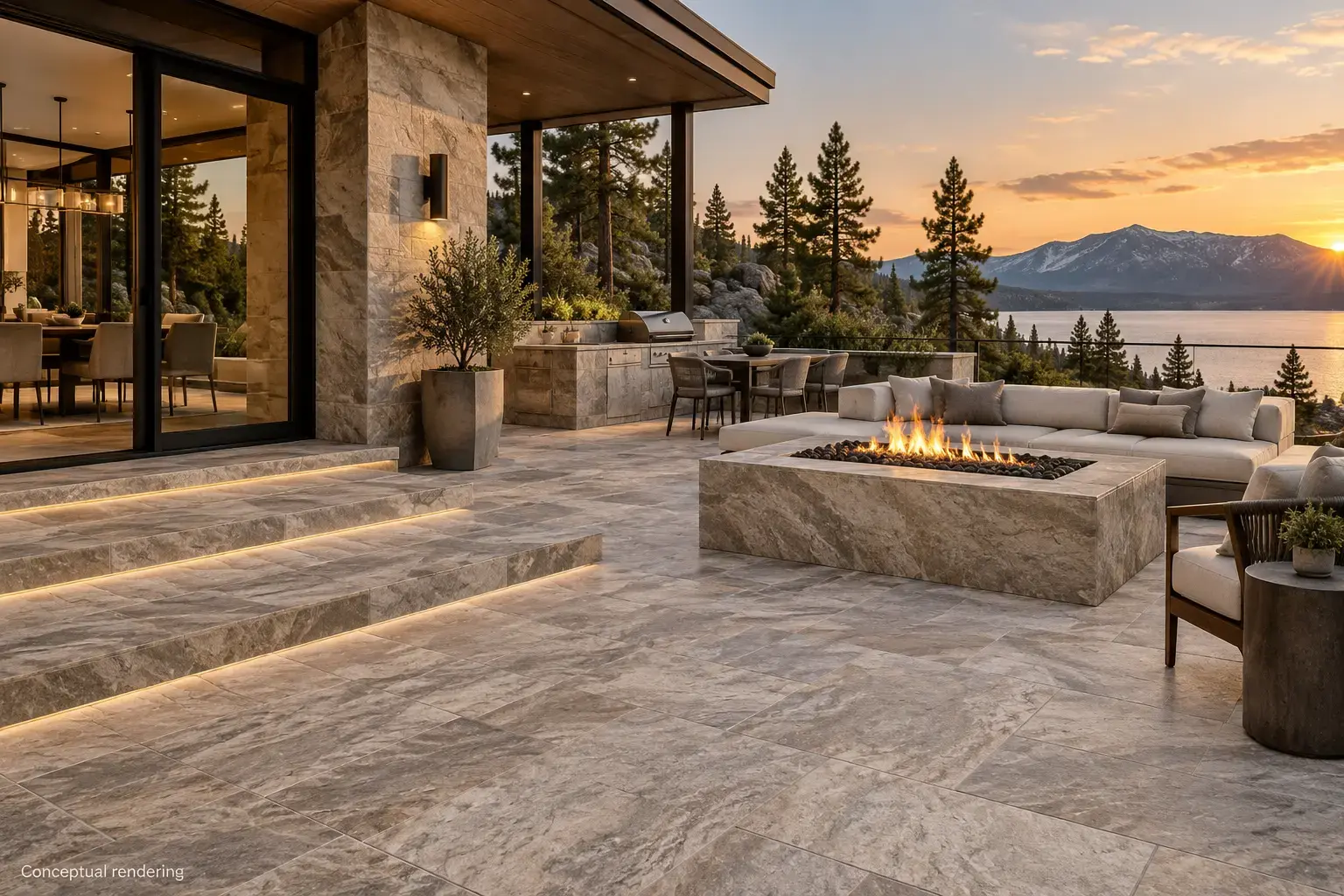
What Makes a Stone Suited for Exterior Use
Every stone has some degree of porosity, meaning it can absorb a small amount of water into its internal structure. This matters for two reasons. First, in any climate that sees winter freezes, absorbed water expands by roughly nine percent in volume when it turns to ice, and if the surrounding stone can't accommodate that expansion, microscopic cracks begin to form. A single freeze-thaw cycle rarely causes visible damage, but repeated over many winters, it can lead to surface flaking, cracking, or loss of structural integrity, particularly at edges and corners where stress concentrates. Second, even without freezing, a porous stone that absorbs moisture is more prone to staining, mottling, and surface breakdown over time, including from coastal salt air, which behaves similarly to moisture in how it works its way into a stone's pores.
This is why absorption rate is one of the most useful numbers when comparing stones for exterior use, arguably more useful than hardness or price alone. The industry standard for measuring it is ASTM C97, a test for absorption and bulk specific gravity of dimension stone, used for granite, limestone, sandstone, marble, and travertine (slate is tested separately under its own standard, ASTM C121). Dense, low-absorption stones consistently perform better over the long run than porous ones, in freeze-thaw climates and otherwise.
Sun and UV exposure add a second consideration. Darker, denser stones with tightly interlocked mineral structures tend to resist fading better than lighter, more porous ones over years of direct sun. This doesn't rule out lighter stones for exterior use, but it does mean a porous, light-colored stone in constant direct sun is more likely to show visible wear sooner than a dense one in the same spot.
A stone's mineral composition matters as much as its porosity. Calcite-based stones like marble and limestone react chemically with the mild acids present in rainwater and airborne pollutants, a process called etching that dulls a polished surface over time regardless of how little water the stone actually absorbs. Research on how acid rain affects different building stones confirms that calcite-based stones like marble and limestone are especially vulnerable, while silicate-based stones like granite and sandstone resist this kind of chemical attack. This is a separate durability factor from absorption, and it's part of why some low-absorption stones still aren't the best fit for full weather exposure.
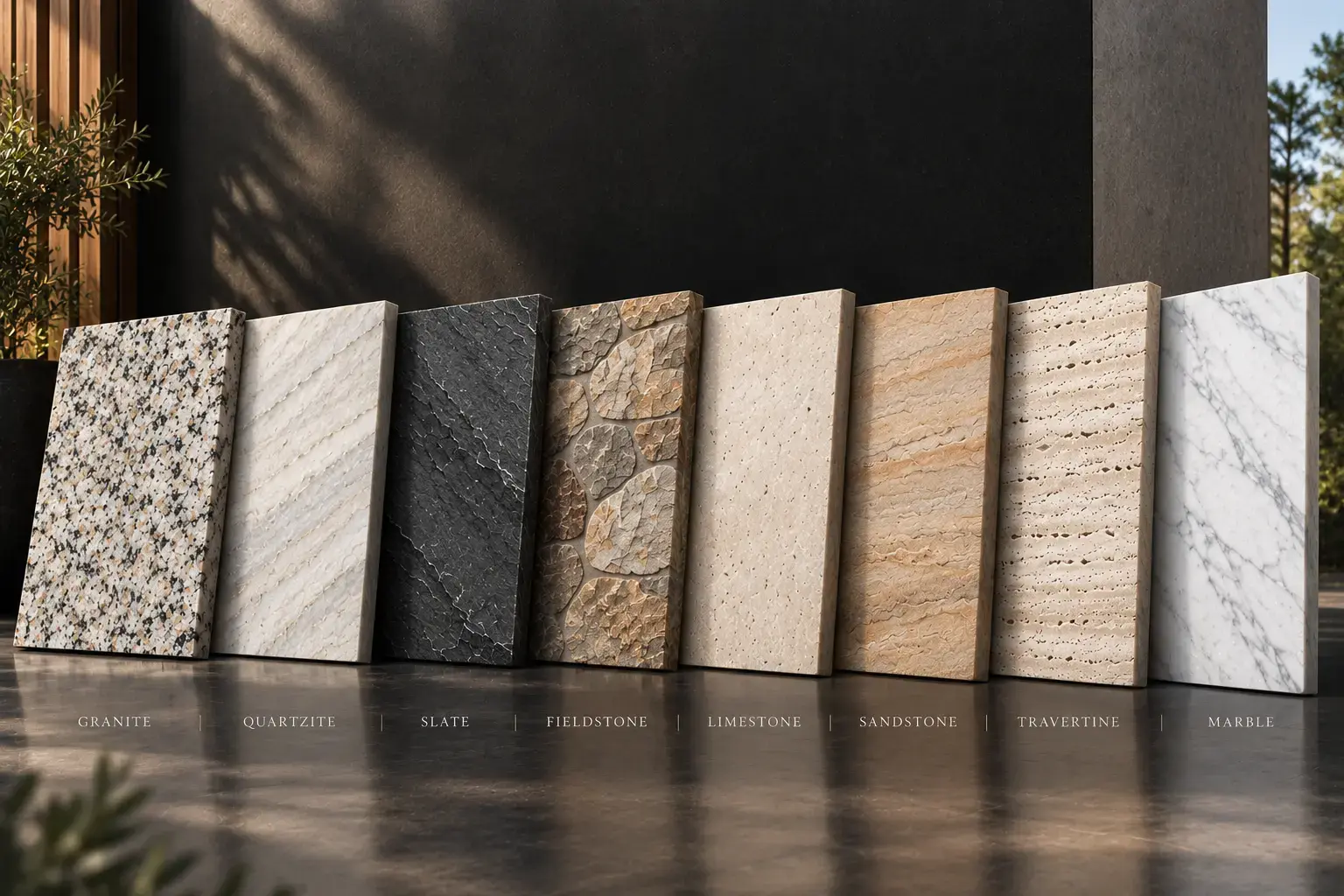
Comparing Natural Stone Types for Exterior Use
Not every stone sold for interior countertops or flooring is a good candidate for an exterior wall, patio, or entryway, and the specific application changes what matters most just as much as the stone itself does. A fully exposed façade sees constant, unbroken sun, rain, and freeze-thaw cycling with no relief, which is why the lowest-absorption stones are typically specified there rather than for lower-exposure applications. Patios and walkways add foot traffic and standing water to the mix, so surface finish and slip resistance matter alongside absorption rate.
A honed or flamed finish may offer more traction underfoot than a polished one, but suitability for wet patios and walkways should be confirmed with product-specific DCOF/ANSI A326.3 data. Accent walls, columns, and entryways often benefit from some shelter provided by surrounding walls or roof overhangs, which opens the door to more porous or characterful stones than a full façade would allow.
Retaining and garden walls sit in constant contact with soil moisture, so drainage behind the wall matters as much as the stone's own absorption rate. Long-term field studies of exposed stone masonry have documented how repeated moisture, salt, and freeze-thaw cycling gradually weaken more porous stone especially at fully exposed wall surfaces, underscoring why density matters most for that specific application.
The table below covers the types most commonly specified for exterior use, followed by where each one tends to perform best.
Stone
| Water Absorption | Durability Outdoors | Best Exterior Uses |
Granite | Very low | Excellent | Full façades, entry columns, low walls |
Quartzite | Low | Excellent | Façade cladding, accent walls, walkways |
Slate | Low | Very good | Wall cladding, flat cladding panels |
Fieldstone | Varies by source | Good, depends on stone type | Accent walls, garden walls, rustic façades |
Limestone | Moderate to high | Fair, needs sealing | Accents, protected areas, not full exposure |
Sandstone | Moderate to high | Fair, varies widely by source | Accents in protected, non-freezing exposures |
Travertine | Moderate | Fair to good, needs sealing | Patios, pool surrounds in milder climates |
Marble | Low to moderate | Fair, sensitive to acid exposure | Decorative accents, low-traffic areas |
Granite is the densest commonly used option and holds up to freeze-thaw cycling, salt exposure, and direct sun with very little change in appearance over time. It works well as a primary façade material or for entry columns and low walls that see constant weather exposure, and it also holds up well underfoot, making it a durable choice for patios and walkways in addition to full exterior walls.
Quartzite offers a similar performance profile to granite, with high silica content giving it strong resistance to both moisture absorption and UV fading. Its lighter, brighter coloring makes it a common choice for contemporary façades where a lighter palette is desired without sacrificing durability, and like granite, it performs well as a patio or walkway surface, not just a façade material.
Slate splits naturally into thin, relatively flat sheets, which makes it well suited to cladding panels and accent walls. Its low absorption rate gives it solid outdoor durability, though it is generally used as a thinner veneer application rather than a full structural facing.
Fieldstone is naturally occurring stone gathered whole rather than quarried and cut, which gives it an irregular, rustic character well suited to garden walls, accent walls, and traditional or farmhouse-style façades. Its rustic, uneven look is often the specific design goal for retaining and garden walls rather than a limitation, provided the wall behind it drains properly. Because fieldstone can be composed of many different underlying stone types, its durability varies more than a single-quarry material, so it's worth confirming the composition of a specific batch before specifying it for a fully exposed wall.
Limestone and sandstone are more porous than the stones above, and their performance depends heavily on the specific quarry source. Some sandstones with high quartz content and low clay content hold up reasonably well, while others degrade quickly once clay minerals inside the stone begin absorbing and releasing moisture. Limestone shares marble's calcite-based sensitivity to acid exposure, discussed above. These are better suited to accents, covered entryways, or other areas with some protection from direct weather exposure rather than a fully exposed façade, and they benefit from regular sealing.
Travertine is prized for its warm, textured look on patios and pool surrounds, but its natural porosity means it needs a consistent sealing schedule. It performs best in milder or more sheltered installations. A honed or flamed finish may help with traction, but slip resistance underfoot should be confirmed with product-specific DCOF/ANSI A326.3 data rather than assumed from finish alone.
Marble is more commonly used indoors. Its water absorption is somewhat higher than granite's, and its susceptibility to acid etching, combined with a surface that's softer than granite's, makes it a better fit for a decorative accent, such as a threshold, low wall cap, or feature panel, than a fully exposed façade or a walking surface subject to heavy weather.
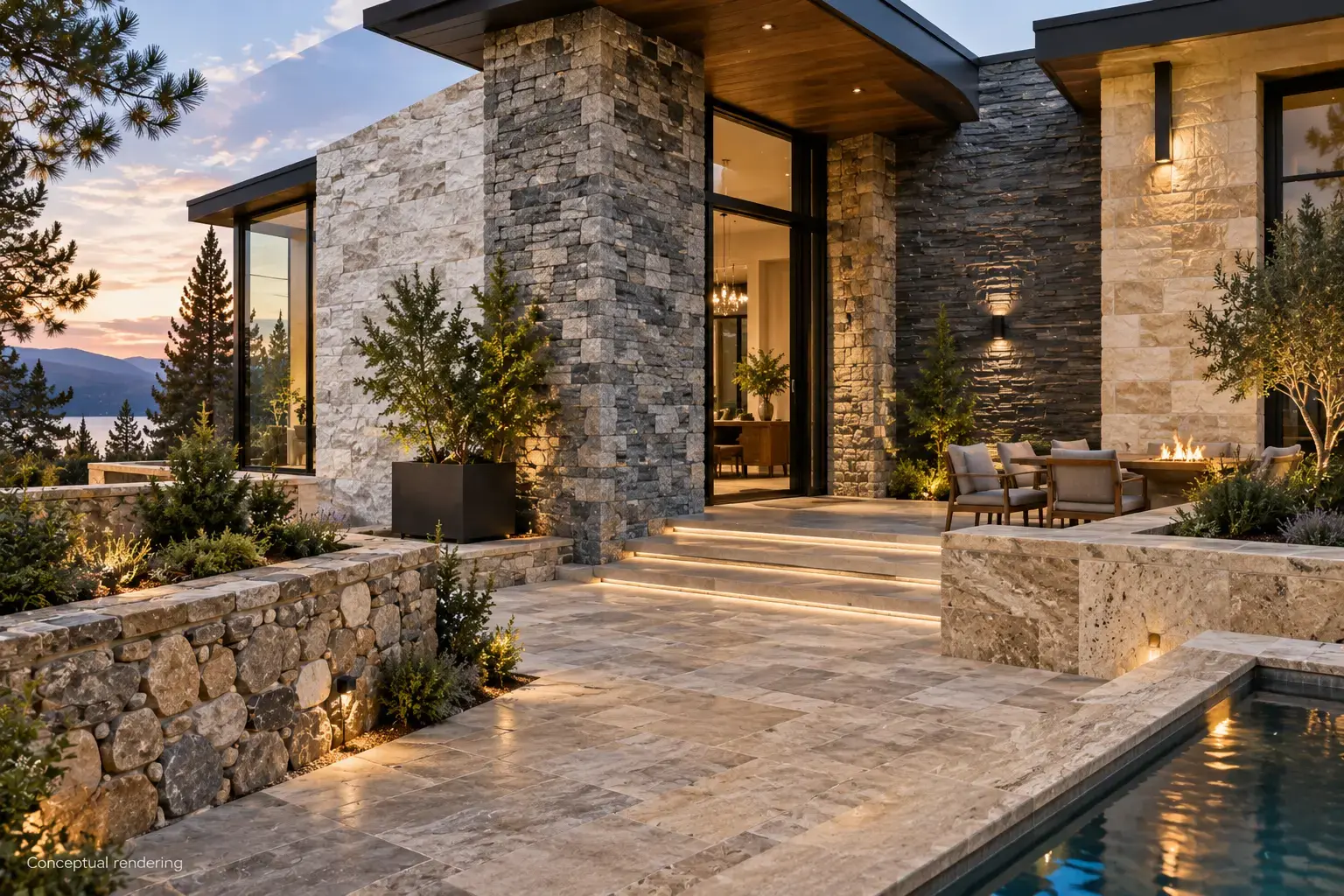
Matching Stone to Architectural Style
Performance narrows the field, but style still matters for the final decision. Granite's range of colors, from deep charcoal to warm gray, works across both contemporary and traditional designs. Quartzite's lighter, often bright white or soft gray tones suit modern builds looking for a clean façade. Slate's flat, uniform texture pairs naturally with contemporary and minimalist architecture. Fieldstone lends itself to farmhouse, cottage, and traditional styles where an irregular, handcrafted look is the goal. For homes seeking a more refined or traditional character, limestone, sandstone, and marble accents still work well when used on covered entries, chimneys, or partial walls rather than full, unprotected façades, provided a regular sealing routine is part of the plan.
Sealing and Maintenance for Exterior Stone
Even the densest stones benefit from periodic sealing, and porous stones require it to perform acceptably outdoors. Resealing needs vary by stone type, finish, climate, and the specific sealer used. Test periodically by seeing whether water beads on the surface, and follow the sealer manufacturer's guidance. Porous stones like limestone, sandstone, and travertine often need more frequent attention than granite, quartzite, or slate, and marble, while less porous, benefits from regular sealing and a neutral-pH cleaning routine to help limit acid-related etching over time.
Climate plays a role here too: a stone in a freeze-thaw climate or one facing constant coastal salt air will generally need closer attention than the same stone in a mild, dry setting. A proposed testing standard that subjects stone samples to 100 simulated freeze-thaw cycles under worst-case conditions to approximate decades of real-world exposure is a useful reminder that a stone's long-term performance depends on cumulative exposure over many years, not just how it looks when it's first installed.
Sealing both the exposed face and, where possible, the back and cut edges before installation helps prevent moisture from working its way in from below, which can cause as much damage as moisture entering from the surface. Routine inspection matters too. A twice-yearly check, ideally in spring and fall, for hairline cracks, loose sections, or deteriorated joints catches small problems before they turn into larger ones.
Conclusion
Choosing the right exterior stone comes down to matching a stone's density, absorption rate, and chemical composition to the application it will serve, whether that's a fully exposed façade, a patio, or a decorative accent, and then layering in style preferences and a consistent maintenance routine. Dense, low-absorption stones like granite, quartzite, and slate are the most versatile choices for fully exposed exterior surfaces, standing up well to sun, moisture, and repeated freeze-thaw cycling with minimal upkeep. More porous stones like limestone, sandstone, and travertine, along with acid-sensitive stones like marble, still have a place in accents, patios, and protected applications, provided they're paired with the right sealing and cleaning routine.
The right stone for one home's façade might not be the right stone for another's patio or accent wall, which is why matching material to application matters as much as matching material to style. Getting this right at the selection stage saves on maintenance and replacement costs for decades to come.
Nova Tile and Stone's selection of exterior stone spans granite, quartzite, slate, travertine, and more, available for viewing across all four showroom locations in Reno, Minden, Fernley, and Sacramento.
Frequently Asked Questions
Both perform well outdoors and resist UV fading. The choice usually comes down to color preference and architectural style rather than a meaningful performance gap between the two.
They can, but limestone's higher porosity and marble's sensitivity to acid exposure and softer surface mean both are more likely to show wear over time than granite, quartzite, or slate. They perform best in accents or partially protected areas rather than a full façade.
Resealing needs vary by stone type, finish, and exposure. Test periodically by seeing whether water beads on the surface, and follow the sealer manufacturer's guidance. Porous stones and high-exposure surfaces typically need more frequent attention.
Fieldstone is gathered whole from the landscape rather than cut from a quarry, which gives it an irregular, rustic look. Because it can include a mix of stone types, its durability varies more than a single-source quarried stone.
Yes. A stone that isn't ideal for a fully exposed façade, like limestone, sandstone, or marble, can still hold up well as an accent, a patio surface, or a low garden wall, where it gets some shelter from constant weather. Matching the stone to its specific application, not just picking a stone type in isolation, is what determines whether it lasts.
Note: Some images on this page may be conceptual renderings created to illustrate design possibilities and may not depict actual installations.