No, not every paver can be used for a driveway. Paver stone is a flat unit of natural stone, concrete, brick, or porcelain set side by side to form an outdoor surface, and only pavers with enough strength, thickness, and support underneath can handle the weight and turning force of vehicles. Many pavers made for patios and walkways are too thin or too large to carry a car without cracking or shifting.
Whether a paver can work under a car depends on four things: the material, its thickness and size, its surface finish, and how it is set. For concrete pavers, about 2 3/8 inches (60mm) is a common thickness for residential driveways. For natural stone, flexural strength, measured according to the ASTM C880 standard, guides how thick each piece needs to be. Absorption, measured according to the ASTM C97 standard, helps indicate stain resistance and how the stone may handle freezing and thawing.
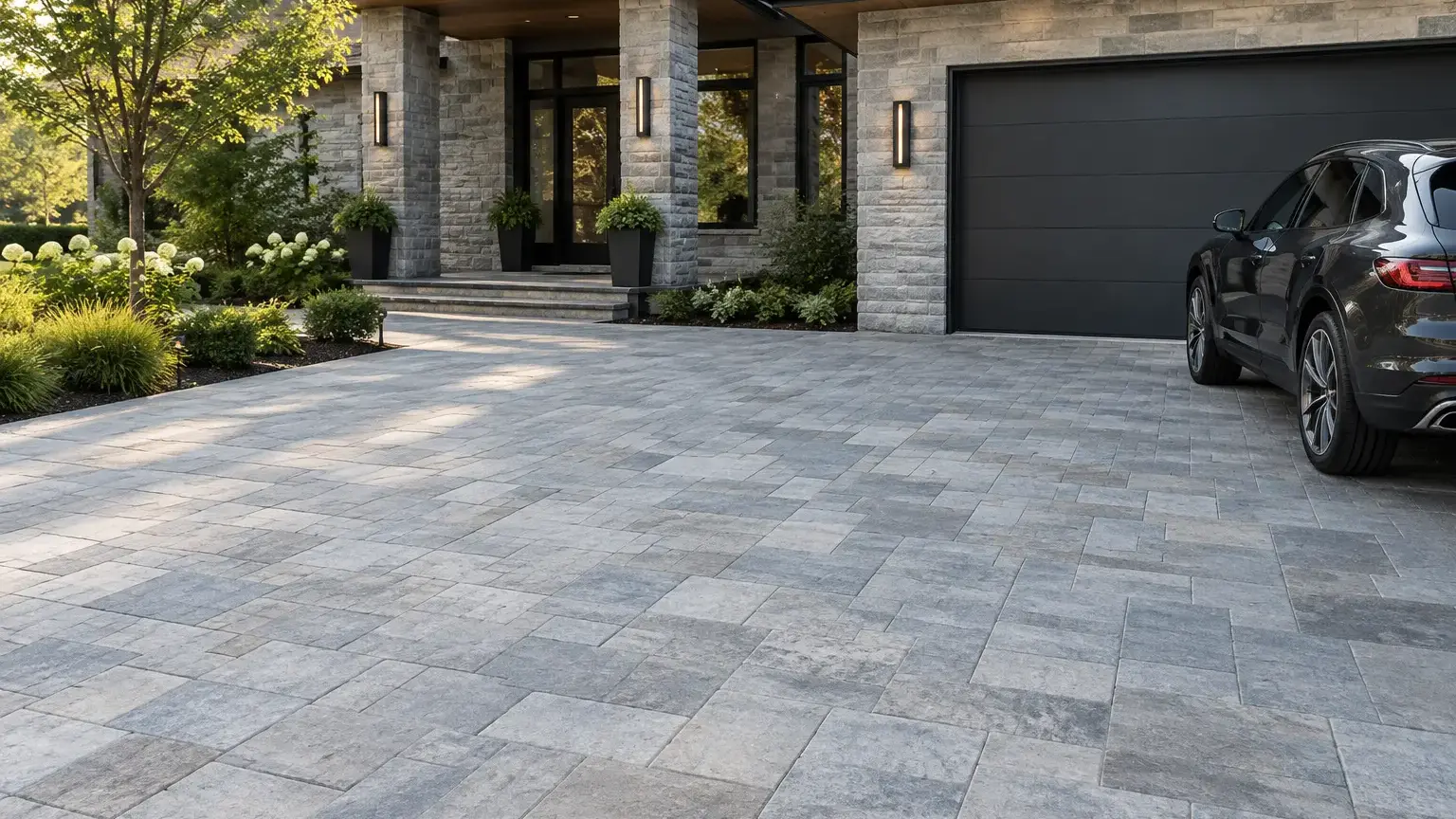
Why Cars Ask More of Stone Than Foot Traffic Does
Foot traffic spreads a fairly light load across a surface. A car concentrates its weight at four small tire contact points, and every time the wheels turn while the car is standing still, they twist against the surface. Exterior paving also deals with precipitation, temperature extremes, and sometimes substantial vehicle loads, so the stone has to be durable as well as strong.
Two kinds of strength are usually discussed. Compressive strength, measured under ASTM C170, describes how well a stone resists crushing. It is typically high compared with the loads stone carries, so it rarely decides whether a stone will work. Flexural strength describes how well a stone resists bending before it breaks, and it is measured in two ways. ASTM C99 (modulus of rupture) uses a standard-size specimen loaded at a single point. ASTM C880 tests the stone at the actual thickness planned for the project and spreads the load across two points, which is why stone engineers often prefer it for paving design. The ASTM specifications for limestone, quartz-based stone, and slate rely on modulus of rupture rather than C880, although additional testing can be requested.
These values vary widely from one stone to another. Two pieces that look similar side by side can perform very differently once a car is parked on them, which is why design professionals rely on standardized testing of natural stone for exterior and walking surfaces rather than on appearance alone.
Water is the other major factor, since paving can stay saturated for long periods. Absorption limits differ even within a single stone type. ASTM divides limestone into low-, medium-, and high-density classes, and the low-density class may absorb up to 12 percent of its weight in water, while the high-density class is limited to 3 percent. There is currently no stone-specific ASTM standard for freeze-thaw resistance, although ASTM's dimension stone committee is working on one. In the meantime, some projects use accelerated weathering tests that compare a stone's properties before and after repeated temperature and moisture cycles.
How to Read Stone Test Data
If a supplier or quarry provides test results, a few details make them more useful. First, check which test was used. C880 and C99 results are not interchangeable, so compare results from the same test. Second, look at the date. ASTM C1799, the guide for sampling and preparing stone test specimens, recommends using test data that is less than three years old, since quarry production can change over time. Third, keep in mind that a stone's properties can vary even between different areas of the same quarry, and stones are sometimes sold under different trade names or placed in the wrong stone classification. Either situation can lead to incorrect assumptions about whether a material suits exterior paving.
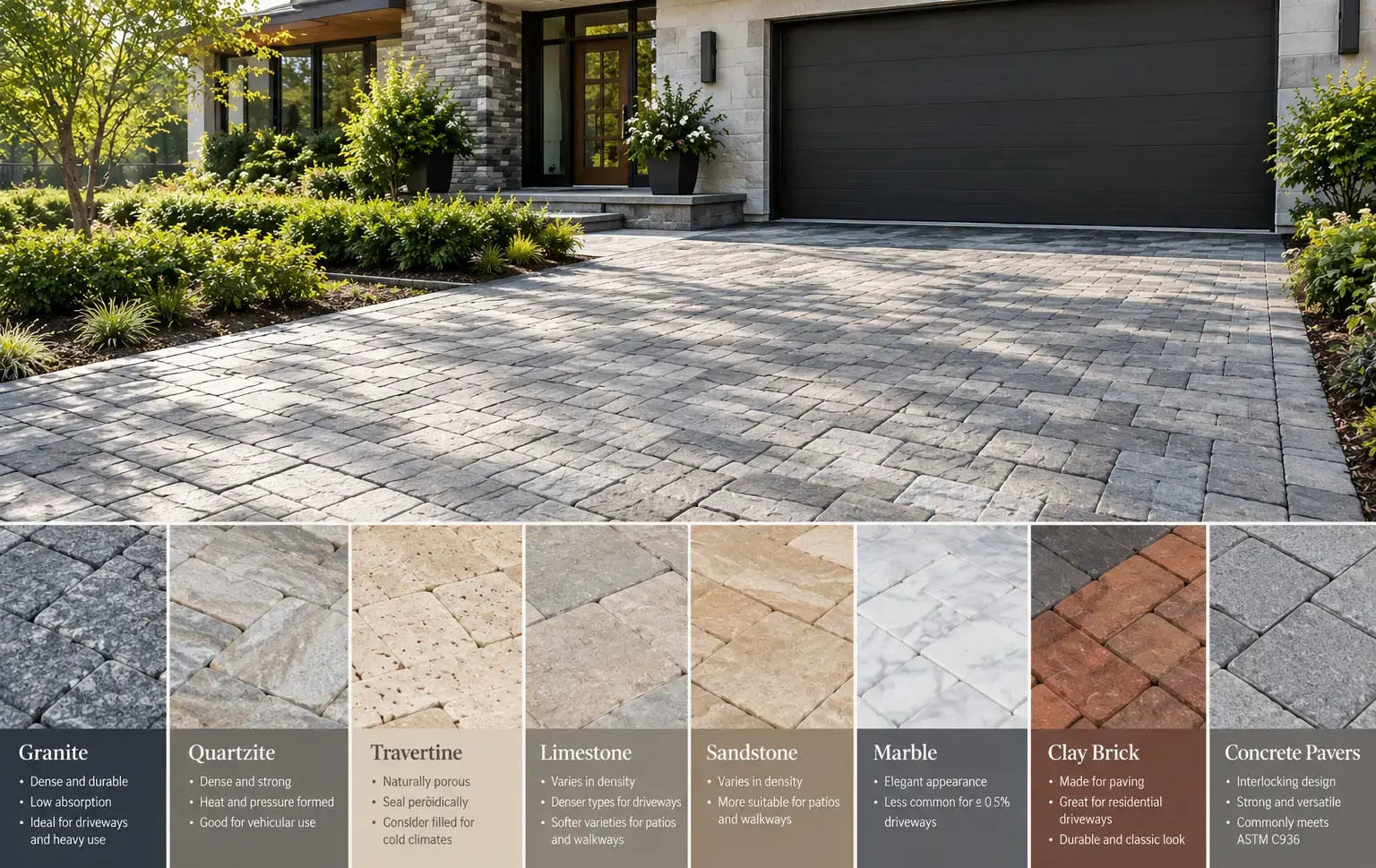
How Common Materials Compare
Natural stone falls into two broad chemical groups. Siliceous stones, such as granite, quartzite, slate, and most sandstones, contain silica and tend to be strong and resistant to acids. Calcareous stones, such as marble, limestone, and travertine, are made of calcium carbonate and can react to acids, even mild ones. That difference can affect how a stone responds to spills, cleaners, and some deicing products.
Granite is dense, has low absorption, and is commonly used for vehicular and commercial paving.
Quartzite forms when sandstone is exposed to heat and pressure over time, a process that generally makes it dense. ASTM covers quartzite, sandstone, and bluestone together under its specification for quartz-based dimension stone.
Travertine is naturally porous, so periodic sealing is usually recommended. In climates with freezing temperatures, filled travertine is often suggested, since water can collect in unfilled voids, freeze, and lead to cracking.
Limestone and sandstone vary more than most people expect, as the limestone density classes above show. Denser varieties are more often considered for vehicle areas, while softer, lower-density stone may be better suited to patios and walkways.
Marble is used outdoors in some projects, but it is a less common choice for surfaces that carry cars.
Each natural stone type is held to its own ASTM material specification for granite, limestone, marble, travertine, and quartz-based stone, so test results are most meaningful when compared against the correct specification.
Porcelain is engineered rather than quarried. Under ANSI A137.1, the American standard for ceramic tile, a tile must have water absorption of 0.5 percent or less to be classified as porcelain. The same standard references ASTM C1026 for freeze-thaw resistance, which is worth checking for exterior use in cold climates.
Clay brick pavers are made specifically for paving. ASTM C902 covers brick for pedestrian and light vehicle traffic, which includes residential driveways, while ASTM C1272 covers brick for heavy vehicle traffic.
Concrete pavers in the United States are commonly made to meet ASTM C936, the specification for solid interlocking concrete paving units. For projects where material selection is still being narrowed down, our Nova Tile and Stone collections offer different options to consider. Shop local to explore our selections in your area.
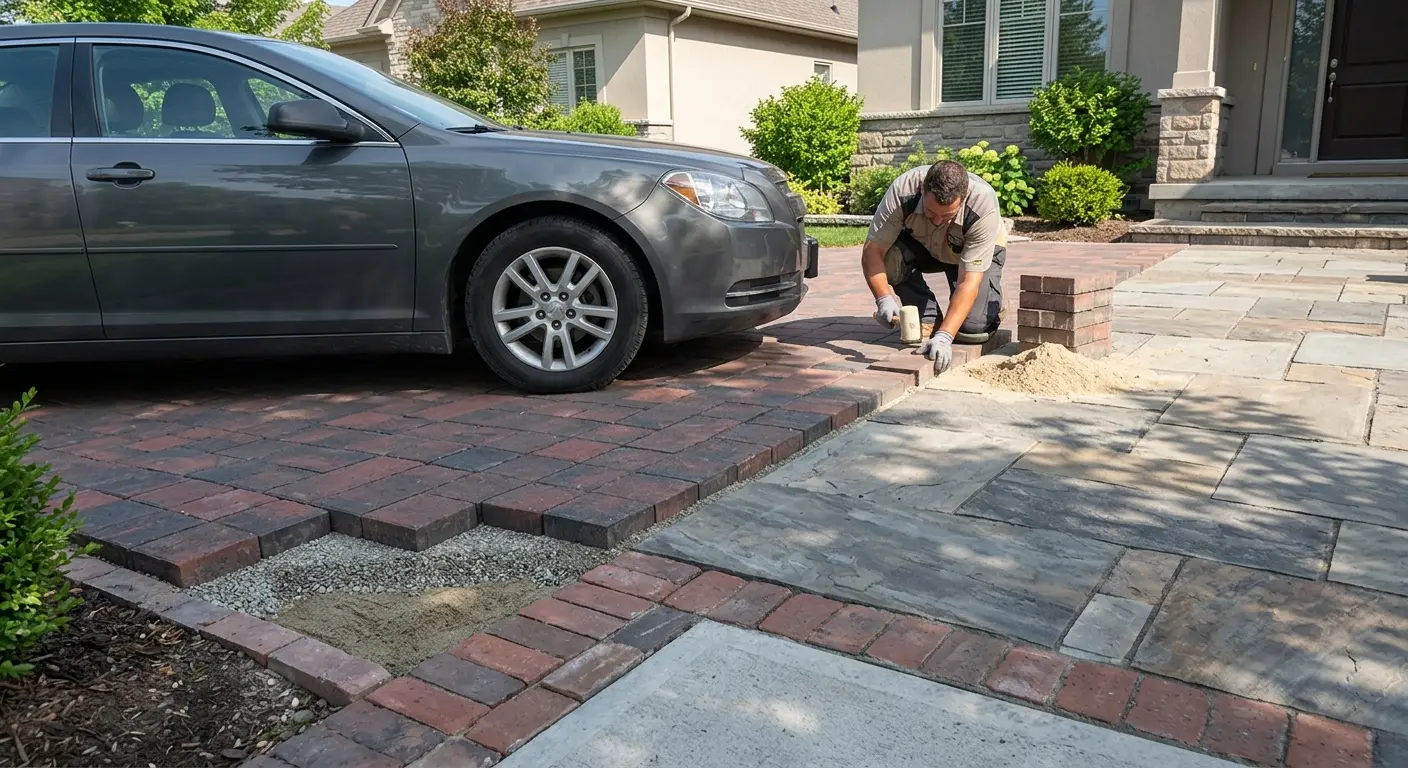
How Thick Should Driveway Pavers Be?
A piece that works well on a patio can crack under a car simply because it is too thin or too large for the load. Concrete pavers have well-established guidelines. While residential driveways commonly use 60mm units, streets and other pavements with regular vehicle traffic typically call for about 3 1/8 inches (80mm). Shape matters too. Concrete paver industry guidance advises against using units whose length is four or more times their thickness in vehicle areas, and it limits units between three and four times their thickness to light-use areas such as residential driveways. Thin concrete units, around 1 1/4 to 1 3/4 inches thick, are not recommended for any vehicle use.
Clay brick pavers follow their own guidelines. When brick is set in mortar over a concrete base at least 4 inches thick, clay pavers for light vehicle traffic such as driveways should be at least 1 1/4 inches thick, and pavers for heavy vehicle traffic should be at least 2 1/4 inches thick.
Natural stone is less standardized, because the right thickness depends on the stone's flexural strength, the size of each piece, and how it is set. A larger, thinner piece has less ability to resist bending under a tire than a smaller, thicker one, and thinner stone used in vehicle areas is generally set in mortar over a concrete slab rather than laid on sand. A practical approach is to choose thickness and format together, based on test data for the specific stone and guidance from the installer or stone engineer.
Surface Finish and Everyday Use
The finish affects traction, appearance, and upkeep. Thermal, brushed, and tumbled finishes add texture and grip, and a thermal finish is a traditional choice for exterior stone. Polished stone is generally not suited to outdoor areas that get wet. For slip resistance, the dynamic coefficient of friction (DCOF) method in ANSI A326.3 is also used to evaluate natural stone paving, although there is currently no mandatory DCOF requirement for these surfaces.
Driveways also collect oil drips and dirt. Stones with higher absorption can take in stains more readily, and sealing can help reduce staining on porous materials. For help selecting a suitable material and finish for a driveway or other exterior application, book an appointment with our team to discuss the available options.
Conclusion
Not every paver belongs on a driveway, but the right combination of material, thickness, format, finish, and setting method can create a surface that holds up to vehicles and still looks good. Dense natural stones such as granite and quartzite, well-selected travertine, and properly installed porcelain are all worth considering, as long as the producer recommends the specific product for vehicle traffic and the base is built to support it.
If you would like to see natural stone and porcelain options in person and talk through which ones may fit your project, Nova Tile and Stone offers free design consultations at showrooms in Reno, Minden, Fernley, and Sacramento.
Frequently Asked Questions
Sometimes, but often not. Many patio pavers are thinner than those made for vehicles, and they are usually laid over a shallower base. Using them under cars can lead to cracking or shifting unless the thickness, format, and setting method are designed for that load.
There is no single standard thickness for natural stone. It is best to ask the supplier for flexural strength results tested at the planned thickness and then confirm the size and setting method with the installer.
Yes. Porcelain pavers can be driven on when they are rated for exterior use and installed according to the manufacturer's guidance for vehicle traffic.
It depends on the material. Porous stones such as travertine and some limestones are usually sealed to help reduce staining and weathering. Lower-absorption materials take in less water, so sealing needs vary, and it is best to follow the producer's care guidance.
Usually not. A polished surface can become slippery when wet, so textured finishes such as thermal, brushed, or tumbled are generally a better fit for driveways, where rain, snowmelt, and hose water are common.
Note: Some images on this page may be conceptual renderings created to illustrate design possibilities and may not depict actual installations.