AT A GLANCE
- Multiply length by width for square footage.
- Add 5 to 20 percent overage, depending on pattern.
- Divide by the coverage of one piece.
- Always round up to whole pieces.
- Diagonal and curved patterns need more overage.
- Order everything at once to keep one lot.
- Measure borders and edging in linear feet.
- Never mix inches and feet.
IN THIS POST
- How to Estimate Hardscape Materials Accurately
- Why Accurate Quantities Protect Your Project
- Outdoor Hardscape Layouts That Change Your Overage
- Planning Exterior Stone With Expert Guidance
- Conclusion
- Frequently Asked Questions
How to Estimate Hardscape Materials Accurately
To estimate hardscape materials, measure the area in square feet (length times width), add overage for cuts and breakage, then divide by the coverage of one piece and round up to whole pieces. Most straight-edged layouts need 5 to 10 percent extra, diagonal layouts and large-format slabs 10 to 15 percent, and curved or multi-angle designs up to 20 percent. Order everything at once, because both natural stone and porcelain vary between production lots, so a second batch may not match.
This guide covers measuring irregular shapes, choosing overage by pattern, and converting area into piece counts for exterior stone slabs. It suits patios, walkways, steps, and pool surrounds across Northern Nevada and the Sacramento area.
Each section adds a different layer: why the math matters, how pattern changes waste, which materials suit exterior use, and how to turn measurements into a confident order. Treat every figure here as a planning estimate. Final quantities depend on product dimensions, pattern, and site shape, so confirm numbers with a design consultant before ordering.
Why Accurate Quantities Protect Your Project
A coverage guide for outdoor hardscape materials keeps ordering predictable. Precise square footage helps limit leftover stock, reduce delays, and keep every piece within the same production lot. Planning details also shape the final look. Joint spacing, pattern, and edge treatments all change how many pieces fit a given area, so review them alongside the exact product dimensions before ordering.
Early math supports realistic scheduling too. When quantities are confirmed first, delivery can be arranged around the project timeline instead of reacting to shortages.
Key benefits of precise calculations:
- Fewer shortages: A calculated overage helps cover breakage and trimmed edges, though results vary by pattern.
- Better visual consistency: Ordering together helps keep shade and veining closer, since both natural stone and porcelain vary by production lot.
- Clearer planning: Known piece counts make delivery and scheduling easier to coordinate.
- Less excess: Right-sized overage limits leftover stone, although a few spare pieces remain useful for future repairs.
Outdoor Hardscape Layouts That Change Your Overage
Shape, pattern, and material choice all influence how much extra stone a project needs. The sections below follow the calculation in order, from measuring to final piece count.
How Do You Measure Square Footage for a Patio?
Rectangles use length times width in feet. A 12 by 15 foot patio equals 180 square feet. Measure twice and record each dimension before combining any areas. Round each dimension up to the next full inch, then convert inches to feet by dividing by 12 so every figure uses the same unit.
 Conceptual rendering
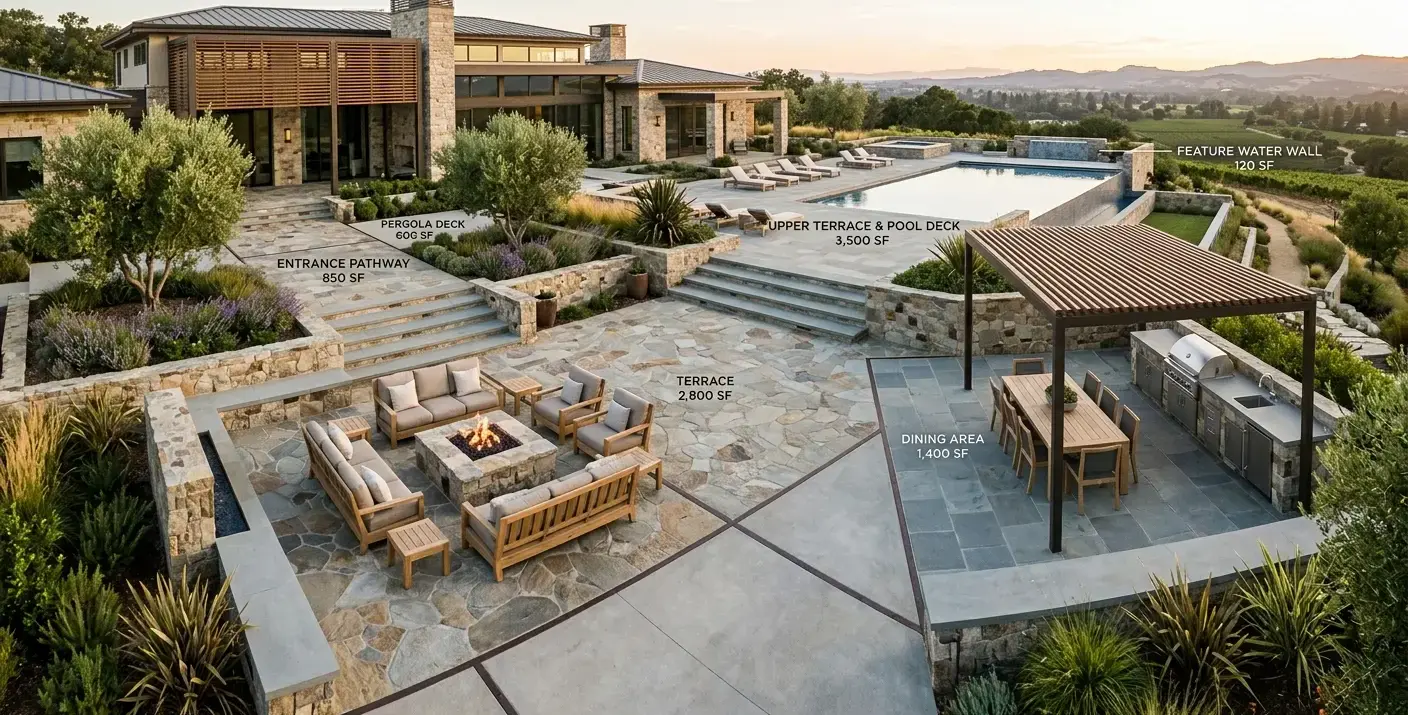
Irregular spaces work best when split into simple shapes. Triangles use half of base times height, and circles use pi times radius squared. Add the areas together for a total. Subtract openings such as planters or built-in features, then keep a short note of each measurement so a consultant can review the math with you.
How Much Extra Stone Should You Order?
Typical planning ranges appear below. Actual needs vary with product size, site shape, and pattern complexity, so treat these as starting points rather than fixed rules.
Pattern | Typical Overage | Why It Changes |
Stacked grid | 5 to 10 percent | Fewer angled pieces and limited edge trimming |
Running bond | 8 to 12 percent | Offset rows create more edge trimming |
Diagonal | 10 to 15 percent | Angled borders require more trimmed pieces |
Curves or multi-angle | 12 to 20 percent | Irregular edges increase trimming and breakage risk |
Large-format slabs | 10 to 15 percent | Fewer, larger pieces make each trimmed or broken piece count more |
Pattern and shape usually affect waste more than overall size does. A small space with a diagonal design can need proportionally more extra stone than a larger straight-edged area, because the edge cuts make up a bigger share of the total. Ordering spare pieces at the start also helps if a repair is needed later, since a later batch may differ slightly in shade or veining.
Which Stone Works Best Outdoors?
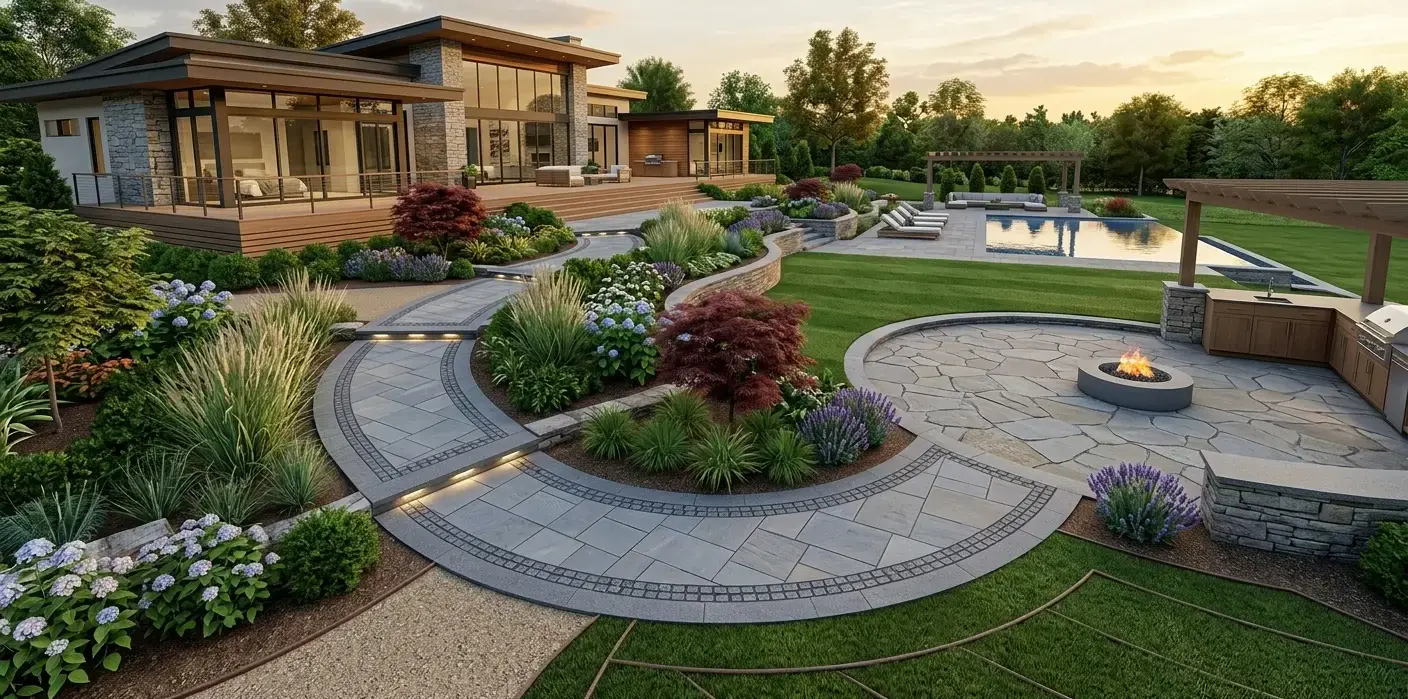
Granite, quartzite, travertine, and porcelain are the exterior-ready materials in Nova's range, while marble and dolomite are better reserved for indoor spaces. Porcelain, granite, and quartzite generally hold their color well in full sun. The main caveat with natural stone is resin: many slabs are resin-treated at the factory to fill small fissures, and some resins can yellow or dull under strong sun. Travertine is also suitable outdoors, but fills and finishes vary by product, so check the sun exposure approval for any stone going into a full-sun area.
All three natural stones usually benefit from a penetrating sealer outdoors, where they face rain, pool water, and dirt. For more detail, see this guide to sealing natural stone pavers. Porcelain generally needs no sealing, depending on the product. In Northern Nevada, freeze-thaw cycles add another factor, so ask about water absorption and freeze-thaw suitability before choosing stone for patios and steps. Polished finishes become slippery when wet, so choose matte or textured finishes for pool surrounds and other wet zones, and confirm slip performance for the specific product.
Finish also shapes both look and traction. Common outdoor finishes include honed, leathered, flamed, and brushed, but availability varies by stone and product, so ask which finishes exist for the material you like.
 Conceptual rendering
How Do You Measure Borders, Edging, and Steps?
Hardscape materials extend beyond the main surface. Borders, steps, and edging pieces are measured differently, so list them as separate line items before combining totals. Borders and edging use linear feet, which is the length of each run. To turn linear feet into a piece count, divide the total length by the length of one piece, then round up. Step treads use depth times width in feet, multiplied by the number of steps, and if the risers will be clad too, measure their height times width the same way. Keeping these items separate helps confirm that each piece type, finish, and thickness matches its use before the final order is placed.
How Much Area Does One Piece Cover?
Coverage per piece equals length times width in feet. A 24 by 24 inch paver covers 4 square feet, while a 12 by 24 inch paver covers 2 square feet. Joint spacing and actual dimensions can shift the final count slightly, so confirm the exact size listed for the product you choose. For a quick check, multiply coverage per piece by the piece count and compare it with your area plus overage. The result should land slightly above the target, never below it.
Mini-Guide: Calculate Your Order in 6 Steps
- Measure each area in feet and calculate its square footage.
- Subtract openings, then add all sections together.
- Multiply the total by your overage factor, such as 1.10 for 10 percent.
- Divide by the coverage of one piece.
- Round up to whole pieces.
- Count borders, edging, and steps separately, then review the full order with a consultant.
Example: 180 square feet with 10 percent overage becomes 198 square feet. Using pieces that cover 4 square feet each, 198 divided by 4 equals 49.5, so order 50.
Common Measuring Mistakes to Avoid
A few small errors cause most quantity problems. Review this list before finalizing any order:
- Mixing inches and feet in the same equation
- Using nominal sizes instead of exact product dimensions
- Forgetting steps, borders, or edging pieces
- Rounding down instead of up to whole pieces
- Skipping overage on small areas, where trimming has a larger effect
Catching these early keeps numbers reliable and supports more accurate piece counts.
Advantages and Trade-Offs of Adding Overage
Overage is a planning decision rather than a default. These points show what a larger order gains and what it requires.
Advantages:
- Covers breakage and trimmed edge pieces
- Helps keep all material within one production lot
- Leaves spare pieces for future repairs when stored properly
Disadvantages:
- Creates a larger initial order
- Spare pieces need storage space
- Simple layouts may leave unused stone
 Conceptual rendering
Planning Exterior Stone With Expert Guidance
Nova Tile and Stone supplies natural stone and engineered slabs, and its commission-free design consultants help turn measurements into piece counts. Arranged delivery assistance supports scheduling once quantities are confirmed.
Visit the Reno showroom to compare finishes in person. Explore the Minden showroom for nearby access to exterior stone options.
Sacramento
6100 Warehouse Way, Sacramento, CA 95826
- Mon–Fri: 7:30am – 6:00pm
- Sat: Closed
- Sun: Closed

BOOK NOW

Minden
2548 Business Pkwy, Minden, NV 89423
- Mon–Fri: 7:30am – 6:00pm
- Sat: 9:00am – 3:00pm
- Sun: Closed

BOOK NOW
Reno
12835 Old Virginia Rd, Suite 24 Reno, NV 89521
- Mon–Fri: 7:30am – 6:00pm
- Sat: 9:00am – 3:00pm
- Sun: Closed

BOOK NOW
The Fernley showroom serves local projects as well. Customers near Sacramento can visit the Sacramento showroom to review materials. Each location can walk through exterior stone options with a consultant.
This coverage guide offers a starting point, and a consultant can refine it for your exact product and pattern. When measurements are ready, book a consultation to review overage and delivery planning. Bring product dimensions or photos of the space to make the review faster.
Conclusion
Accurate square footage, realistic overage, and correct piece coverage turn outdoor hardscape planning into a clear, repeatable process for patios, walkways, and steps. Reliable numbers help reduce shortages, delays, and mismatched lots. Review exterior options from a dependable stone and tile supplier to match materials to your measurements.
Bring your measurements, project sketches, and questions about finishes or patterns, and a design consultant can help review them with you. A short conversation can confirm coverage, overage, and finishes before ordering. Schedule your free consultation now!
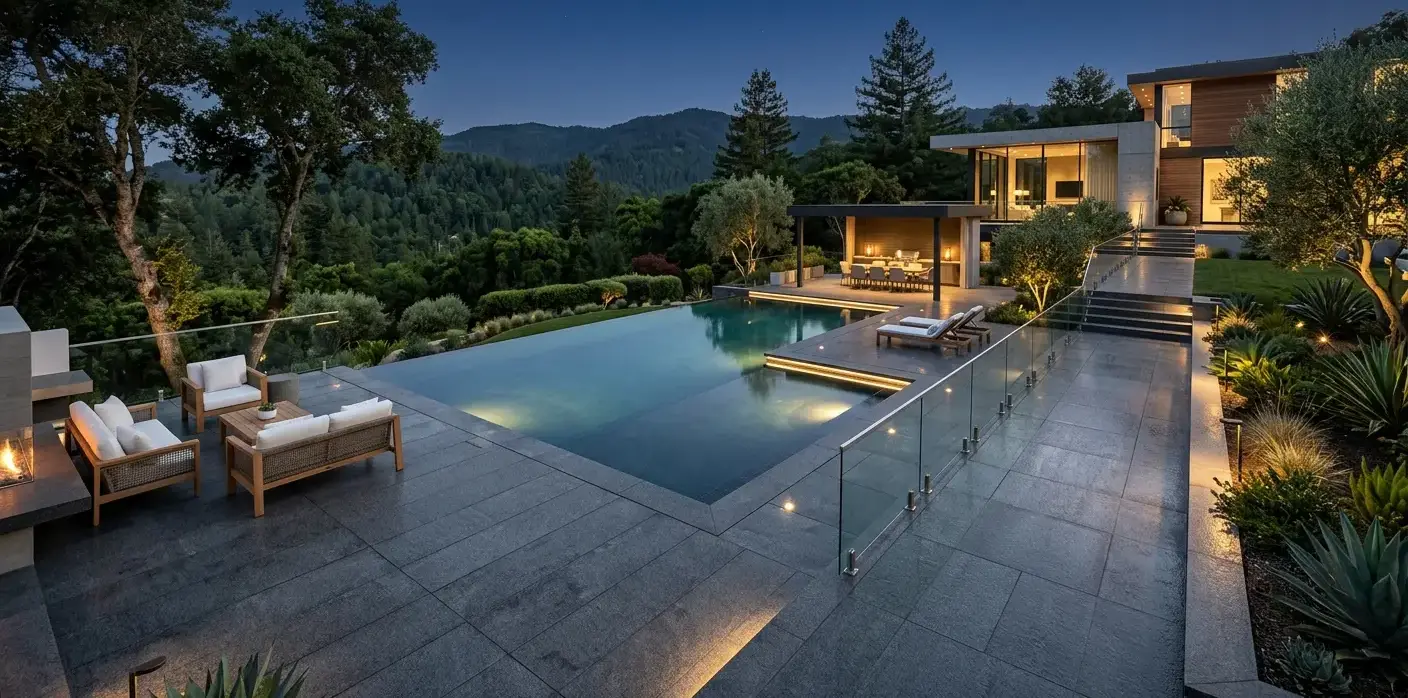
Note: Some images on this page may be conceptual renderings created to illustrate design possibilities and may not depict actual installations.
Frequently Asked Questions
Plan 5 to 10 percent extra for straight grid patterns, 10 to 15 percent for diagonal layouts and large-format slabs, and up to 20 percent for curves or multi-angle designs. Confirm the final figure with a consultant for your specific product and layout.
Divide the space into rectangles, triangles, and circles, calculate each area, then add them together. Subtract any openings, such as planters, to get the final square footage for ordering.
Add overage first, then divide by the coverage of one piece. For example, 200 square feet plus 10 percent is 220, and pieces covering 4 square feet each would require 55. Check actual product dimensions.
Granite, quartzite, travertine, and porcelain are commonly used outdoors, while marble and dolomite are better reserved for indoor spaces. Porcelain and most granite and quartzite hold their color well in sun, but resin-treated slabs and some travertine can change color, so check the product's sun exposure approval for full-sun areas.
Granite, quartzite, and travertine usually benefit from a penetrating sealer outdoors, while porcelain generally does not need one, depending on the product. How often to reseal depends on the stone, finish, and exposure, so follow the product's care guidance.