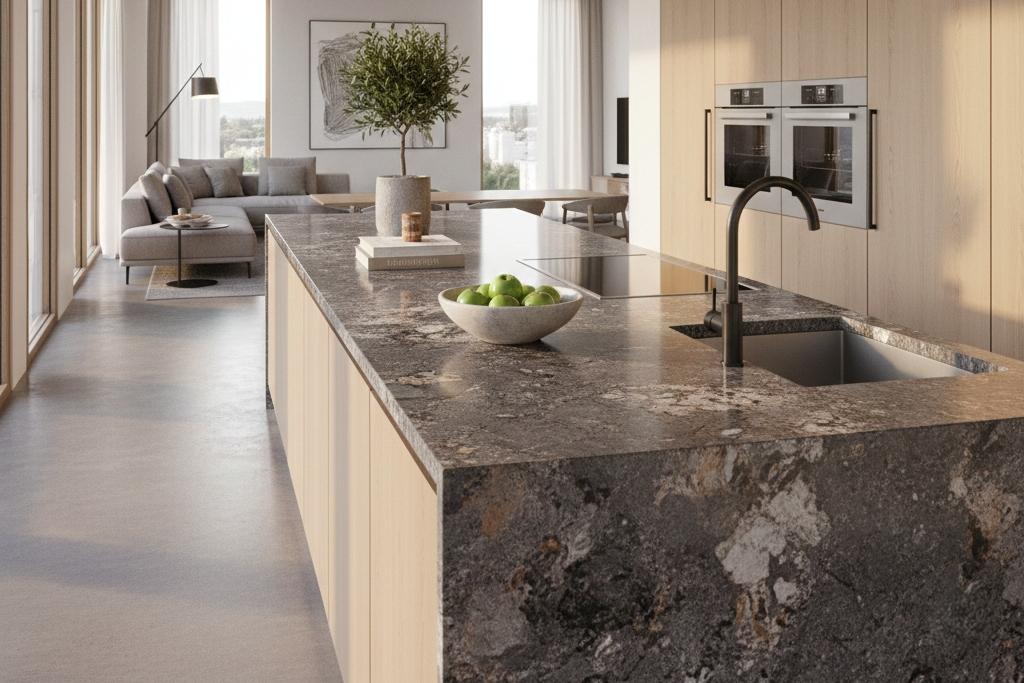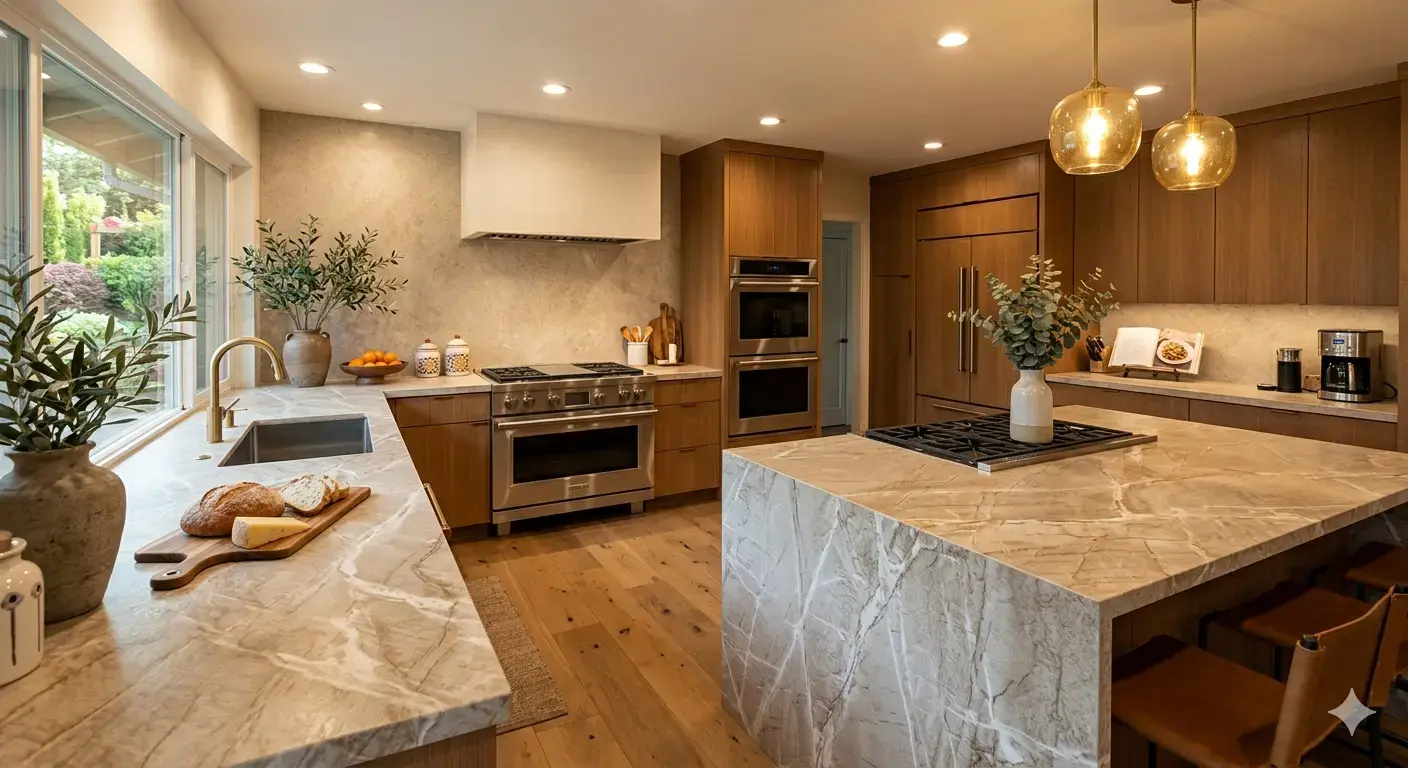
A beige slab used as a kitchen island can anchor a kitchen without competing with cabinetry, backsplash, or flooring. Whether the goal is a cream tone or a deeper sand with movement, natural stone slabs for kitchens deliver color depth and surface variation that synthetic finishes cannot replicate. Granite, quartzite, marble, and dolomite each carry distinct properties worth understanding before selecting a slab for a beige kitchen island.
Stone Types for a Beige Kitchen Island
Not all beige slabs perform the same way under kitchen conditions. The stone type determines how the surface handles heat, moisture, and daily use. Reviewing the natural stone slab inventory gives a useful starting point for comparing available options across stone types.
 Conceptual rendering
Granite
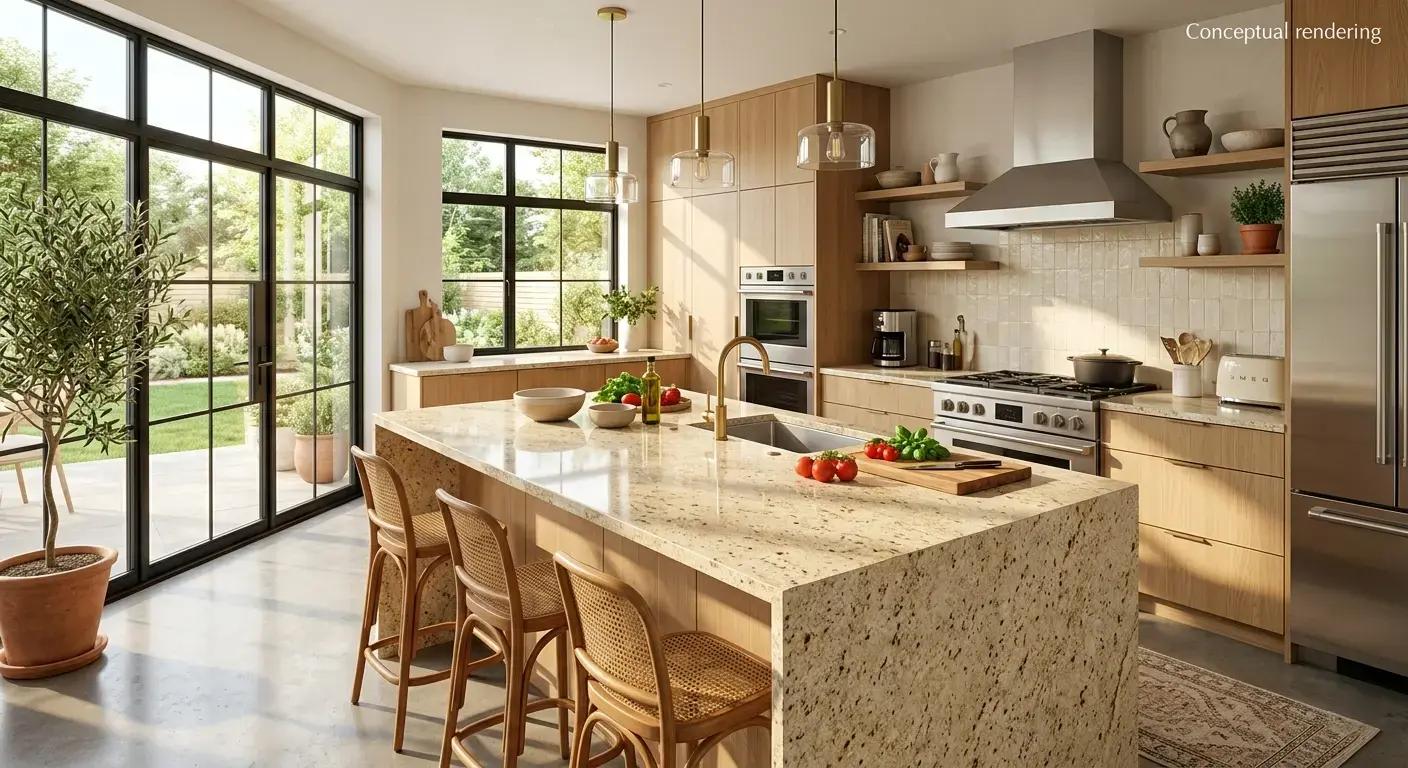
Granite in beige tones typically displays a speckled pattern with brown movements throughout the slab. It measures 6 to 6.5 on the Mohs hardness scale, which makes it resistant to scratching from knives and cookware. Granite also handles incidental heat well, though placing hot pots directly on any natural stone surface without a trivet is not recommended. Annual sealing maintains stain resistance. For more on this option, see the granite kitchen island slabs page.
Quartzite
Quartzite often produces soft cream and beige tones with flowing veining. At 7 to 7.5 on the Mohs scale, it is one of the harder natural stone options available for kitchen surfaces. Sealing quartzite every 12 to 18 months is recommended. Because quartzite is sometimes confused with quartz or marble at the point of sale, confirming the stone type with your supplier before purchasing is worth doing.
Marble
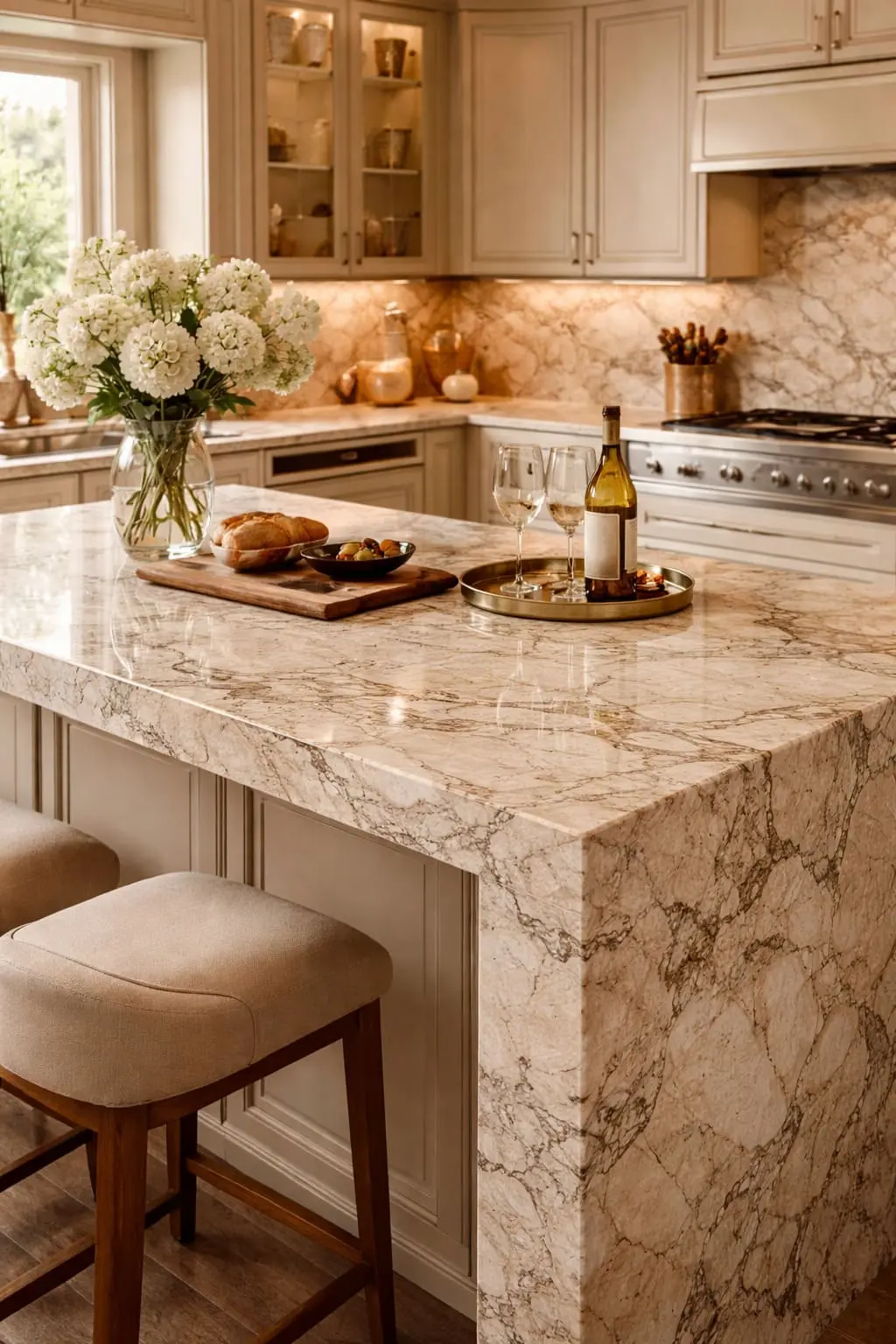
Marble in beige tones, such as Crema Marfil or Botticino, brings a finer-grained surface with subtle to moderate veining. Marble measures 3 to 4 on the Mohs scale, making it softer than granite or quartzite and more susceptible to etching from acidic substances like lemon juice or vinegar. Sealing marble every 6 to 12 months helps maintain its appearance.
 Conceptual rendering
Dolomite
Dolomite sits between marble and quartzite in hardness at approximately 3.5 to 4 on the Mohs scale. Beige dolomite slabs carry tonal variation and natural veining that reads similarly to marble but with modestly better resistance to etching. Sealing dolomite every 6 to 12 months is generally recommended, following a similar schedule to marble.
Finish and Thickness Considerations
Surface finish affects both the look and maintenance of a beige kitchen island. A polished finish brings out the depth of color and veining and is generally easier to wipe clean. A honed finish produces a matte surface that conceals minor scratches more readily but requires more attentive sealing. A leathered finish, where available, adds subtle surface texture and is less reflective than a polished surface while being more forgiving of fingerprints and water spots. In beige tones, leathered finishes are most commonly available on quartzite and granite. Marble and dolomite are more typically offered in polished or honed.
Standard residential slabs are commonly available in 2 cm or 3 cm thicknesses. A 3 cm slab has enough mass to be installed without a plywood substrate in most cases and conveys a substantial appearance at the edge profile. Edge profiles on a kitchen island are visible from multiple sides, so the selection is more prominent than on a standard countertop.
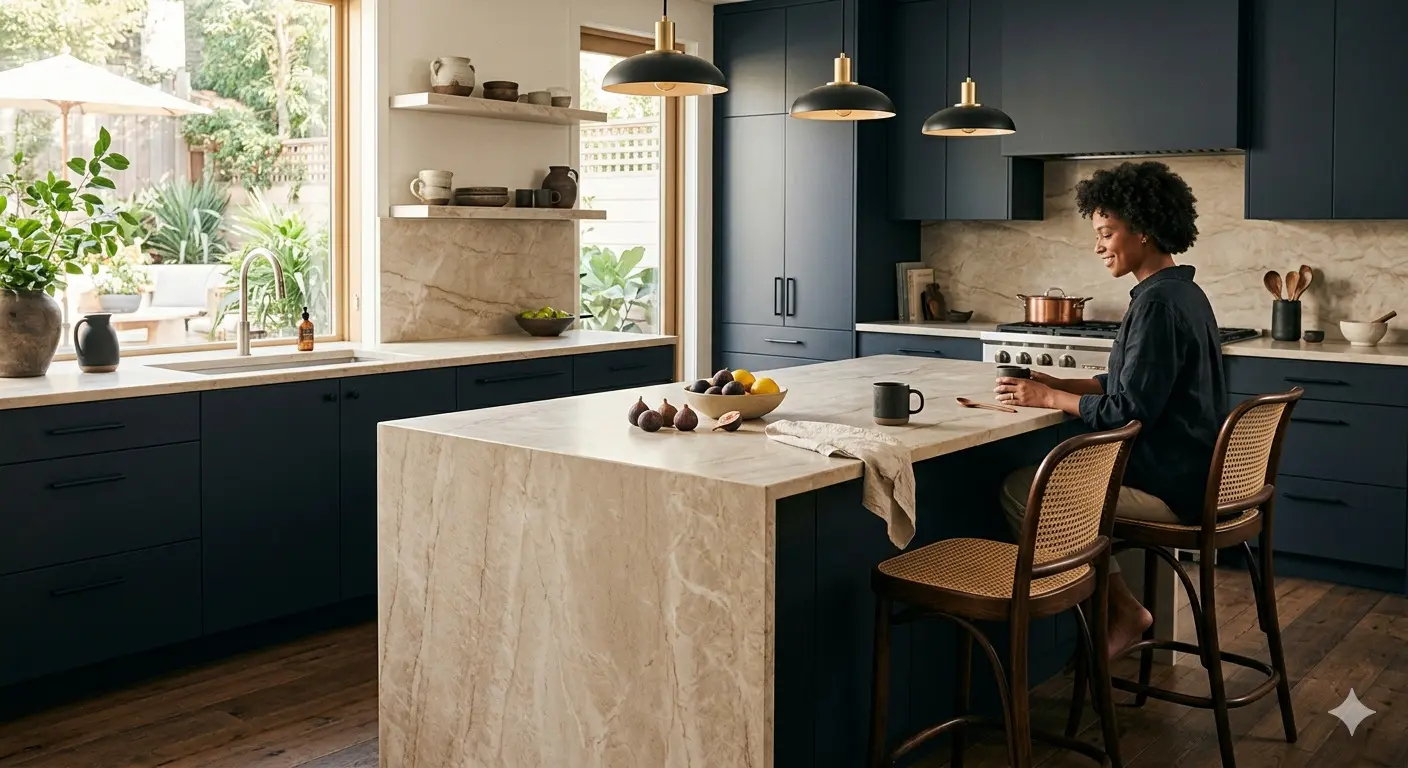 Conceptual rendering
Note: Some images on this page may be conceptual renderings created to illustrate design possibilities and may not depict actual installations.
Our Latest Content
Frequently Asked Questions
The right choice depends on how the island will be used. Quartzite is the hardest natural stone option in the beige range and holds up well to daily kitchen use, requiring sealing every 12 to 18 months. Granite is also a hard-wearing option and available in beige tones with speckled patterning. Marble and dolomite offer finer veining but require more careful maintenance and are more susceptible to etching from acidic substances.
Yes. All natural stone used for kitchen surfaces requires periodic sealing to maintain stain resistance. Quartzite generally needs sealing every 12 to 18 months. Marble requires sealing every 6 to 12 months. Granite typically needs sealing once a year. The specific schedule depends on the stone type, finish, and how heavily the surface is used.
Quartzite is a natural metamorphic stone quarried from the earth, while quartz is an engineered product made from crushed quartz crystals and resin binders. Natural quartzite has a Mohs hardness of 7 to 7.5 and requires sealing. Engineered quartz is non-porous and does not require sealing, but it is less heat-tolerant than natural stone and should not have hot pots placed directly on the surface.
A polished finish is more reflective, brings out the depth of color and veining, and is generally easier to wipe clean. A honed finish is matte and conceals minor scratches better, but it is more porous and may require more frequent sealing. For a kitchen island that sees regular use, both finishes are viable; the choice comes down to aesthetic preference and maintenance expectations.
Yes. Nova Tile and Stone carries natural stone slabs at four Home Design Centers in Reno, Sacramento, Minden, and Fernley. Free design consultations are available at all locations to help you find the right material for your project.
Viewing Slabs in Person
Because natural stone varies from slab to slab, seeing the material in person gives a more accurate basis for a final selection than photographs or digital renders, which do not capture the depth, surface texture, or tonal variation in a beige kitchen island slab.
As a stone supplier, Nova Tile and Stone offers natural stone slabs through its four home design centers in Reno, Minden, Sacramento, and Fernley. The design team can help evaluate which stone types are appropriate based on how the island will be used, what finishes are already in the kitchen, and what slab dimensions the project requires. To plan a visit, schedule an appointment online in advance. Bringing cabinet door samples, flooring samples, or paint chips makes it easier to assess how a beige slab reads alongside the other materials in the space. Contractors and designers working on client projects can also apply for a trade account for additional support.