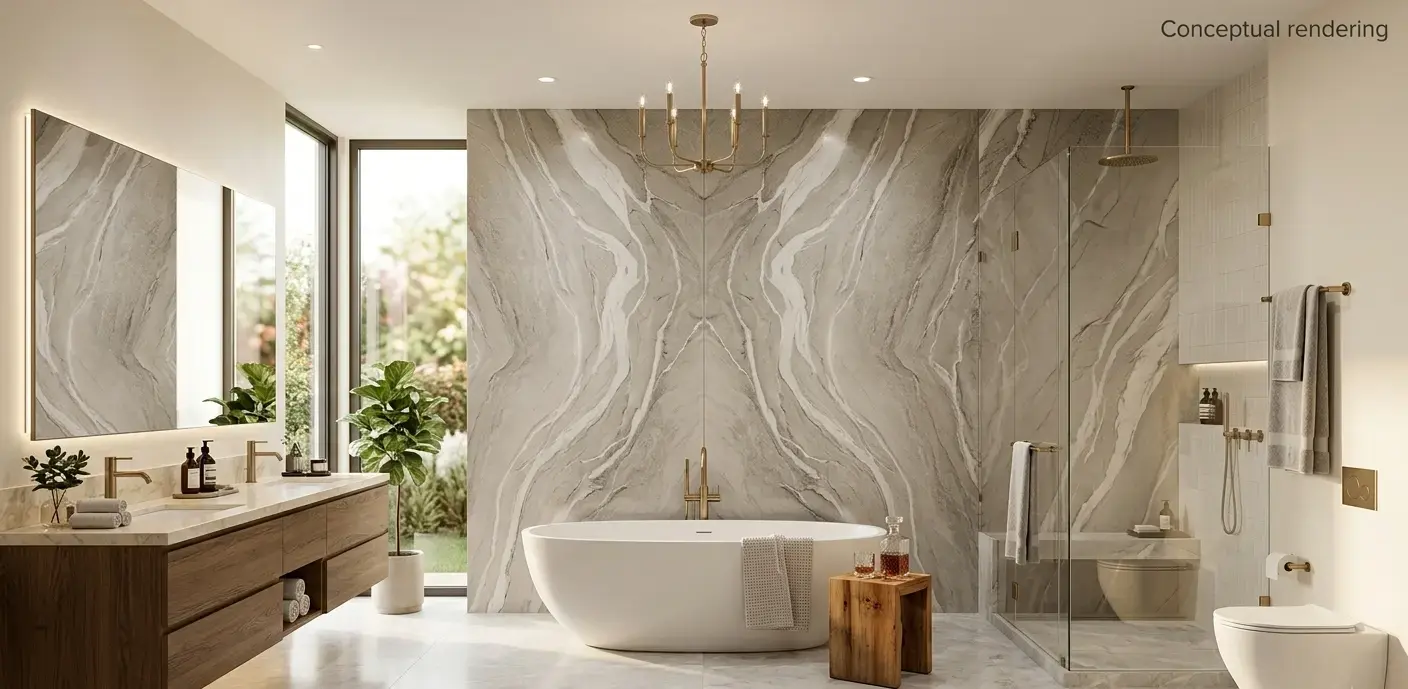
Indoor Applications Worth Considering
Allure Quartzite works across a wide range of interior surfaces. Kitchen countertops are the most common application, and the stone's color range, cool grays and blues alongside warmer cream tones, pairs with both light and dark cabinetry. The veining pattern also translates well to backsplash installations, where continuing the countertop material up the wall creates a cohesive visual flow. You can learn more about the stone's specific characteristics on our Allure Quartzite natural stone page.
Bathroom vanities are another natural fit. The stone's coloring coordinates well with chrome, brushed nickel, and matte black fixtures, giving designers flexibility on hardware choices. The veining in Allure tends to be fine and linear rather than bold and graphic, which means it reads as refined in smaller spaces without overwhelming them. For homeowners looking to make a stronger statement, Allure Quartzite can be used as a feature wall or fireplace surround, where the full slab dimensions allow the natural patterning to read at scale.
Flooring is also an option in appropriate settings. Quartzite's density makes it durable underfoot, though finish selection matters here. A honed or leathered finish reduces slip risk compared to polished surfaces, which can become slippery when wet. For large-format floor installations, working with a fabricator experienced in natural stone is important, as proper substrate preparation and grout selection both affect long-term performance. Interior designers and contractors working on larger projects can also apply for a trade account to access trade pricing and resources.
Understanding Color Variation in Allure Quartzite
One aspect of Allure Quartzite that surprises some buyers is the degree of variation across slabs from the same material family. While the general palette, creams, grays, and cool blue-silver tones, stays consistent, the density of veining, the distribution of color, and the overall movement in the stone can shift noticeably from one slab to the next. Some slabs read lighter and more neutral, while others carry more of the blue and platinum tones.
Slab-to-slab variation is a natural characteristic of the material, and for many buyers it is part of what draws them to natural stone over engineered alternatives. It does, however, underscore the importance of selecting your actual slabs rather than ordering based on a sample chip or a digital image. What looks like a close match at small scale may read differently once fabricated and installed at full surface area.