AT A GLANCE
- Outdoor stacked stone is thin stone strips laid in tight rows.
- Dense stone tends to handle freeze-thaw better than porous stone.
- Manufactured stacked stone that meets ASTM C1670 has passed minimum freeze-thaw testing.
- Modern stacked stone fireplaces use uniform strips in white, gray, or charcoal.
- Rustic stacked stone fireplaces use deep, split-face stone in earth tones.
- Clean outdoor stacked stone with water and a neutral cleaner, not acid.
IN THIS POST
- What is an outdoor stacked stone fireplace?
- Natural vs. manufactured: which is better outdoors?
- Which stacked stone holds up best outdoors?
- What are the best modern outdoor stacked stone fireplace ideas?
- What are the best rustic outdoor stacked stone fireplace ideas?
- What color is best for an outdoor fireplace?
- Is stacked stone safe for an outdoor fireplace?
- How do you clean and seal an outdoor stacked stone fireplace?
- Conclusion
- Frequently Asked Questions
- Sources
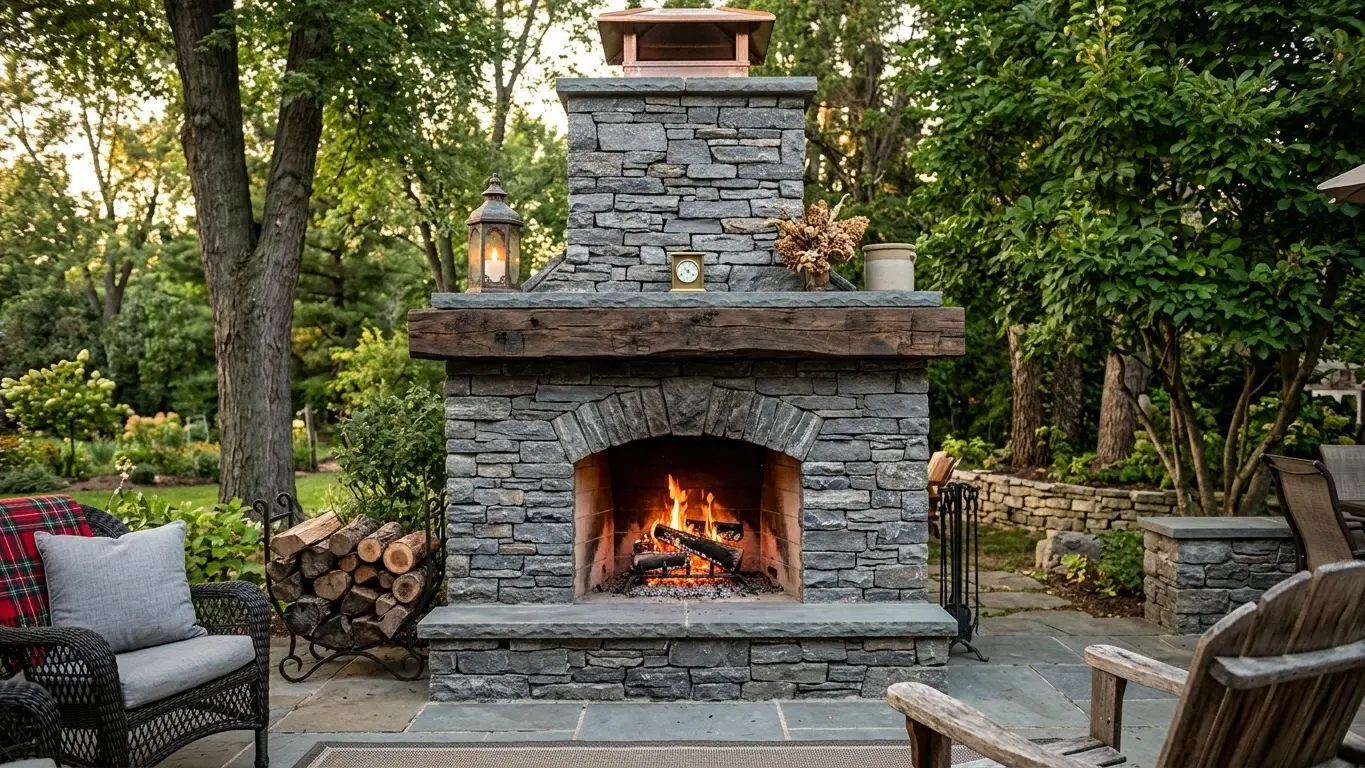
An outdoor stacked stone fireplace is clad in narrow strips of natural or manufactured stone, laid in tight horizontal rows across the firebox surround, chimney, or full fireplace wall. It looks modern with thin, uniform strips in a single tone and clean lines, and rustic with deeper, split-face stone in mixed earth tones paired with a heavy timber or stone mantel.
Outdoors, the stone does more than set the style. It faces sun, rain, snow, and in many regions repeated freezing and thawing, so the right choice balances looks with how well the stone handles the weather where you live.
Below, we cover how to choose between natural and manufactured stacked stone, which stones hold up outside, design ideas for modern and rustic patios, and what to know about safety, cleaning, and sealing.
What Is an Outdoor Stacked Stone Fireplace?
An outdoor stacked stone fireplace is a patio, porch, or backyard fireplace finished with layered stone instead of stucco, brick, or a plain concrete face. The look recalls dry-stacked masonry, where stones fit closely without wide mortar joints showing.
Most stacked stone comes as ledger panels, which are strips pre-assembled into modular rectangles with staggered ends so the seams are hard to spot, or as loose veneer pieces set one at a time for more variation. Corner pieces let the stone wrap around the sides of a freestanding fireplace or chimney, so it reads as solid stone from every angle.
A stone fireplace quickly becomes the gathering point of a backyard, and it can extend your evenings outdoors so the patio gets used across more of the year.
Natural vs. Manufactured Stacked Stone: Which Is Better Outdoors?
Neither is better for every outdoor fireplace. Natural stacked stone offers piece-to-piece variation that can't be copied, while manufactured stacked stone, a cast product designed to imitate it, is lighter and usually costs less.
Natural stacked stone is commonly cut from quartzite, slate, granite, travertine, limestone, or sandstone, and stacked stone is part of the pavers and exterior stone we carry. Because every strip comes from real rock, no two fireplaces look exactly alike, and how well it handles weather depends on the specific stone, which we cover in the next section.
Manufactured stone veneer is a lightweight concrete product made with cement, lightweight aggregates, and mineral oxide pigments, and it is used on exterior walls as well as interiors. According to the ASTM C1670 standard, these units must meet minimum requirements for compressive strength, freeze-thaw durability, and bond strength, along with limits on size and weight. The table below sums up how the two compare.
Natural stacked stone | Manufactured stacked stone | |
Appearance | Unique variation in every piece | More consistent; shapes may repeat |
Weight | Heavier | Lighter |
Relative cost | Usually higher | Usually lower |
Freeze-thaw performance | Depends on the specific stone | Tested to minimums if it meets ASTM C1670 |
Care | Depends on stone type | Follow the maker's care guidance |
Which Stacked Stone Holds Up Best Outdoors?
Dense natural stone that absorbs little water generally holds up best outdoors, especially where winters bring repeated freezing and thawing. Stone that soaks up more water has more moisture to expand when it freezes.
That is why higher absorption can signal more freeze-thaw distress. Granite, for example, is typically less absorptive than travertine, which generally makes it less prone to freeze-thaw wear in cold climates. Stone that performs well on a vertical wall may also not suit a horizontal surface, such as a hearth or chimney cap that collects rain and snow.
This does not rule out more porous stones. Many travertines, limestones, and sandstones are used outdoors, but in freeze-thaw areas the specific stone deserves a closer look. Stone industry experts often point out that problems usually come from choosing the wrong stone for the setting, not from the stone itself. When comparing options, ask for the water absorption figure and exterior-use guidance for the exact stone you are considering.
What Are the Best Modern Outdoor Stacked Stone Fireplace Ideas?
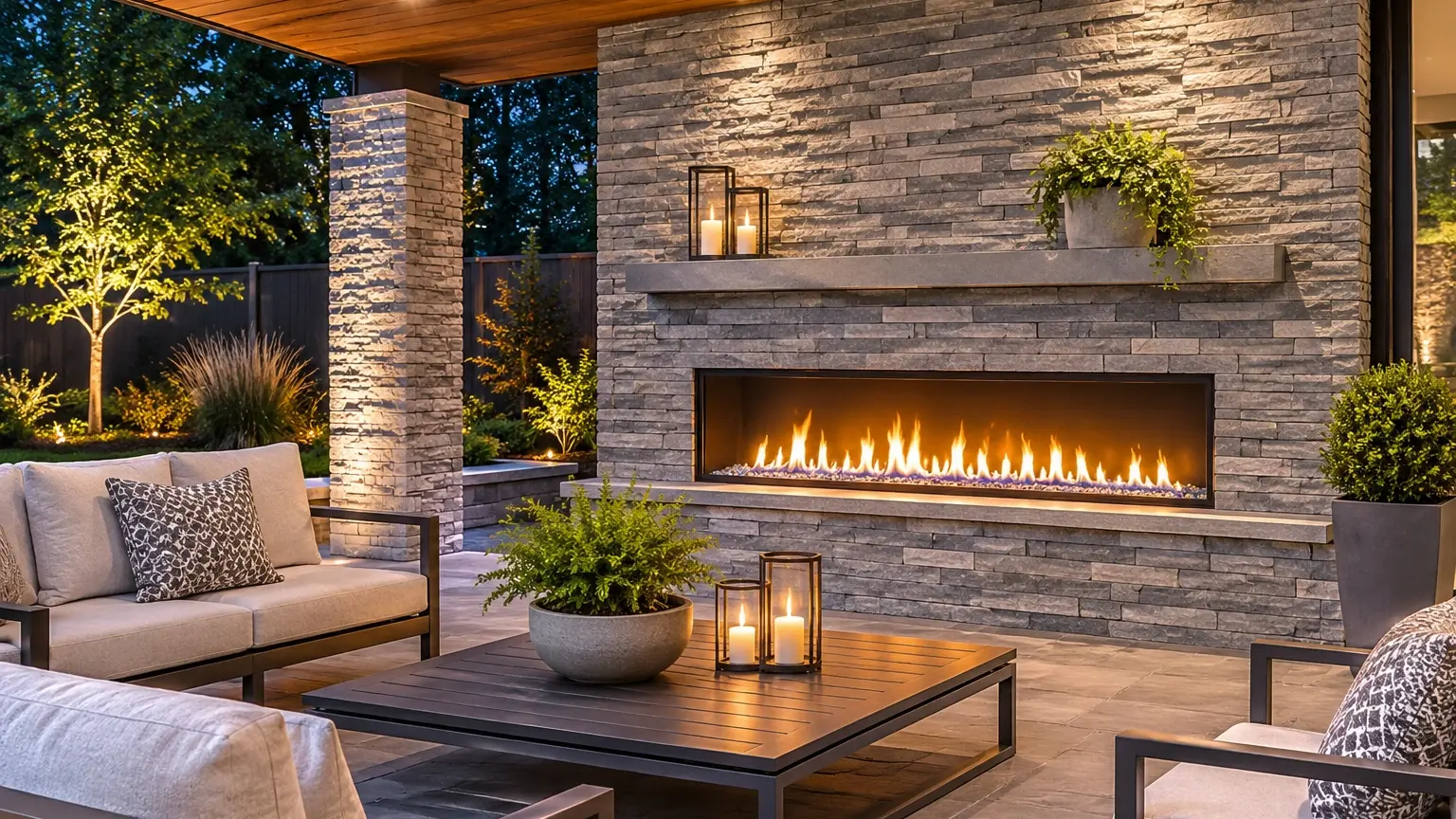
The best modern outdoor stacked stone fireplace ideas use uniform stone, a narrow color range, and clean lines that tie into the house and patio. The texture does the work, so everything else should stay simple.
- Choose thin, even strips. Smaller pieces that are similar in size and depth create clean horizontal lines. A smooth or honed face looks more refined than a heavily split one.
- Stick to one tone. A single color, such as white, soft gray, or charcoal, keeps the wall calm and lets the shadows between strips stand out.
- Try a linear firebox. Many modern outdoor fireplaces use a long, narrow horizontal opening, and stacked stone running wide across the wall emphasizes that line.
- Keep the mantel slim or skip it. A thin stone or concrete ledge keeps the profile clean.
- Match the patio. Pairing stacked stone with large-format pavers in a related tone makes the fireplace and patio read as one design.
- Light it at night. Landscape or wall-washing lights aimed at the stone graze across the texture and add depth after dark.
Modern does not have to mean stark. Warm wood seating or a cedar ceiling on a covered patio softens a gray or white stone wall, and you can compare stacked stone and pavers side by side at one of our showrooms.
What Are the Best Rustic Outdoor Stacked Stone Fireplace Ideas?
The best rustic outdoor stacked stone fireplace ideas pair deeper, irregular stone and natural color variation with heavy, natural materials like timber and rough-cut stone. The goal is a fireplace that feels gathered from the landscape rather than cut to fit.
- Pick bigger, deeper stones. Larger stones or a rough split face with plenty of depth between strips add strong texture that suits wooded lots and mountain settings.
- Mix warm earth tones. Blends with rust, tan, gold, brown, and gray in the same panel echo the look of natural rock.
- Add a heavy mantel. A thick timber beam suited to outdoor exposure, or a solid stone slab, gives the stone a strong horizontal anchor.
- Extend the hearth into seating. A raised stone hearth that runs into built-in benches turns the fireplace into a place to gather.
- Build in firewood storage. Recessed log cubbies on each side of the firebox keep the look practical and add another layer of shadow.
- Take the chimney tall. A full-height stacked stone chimney gives the fireplace presence at the edge of a patio.
Rustic also works with simpler homes. A mixed-tone stone with a squared-off mantel suits a modern farmhouse exterior without feeling like a mountain lodge.
What Color Stacked Stone Is Best for an Outdoor Fireplace?
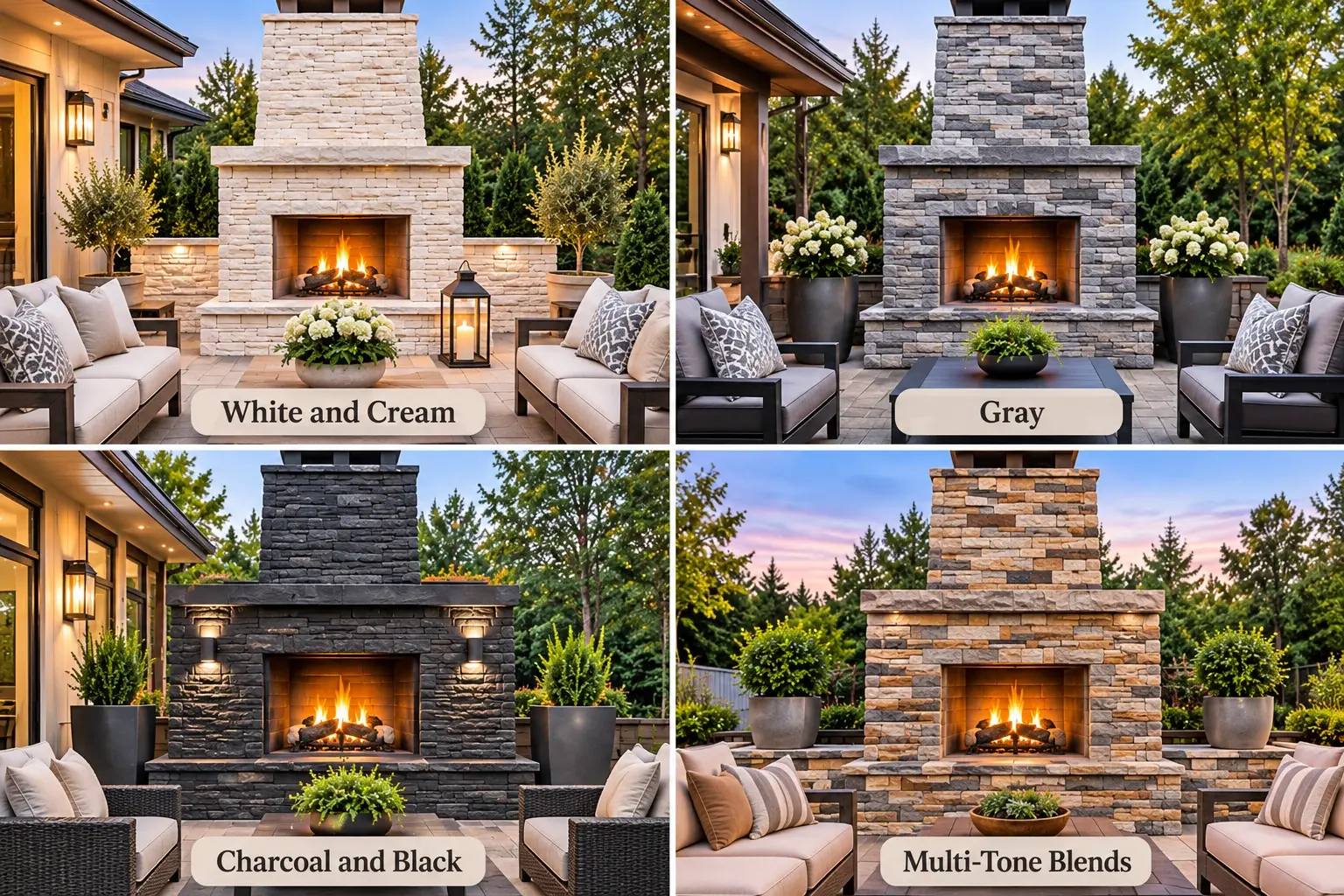
The best stacked stone color for an outdoor fireplace is the one that works with your home's exterior, roof, and patio. As a general guide, light stone brightens a shaded patio, gray and other mid tones are the most flexible, and dark stone adds drama.
- White and cream brighten covered patios and suit coastal and minimal homes. Light stone may show smoke staining sooner above a wood-burning firebox.
- Gray works with most siding and paver colors and moves easily between modern and rustic, depending on the texture.
- Charcoal and black create a bold focal point against light siding or stucco.
- Multi-tone blends connect the fireplace to wood decks, plantings, and natural landscaping.
Daylight changes how stone looks, so view several full panels together outside in natural light, ideally next to your siding or paver color, before deciding. To narrow your options first, bring a photo of your home's exterior and patio to our Reno, Minden, or Sacramento showroom and compare stone colors against it in person.
Is Stacked Stone Safe for an Outdoor Fireplace?
Stacked stone is commonly used on outdoor fireplaces, and for prefabricated units or inserts, the manufacturer's instructions may set how close it can sit to the firebox. On covered patios, heat and smoke also rise toward the ceiling, so the area above needs planning too.
Whether any spacing requirements apply depends on the type of fireplace and where you live, so a qualified fireplace professional can tell you what applies to your project, such as distances to a patio cover or pergola, before you choose the stone.
Covered patios often pair a fireplace with a TV. With wood-burning fireplaces in particular, heat and smoke residue can damage electronics over time, so a deep mantel or a recessed alcove is often recommended when a TV goes above the fire.
Outdoor wood-burning fireplaces have chimneys too, and an annual chimney inspection by a qualified professional helps catch creosote buildup before it becomes a fire risk.
How Do You Clean and Seal an Outdoor Stacked Stone Fireplace?
Clean an outdoor stacked stone fireplace by brushing debris from the grooves, rinsing with clear water, and washing with a neutral stone cleaner or mild soap. Sealing is optional for many stones, so the key to both is matching the product to the stone.
Calcareous stones such as travertine, limestone, and marble are made mostly of calcium carbonate, which reacts with acid, so mild, non-acidic cleaners are recommended. Siliceous stones such as slate and quartzite resist most household acids better, but acidic cleaners are still not recommended for them.
Outdoor stone also faces a few issues that indoor stone rarely does:
- Algae and moss: Flushing with clear water and using a mild bleach solution can remove algae or moss. Never mix bleach with ammonia.
- Efflorescence: A white powder can appear when water carries mineral salts to the surface. Brush it away dry rather than washing it, and if it keeps returning, have the installer look for the source of the moisture.
- Smoke staining: Smoke-stained stone may need a more thorough cleaning, and because smoke carries acids, some etching can show once the residue is removed.
A simple routine for outdoor stacked stone:
- Brush the grooves with a soft, dry brush to clear leaves, dust, and ash.
- Test any cleaner on a small, hidden area first.
- Wash with a diluted neutral cleaner and a soft brush.
- Rinse thoroughly with clean water so no cleaner film is left in the crevices.
If you do seal, keep in mind that impregnating sealers make stone more stain resistant, not stain proof, so ask about a sealer suited to exterior use and the specific stone. For manufactured veneer, follow the maker's care instructions, since cleaners suited to natural stone may not suit a cast product.
Conclusion
Whether your patio leans modern or rustic, the strongest outdoor stacked stone fireplaces start with a stone that suits your climate and carry one clear style through the stone, mantel, hearth, and lighting. Matching the fireplace to your home's exterior and patio keeps the whole outdoor space feeling connected.
Practical planning matters as much as style. Checking the stone's suitability for freeze-thaw exposure, checking whether any spacing requirements apply to your fireplace, and cleaning with products made for stone all help the fireplace keep its good looks season after season.
Texture and color are easiest to judge in person and in daylight. Visit one of our showrooms to see stacked stone alongside our pavers and exterior stone, or book a free design consultation to talk through the look that fits your outdoor space.
Frequently Asked Questions
Dense, low-absorption stone generally holds up best outdoors, especially in freeze-thaw climates. Manufactured veneer that meets the ASTM C1670 standard is another option. Ask for the absorption figure and exterior-use guidance for the specific stone.
Yes. Manufactured stone veneer is used on exterior walls, and the ASTM C1670 standard sets minimum requirements for freeze-thaw durability, strength, and bond. Follow the maker's guidance for outdoor care.
Not always. Many stones do not require sealing, and sealers make stone more stain resistant rather than stain proof. If you seal, choose a product suited to exterior use and the specific stone.
Flush the stone with clear water, then use a mild bleach solution and rinse well. Never mix bleach with ammonia, and avoid acidic cleaners on travertine, limestone, and marble.
You can on a covered patio, but heat and smoke from a wood-burning fireplace can damage a TV over time. A deep mantel or a recessed alcove helps redirect heat, and a fireplace professional can advise on your specific unit.
Sources
- ASTM International, ASTM C1670/C1670M-24a Standard Specification for Adhered Manufactured Stone Masonry Veneer Units | https://store.astm.org/c1670_c1670m-24a.html
- Natural Stone Institute, Care & Cleaning of Natural Stone | https://www.naturalstoneinstitute.org/consumers/care/
- ASTM International, Standardization News: Stone Cold, Dimension Stone Standards | https://www.astm.org/news/stone-cold-dimension-stone-standards-jf24
- Mason Contractors Association of America, Masonry Magazine: Codes and Standards for Manufactured Stone Veneer | https://www.masonrymagazine.com/blog/2017/10/01/codes-and-standards-for-manufactured-stone-veneer/
- Chimney Safety Institute of America, Preventing Chimney Fires | https://www.csia.org/latest-news/preventing-chimney-fires
- NYC Landmarks Preservation Commission, 140 Broadway Technical Review of Stone Selection | https://www.nyc.gov/assets/lpc/downloads/pdf/presentation-materials/20190205/140-Broadway.pdf
- Livingetc, 10 Stone Fireplace Ideas for Classic Cozy Style | https://www.livingetc.com/us/ideas/stone-fireplace-ideas
- Bob Vila, 10 Outdoor Fireplace Ideas You'll Want to Copy in Your Backyard | https://www.bobvila.com/articles/outdoor-fireplace-ideas/
- Homes & Gardens, Should You Hang a TV Above a Fireplace? | https://www.homesandgardens.com/solved/can-you-mount-a-tv-above-a-fireplace
Note: Some images on this page may be conceptual renderings created to illustrate design possibilities and may not depict actual installations.